


A corneal ulcer isn’t just a sore eye-it’s an open wound on the clear front surface of your eye that can destroy vision in days if ignored. For the 85 million people worldwide who wear contact lenses, this isn’t a rare scare. It’s a real, preventable danger. While most lens wearers never have problems, the moment you sleep in your contacts, skip cleaning them, or swim with them in, you’re gambling with your sight. And if you start feeling intense pain, notice blurry vision, or see a white spot on your eye, corneal ulcer is likely the culprit-and you need help now.
What Exactly Is a Corneal Ulcer?
The cornea is the clear, dome-shaped layer covering your iris and pupil. It’s tough, but not invincible. A corneal ulcer is a break in this surface, usually caused by an infection that eats away at the tissue. It’s not the same as a scratch (called a corneal abrasion), which heals on its own. Ulcers involve actual tissue loss. Left untreated, they can scar the cornea, cause permanent vision loss, or even lead to blindness.
The most common cause? Contact lenses. Not because lenses are bad-but because they create the perfect conditions for infection. When you wear a lens, especially overnight, it blocks oxygen from reaching the cornea. That weakens the eye’s natural defenses. Then, bacteria, fungi, or even tiny parasites like Acanthamoeba get trapped under the lens. They multiply fast. Your eye can’t fight back alone.
Why Contact Lenses Are the #1 Risk Factor
Wearing contacts makes you about 10 times more likely to get a corneal ulcer than someone who doesn’t wear them. But it gets worse. If you sleep in your lenses-even just once-you’re 100 times more likely to develop one. That’s not a typo. Extended-wear soft lenses, marketed as convenient, are the biggest offenders. The FDA explicitly warns that improper contact lens use can lead to blindness.
It’s not just about sleeping in them. Other habits raise your risk:
- Using tap water to rinse or store lenses
- Wearing lenses longer than recommended (monthly, biweekly, daily)
- Not washing hands before touching lenses
- Using expired or non-prescription cleaning solutions
- Wearing lenses while swimming, showering, or in hot tubs
- Using scratched or dirty lenses
Even your eye health matters. If you have dry eyes, blepharitis (eyelid inflammation), or conditions like Bell’s palsy that prevent full eyelid closure, your cornea is more vulnerable. Steroid eye drops, sometimes used for redness or allergies, can make infections worse by suppressing your immune response.
Red Flags: When Your Eye Is Screaming for Help
Corneal ulcers don’t sneak up. They hit hard and fast. If you’re wearing contacts and notice any of these symptoms, stop wearing your lenses immediately and call your eye doctor-or go to an emergency clinic.
- Severe eye pain, even when you’re not touching it
- Blurry, hazy, or foggy vision
- Red, bloodshot eyes that won’t improve
- White or grayish spot on the cornea (visible in the mirror)
- Excessive tearing or pus-like discharge
- Extreme sensitivity to light (photophobia)
- Feeling like something’s stuck in your eye-even when there’s nothing there
Some people mistake these for a bad case of dry eyes or pink eye. Don’t. Pain that wakes you up at night? Vision changes? That’s not a minor irritation. That’s an emergency.
How Doctors Diagnose a Corneal Ulcer
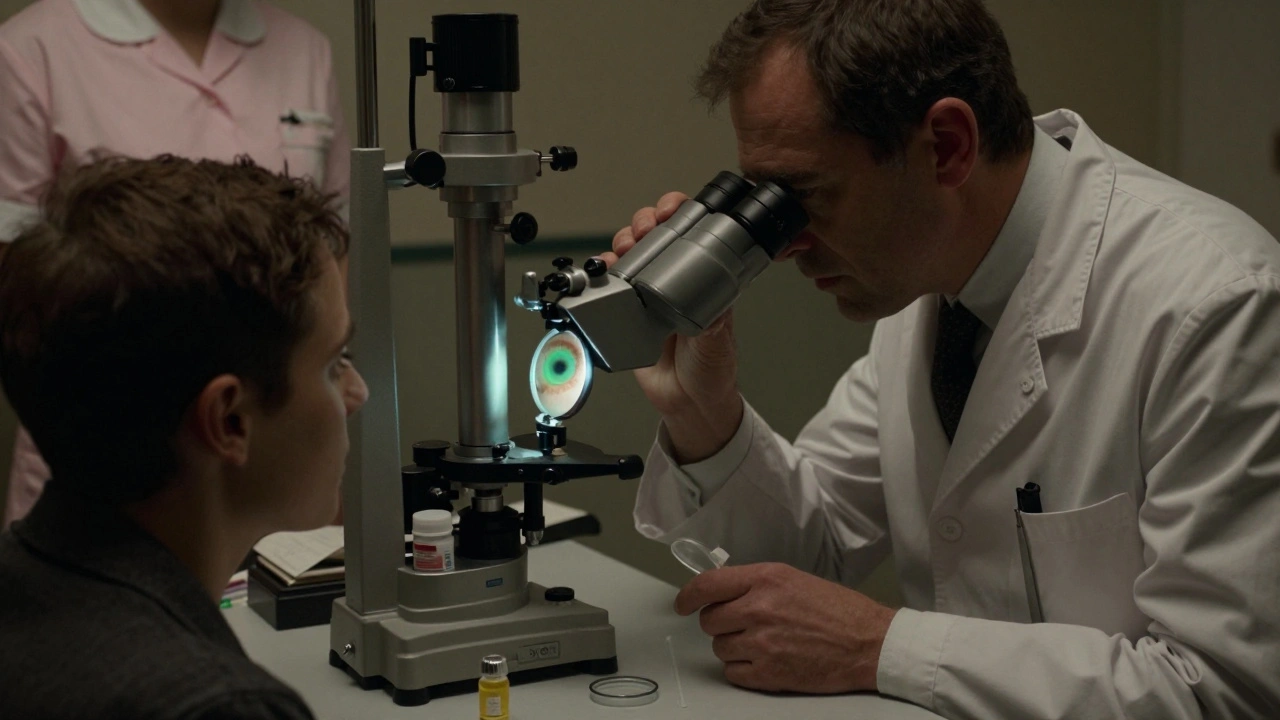
If you show up with these symptoms, your eye doctor won’t guess. They’ll test. The first step is usually fluorescein staining: a yellow dye is dropped into your eye, and under blue light, any damaged areas glow green. That’s how they see the ulcer’s size and shape.
Then comes the slit-lamp exam-a powerful microscope that lets them zoom in on every layer of your cornea. If the ulcer is large or deep, they’ll scrape a tiny sample from the surface. That sample goes to a lab to find out what’s causing the infection: bacteria? fungus? Acanthamoeba? The answer changes everything.
They’ll also check your vision with an eye chart and measure your corneal curvature. Newer tools now use high-resolution photos and AI to spot early signs of infection before it’s obvious to the naked eye. But none of this replaces a hands-on exam.
How Corneal Ulcers Are Treated
Time is everything. The longer you wait, the more damage the infection does. Treatment starts immediately-often before the lab results come back.
For most bacterial ulcers, doctors prescribe strong antibiotic eye drops-usually fluoroquinolones like ciprofloxacin or moxifloxacin. You’ll need to use them every hour or two, day and night, for several days. If the ulcer is near the center of your cornea (the visual axis) or larger than 2 mm, it’s considered sight-threatening. In those cases, you’ll likely be referred to a corneal specialist right away.
If it’s viral, antiviral drops like acyclovir are used. Fungal ulcers need antifungal medications, which are harder to treat and take weeks. In rare cases, if the infection destroys too much tissue, a corneal transplant becomes the only option to restore vision.
Here’s what you should never do: use over-the-counter redness drops, steroid eye drops without a prescription, or home remedies like honey or tea bags. These can make things worse. Only use what your doctor prescribes.
Prevention: The Only Real Cure
The best treatment for a corneal ulcer is never having one. Here’s what actually works:
- Never sleep in your lenses. Even if they’re labeled “extended wear,” the risk isn’t worth it.
- Replace lenses on schedule. Don’t stretch monthly lenses into month two.
- Wash your hands before touching your eyes or lenses.
- Use only recommended solutions. Never use water, saliva, or homemade mixes.
- Take lenses out before swimming, showering, or using a hot tub. Water carries dangerous microbes.
- Store lenses in fresh solution every night. Never top off old solution.
- Give your eyes a break. Wear glasses at least one day a week.
- Replace your lens case every 3 months. Bacteria build up in old cases.
And if you’re ever unsure-skip the lens. Wear glasses. It’s not inconvenient. It’s safer.
What Happens If You Ignore It?
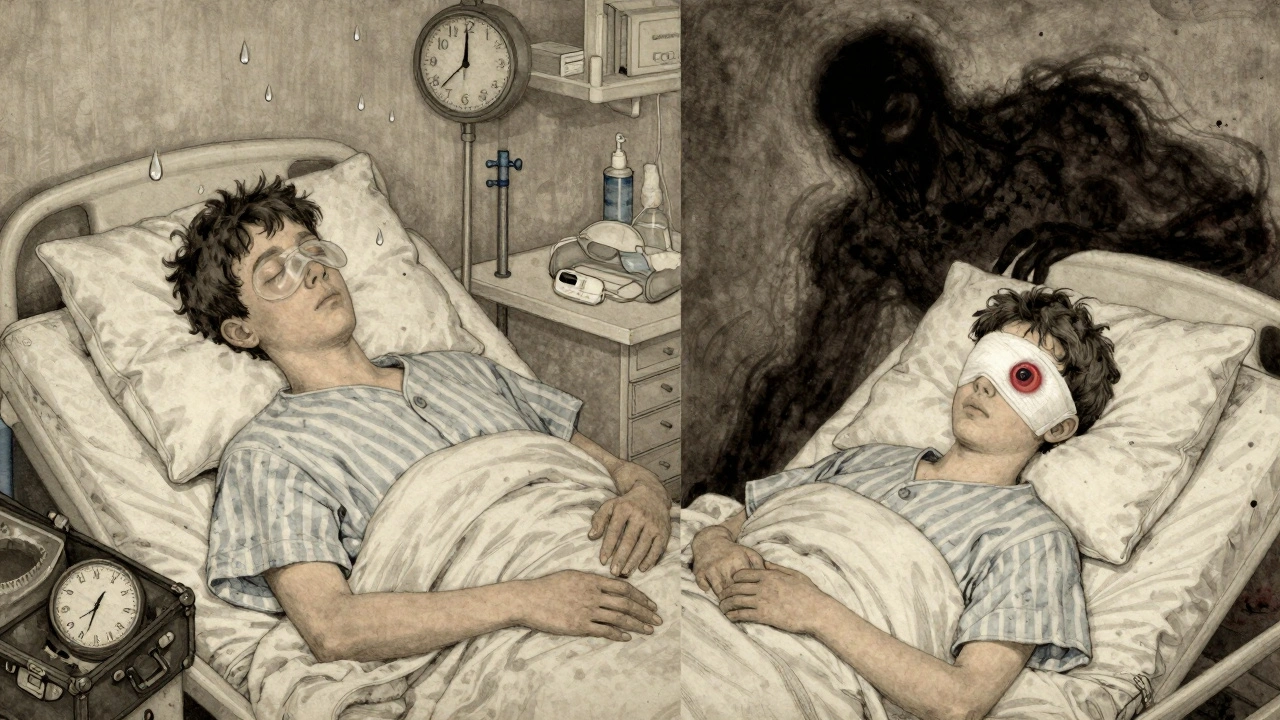
Some people think, “I’ll wait a day to see if it gets better.” That’s how people lose vision. A small ulcer can turn into a deep scar in 24 to 48 hours. Scarring means permanent blurriness, glare, or even a blind spot. In worst-case scenarios, the infection spreads to the inside of the eye, causing endophthalmitis-a medical emergency that can lead to eye removal.
The FDA and the American Academy of Ophthalmology agree: if you suspect a corneal ulcer, stop wearing lenses immediately and get evaluated within hours-not days. Delaying treatment isn’t just risky. It’s reckless.
Looking Ahead: Are New Lenses Safer?
Yes, modern lenses allow more oxygen than older ones. Some now have antimicrobial coatings. But none are foolproof. The biggest risk isn’t the lens material-it’s how you use it. Studies show that even with advanced lenses, people who sleep in them or skip hygiene still get ulcers at the same high rates.
Technology helps with faster diagnosis, but it doesn’t replace responsibility. The real breakthrough isn’t in the lens-it’s in patient education. Knowing the signs. Knowing the risks. Knowing when to act.
Contacts are convenient. But they’re not toys. They’re medical devices. And like any medical device, misuse has consequences.
Can a corneal ulcer heal on its own?
No. A corneal ulcer is an open wound caused by infection, and it will not heal without treatment. Even small ulcers can worsen quickly. Delaying care increases the risk of permanent scarring and vision loss. Always seek professional medical attention if you suspect a corneal ulcer.
Can I wear contacts again after a corneal ulcer?
You may be able to wear contacts again, but only after your eye has fully healed and your doctor gives you the go-ahead. Many people switch to daily disposable lenses and are advised to avoid overnight wear. Your doctor might also recommend a different lens type or a strict hygiene routine. Never return to contacts without a professional evaluation.
Are daily disposable contacts safer than monthly ones?
Yes, daily disposables reduce the risk of corneal ulcers because you throw them away each night-no cleaning, no storage, no buildup of bacteria. They’re especially safer for people who have trouble with hygiene or forget to clean lenses. But they’re not risk-free. You still need to wash your hands, avoid water, and never sleep in them.
Can I use over-the-counter eye drops for a suspected ulcer?
No. Over-the-counter drops for redness or dryness won’t treat an infection and can mask symptoms, making it harder for your doctor to diagnose the problem. Some, like steroid drops, can make the infection worse. Only use eye drops prescribed by your eye care professional.
How long does it take to recover from a corneal ulcer?
Recovery depends on the severity and cause. Minor bacterial ulcers may heal in 1-2 weeks with proper treatment. Fungal or Acanthamoeba ulcers can take months and require aggressive therapy. Scarring may remain even after the infection clears, affecting vision. Full healing can take up to 6 months in serious cases. Follow-up visits are essential.
Final Thought: Your Vision Isn’t Worth Risking
Contacts are a tool-not a lifestyle. They’re not a second skin. If you’re tempted to sleep in them because you’re tired, or skip cleaning because you’re busy, remember: your eyes don’t have a reset button. One bad night can cost you your sight. The best way to protect your vision isn’t expensive drops or fancy lenses. It’s simple: take them out. Wash your hands. Don’t risk it. Your future self will thank you.
Eddie Bennett
December 10, 2025 AT 13:51Man, I used to sleep in my contacts all the time back in college. Thought I was invincible. Then one morning my eye felt like it was full of sand and I couldn’t open it without crying. Turns out it was a tiny ulcer. Scared the hell out of me. Now I wear glasses on weekends and never look back. Your eyes don’t forgive stupid.
Sylvia Frenzel
December 11, 2025 AT 02:33This is why America needs to stop being so lazy. People don’t wash their hands, they swim in contacts, they sleep in them like they’re pajamas. This isn’t a medical issue-it’s a cultural failure. Stop blaming the lenses and start blaming the people who treat their eyes like disposable trash.
Paul Dixon
December 12, 2025 AT 22:42Big respect to whoever wrote this. I used to be the guy who’d rinse his lenses with tap water ‘cause it was ‘fine’-until my optometrist showed me a photo of Acanthamoeba under a scope. Looked like a tiny alien. I haven’t worn contacts in 3 years. Best decision ever. Also, daily disposables? Worth every penny if you’re messy like me.
Vivian Amadi
December 13, 2025 AT 19:37Stop pretending daily disposables are safe. They’re still plastic. You’re still touching your eye. You’re still risking everything. And no, ‘I wash my hands’ doesn’t cut it. You don’t know what’s under your nails. You’re not clean. You’re not safe. Stop lying to yourself.
Lisa Stringfellow
December 15, 2025 AT 04:14I used to think this was just fearmongering until I saw my friend lose 30% of her vision because she ‘waited to see if it got better.’ Now she can’t drive at night. She cries every time she looks in the mirror. And the worst part? She still blames the doctor. Not herself. Not the lens. Just… the system. It’s tragic. And so predictable.
Kristi Pope
December 15, 2025 AT 22:41Just wanted to say thank you for writing this. I’m a nurse and I’ve seen too many people come in too late. One guy thought his red eye was ‘just allergies’-turned out he had a fungal ulcer from swimming in his contacts. He’s lucky he kept his eye. Please, if you’re reading this and you wear lenses-take them out. Wash your hands. Breathe. Your vision is the one thing you can’t replace. You got this.
Aman deep
December 17, 2025 AT 04:12From India here-grew up with my dad telling me ‘eye is temple, don’t touch it with dirty hands.’ We didn’t even have daily disposables back then, but we washed lenses with boiled water and stored them in clean bottles. Simple. But effective. Modern tech doesn’t fix lazy habits. Respect your eyes, they’re your first window to the world.
Jimmy Kärnfeldt
December 18, 2025 AT 05:38It’s wild how we treat our eyes like they’re replaceable. We’ll spend hours picking out a new phone case but won’t spend five minutes cleaning our lenses. We think ‘it’s just a little red’-but our eyes aren’t phones. They don’t reboot. They don’t get updates. Once the damage is done, it’s permanent. Maybe we need to start seeing them as sacred, not just functional.
Ariel Nichole
December 19, 2025 AT 13:45My mom always said, ‘If it feels wrong, it is wrong.’ I ignored that for years. Now I wear glasses every day. No regrets. And honestly? I feel more myself without contacts. Less pressure. More clarity. Not just in vision-in life.