

- 13
When a new drug hits the market, it doesn’t just rely on a patent to block generics. In fact, the patent is often just the beginning. Many drugs enjoy years - sometimes over a decade - of market protection long after the core patent expires. This isn’t magic. It’s a carefully built system of regulatory tricks called market exclusivity extensions. These aren’t patents. They’re legal shortcuts granted by health agencies like the FDA and EMA that give drugmakers a monopoly even when no patent is left standing.
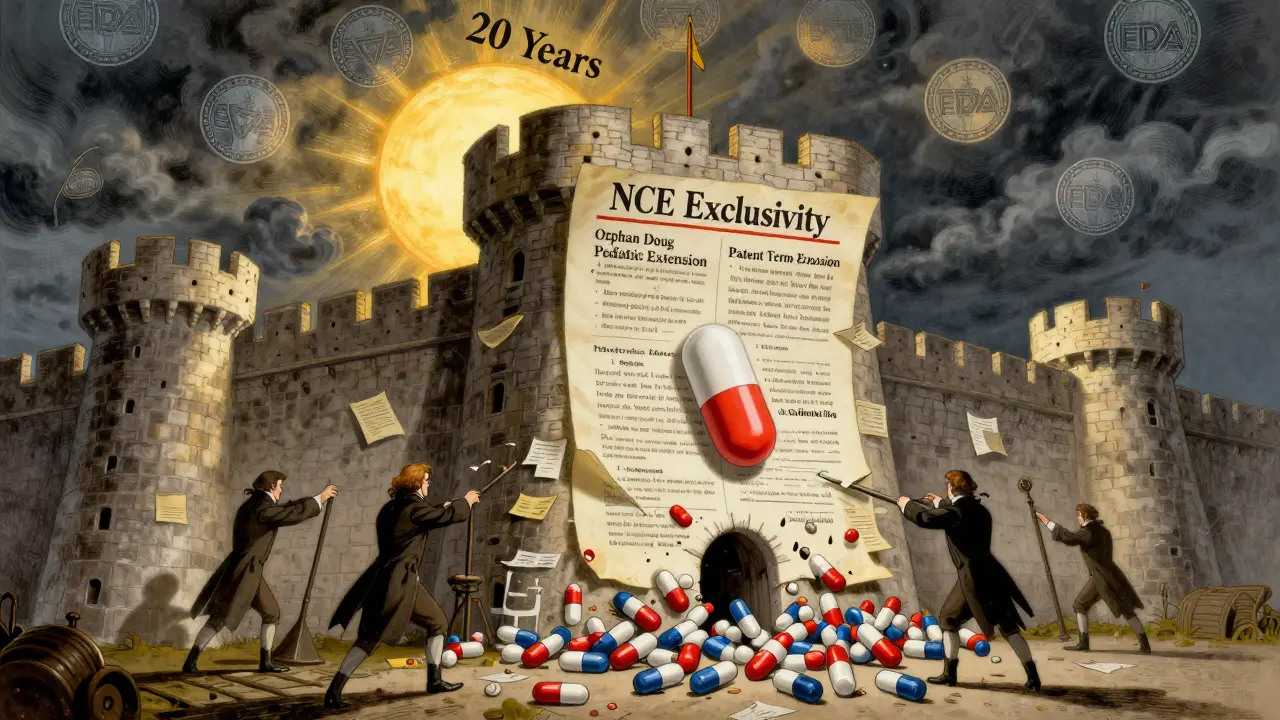
Think of it this way: a patent gives you 20 years from the date you file it. But drug development takes 10-15 years just to get approved. By the time the drug hits shelves, you’ve already lost half your patent life. That’s where exclusivity extensions come in. They don’t extend the patent. They create a separate, parallel wall around your drug that generics can’t break through - even if the patent is dead.
How the Hatch-Waxman Act Started It All
The modern system began in 1984 with the Hatch-Waxman Act. It was meant to strike a balance: reward innovation while letting generics in eventually. The law said: give drugmakers up to five extra years of patent life to make up for FDA delays, and give them five years of market exclusivity for brand-new chemicals. That sounded fair. But today, 91% of drugs that get patent extensions keep their monopoly alive for years after those extensions expire - thanks to a growing pile of other protections.
Take tazarotene. It had one core patent. But over time, the company filed 48 more patents covering minor changes - different dosages, delivery methods, combinations. None of these were groundbreaking. But each one delayed a generic. This isn’t rare. It’s standard practice.
The Five Main Exclusivity Tools in the U.S.
The FDA doesn’t just hand out one type of exclusivity. It has five distinct ones, and companies stack them like layers of armor.
- New Chemical Entity (NCE) exclusivity: 5 years. No generics allowed. Even if a patent expires, generics can’t even file an application until this runs out.
- Orphan Drug exclusivity: 7 years. For drugs treating rare diseases (under 200,000 patients in the U.S.). This one is powerful because it doesn’t care about patents. Even if there’s no patent, the exclusivity stands.
- New Clinical Investigation exclusivity: 3 years. For new uses of existing drugs. But here’s the catch: the new use must show real clinical benefit. Not just a tweak. The FDA tightened this rule in 2023 - now they demand stronger proof.
- Pediatric exclusivity: 6 months added to any existing exclusivity. You get this by completing pediatric studies. It sounds noble - helping kids - but companies use it like a timer extension. One senior patent attorney on Reddit called it "the gift that keeps on giving." A few extra months can mean billions in extra revenue.
- 180-day exclusivity for generic challengers: This one’s sneaky. If a generic company sues to knock out a patent and wins, they get six months of exclusive sales before other generics can enter. It sounds like a reward, but it actually delays full competition.
Some drugs get all five. Vertex’s cystic fibrosis drugs have used NCE, orphan, pediatric, and patent extensions together to stretch exclusivity past 20 years. That’s not an accident. It’s a strategy.
How Europe Does It Differently
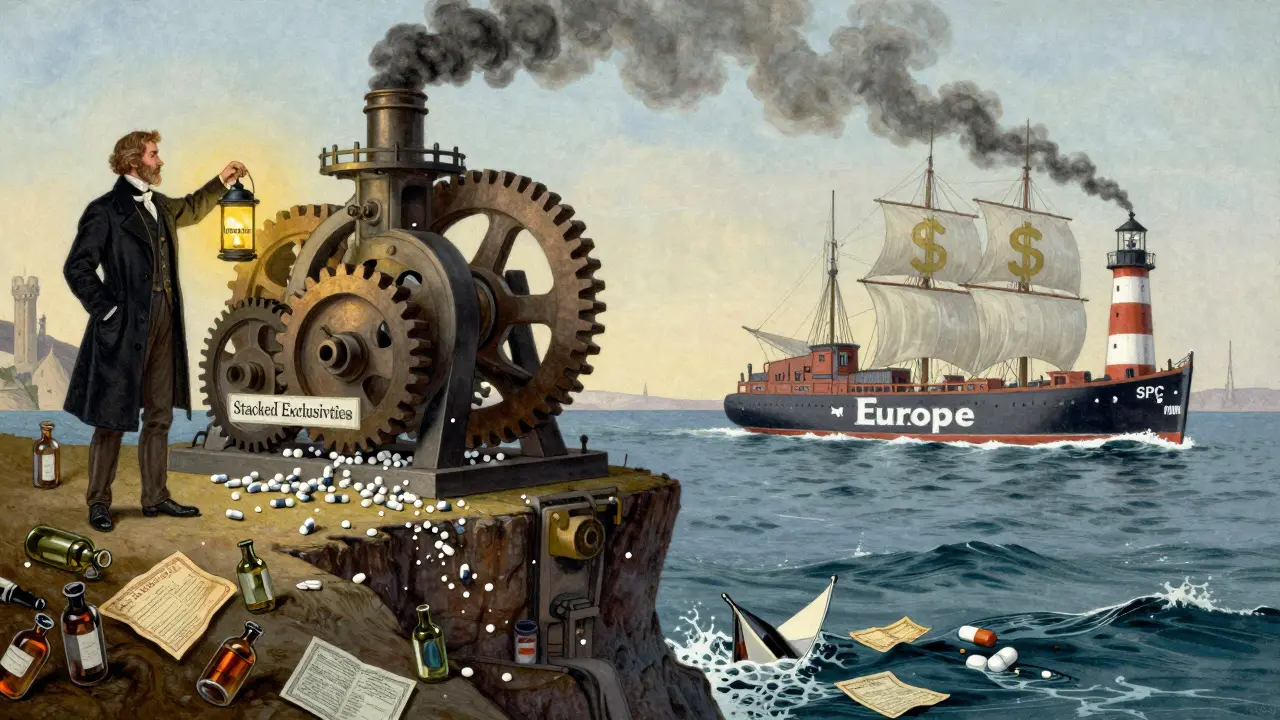
The EU doesn’t use the same system. Instead of patent term extensions, they use Supplemental Protection Certificates (SPCs). These can give up to 15 years of market protection after the original 20-year patent expires. That’s longer than the U.S. cap of 14 years post-approval.
Europe also has orphan drug exclusivity - 10 years, extendable to 12 if the company does pediatric studies. And they have a unique system called PUMA (Pediatric-Use Marketing Authorization) for drugs only meant for kids. PUMA gives 8 years of data protection plus 2 more years of market exclusivity - even if there’s no patent at all.
But here’s the big difference: the EU is cracking down. In 2023, the European Commission proposed reforms to stop companies from using SPCs to protect minor changes. They want exclusivity to go to real innovation, not tweaks.

The Stacking Game: How Companies Stretch Monopolies
The real power isn’t in one exclusivity. It’s in stacking them.
Imagine a drug gets approved in 2020. It has NCE exclusivity (5 years). The company files for pediatric studies. They get 6 months added - now it’s 5.5 years. Then they get orphan designation - adds 7 more years, but it starts after NCE runs out. So total? 12.5 years of exclusivity before generics can even apply. Then they file a new patent for a delivery device. That gets a PTE. Now they’re at 14.5 years. And they’re still not done.
By 2025, that same drug might still have no generic competitors. Not because it’s protected by a patent. But because of the layers.
Companies like Bristol Myers Squibb and Novartis have mastered this. They delay patent filings until after Phase II trials. That way, the 20-year clock starts later - and aligns better with market launch. It’s a legal loophole they’ve turned into a science.
What About Generic Companies?
Generics manufacturers hate this. They call it "evergreening." And they’re right - it’s not always about innovation. Sometimes it’s about making a tiny change: a new pill shape, a different coating, a slightly higher dose. Then they file a new patent. The FDA approves it. The clock resets.
Teva’s 2022 report found that 17% of their target drugs were delayed by "product hopping" - where companies swap the original drug for a slightly modified version right before the patent expires. Patients get the same medicine. But now it’s branded again. And the generic? Blocked.
Even the 180-day exclusivity for generic challengers backfires. It gives one company a head start - but stops everyone else. So instead of 10 generics entering at once, you get one - then a year-long wait for the rest.
The Economic Cost
In 2022, the U.S. spent $621 billion on prescription drugs. Branded drugs made up 78% of that spending - even though they were only 10% of prescriptions. Why? Because they had exclusivity.
A 2023 JAMA Health Forum study looked at just four top-selling drugs: bimatoprost, celecoxib, glatiramer, and imatinib. When exclusivity extended past patent expiration, those four drugs caused $3.5 billion in extra spending over two years. That’s money patients, insurers, and Medicare paid because generics couldn’t enter.
Orphan drugs are a special case. They’re expensive - sometimes $500,000 per patient per year. But without exclusivity, companies wouldn’t develop them. 38% of all new drug approvals in 2022 were for orphan conditions. That’s up from 201 in 2010. So exclusivity works - for rare diseases.
But here’s the problem: 47 of the top 50 best-selling drugs in 2022 used some form of exclusivity extension. That’s not just rare diseases. That’s statins, blood pressure meds, diabetes drugs. The system was meant to help innovation. Now it’s helping profits.
What’s Changing?
The tide is turning. The FTC filed a brief in 2023 saying "product hopping" violates antitrust law. The FDA tightened rules for 3-year exclusivity - now you need real clinical proof, not just a paperwork tweak. The EMA is testing faster reviews for pediatric studies.
By 2028, experts predict the average drug will have 16.3 years of exclusivity - up from 12.7 in 2018. That’s not inevitable. It’s the result of decisions made today.
Some argue we need to scrap the system. Others say it’s essential. The truth? It’s a tool. Used right, it helps develop life-saving drugs for small patient groups. Used wrong, it locks prices and blocks access. The line between innovation and exploitation is thin - and it’s getting thinner.
What’s the difference between a patent and market exclusivity?
A patent is a legal right granted by the patent office that gives the inventor control over the invention for a set time - usually 20 years from filing. Market exclusivity is granted by health regulators like the FDA and stops generics from even applying for approval for a set period, regardless of patent status. You can have exclusivity without a patent, and vice versa.
Can a drug have exclusivity even if it has no patent?
Yes. Orphan drug exclusivity and pediatric exclusivity don’t require a patent. If a drug treats a rare disease and gets orphan designation, it gets 7 years of exclusivity in the U.S. even if no patent exists. This is common in biologics and rare disease treatments where patenting is difficult.
How do companies get the 6-month pediatric exclusivity extension?
The company must submit a "Written Request" to the FDA during early development, outlining pediatric studies they’ll conduct. After completing those studies and submitting the data, the FDA grants a 6-month addition to any existing exclusivity period - whether it’s NCE, orphan, or patent extension. It’s not automatic. The FDA now audits these studies closely.
Why do some drugs get 14 years of exclusivity while others get 20?
The 14-year cap in the U.S. applies only to patent term extensions (PTE). It’s the total time from drug approval to the end of patent + exclusivity. But if a drug gets orphan exclusivity (7 years) on top of NCE (5 years), and then a pediatric extension (6 months), those stack after the patent expires. So the total time without competition can be 20+ years - even if the patent itself is gone.
Are market exclusivity extensions only used in the U.S.?
No. The EU uses Supplemental Protection Certificates (SPCs) and has its own orphan and pediatric exclusivity rules. Other countries like Japan and Canada have similar systems. But the U.S. is the most aggressive in stacking multiple types, making it the global leader in extended monopolies.
Lebogang kekana
March 2, 2026 AT 21:34Justin Rodriguez
March 4, 2026 AT 16:13Raman Kapri
March 6, 2026 AT 05:02Megan Nayak
March 7, 2026 AT 03:45Tildi Fletes
March 7, 2026 AT 12:09Siri Elena
March 9, 2026 AT 00:05Pankaj Gupta
March 9, 2026 AT 18:49Betsy Silverman
March 10, 2026 AT 19:21Ivan Viktor
March 11, 2026 AT 19:33Zacharia Reda
March 12, 2026 AT 08:12Jeff Card
March 12, 2026 AT 09:53Matt Alexander
March 13, 2026 AT 20:22Gretchen Rivas
March 14, 2026 AT 15:30