


- 14
For decades, proving that a generic drug works the same as the brand-name version meant putting healthy volunteers through clinical trials. Blood samples drawn every hour. Long waits. High costs. Sometimes over $1.5 million per study. But now, a smarter approach is cutting through the noise: IVIVC. In Vitro-In Vivo Correlation isn’t just a buzzword-it’s a scientifically validated way to skip human trials altogether by using lab-based dissolution tests to predict how a drug behaves in the body.
What Exactly Is IVIVC?
IVIVC stands for In Vitro-In Vivo Correlation. Simply put, it’s a mathematical model that links how quickly a drug dissolves in a test tube (in vitro) to how fast it gets absorbed into the bloodstream (in vivo). If you can accurately measure dissolution in the lab, you don’t need to measure blood levels in people. The FDA first laid out clear rules for this in 1996, and updated them in 2014. The European Medicines Agency followed with similar guidance in 2012.The goal? Replace costly, time-consuming human studies with reliable lab data. For a generic drug maker, that means saving months of development time and up to $2 million per avoided bioequivalence study. But it’s not easy. Only about 14 ANDA submissions included IVIVC data over an 18-year span-and most were rejected. Why? Because getting it right demands precision, depth, and expertise most companies don’t have in-house.
The Four Levels of IVIVC: Which One Matters?
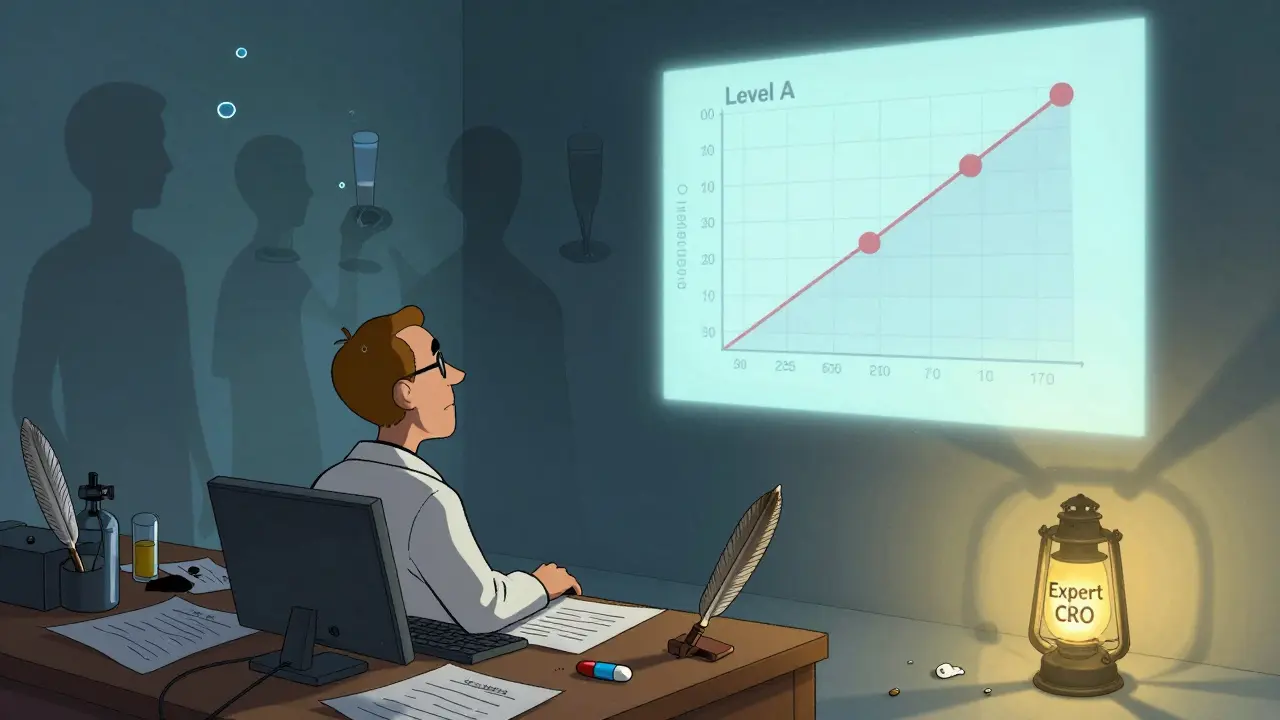
Not all correlations are created equal. The FDA defines four levels, and only one truly unlocks a full biowaiver:- Level A: The gold standard. It’s a point-to-point match between dissolution at each time point and drug concentration in blood. Think of it like a perfect mirror. If your dissolution curve looks exactly like the blood concentration curve, you can predict the entire pharmacokinetic profile. Acceptable models need an R² above 0.95, a slope near 1.0, and an intercept near zero. Predictions must fall within ±10% for AUC and ±15% for Cmax.
- Level B: Uses averages-mean dissolution time vs. mean residence time. Less precise. Doesn’t predict individual curves, just overall trends.
- Level C: Links one dissolution number (like % dissolved at 1 hour) to one PK parameter (like Cmax). Useful for quick checks, but can’t predict full behavior.
- Multiple Level C: Several Level C points tied to multiple PK parameters. Better than single C, but still lacks the full picture of Level A.
For a biowaiver to be approved, regulators want Level A. Multiple Level C might fly if you have extra data backing it up-but it’s risky. A 2023 study in WJARR warned that these models often miss real-world variations like food effects or gut pH shifts, leading to potential therapeutic failure.
Why IVIVC Works Best for Modified-Release Drugs
Immediate-release tablets? Often eligible for a simpler biowaiver under the Biopharmaceutics Classification System (BCS). If the drug is highly soluble and highly permeable (Class I), you can skip human trials without IVIVC.But for extended-release capsules, patches, or delayed-action formulations? BCS doesn’t cut it. That’s where IVIVC shines. The FDA’s SUPAC-MR guidance from 1997 lets companies avoid bioequivalence studies for minor changes-like tweaking a binder by 3% or moving production to a new plant-if they’ve got a validated IVIVC. Without it, each change triggers a full clinical trial.
Teva’s experience with their extended-release oxycodone generic tells the story: 14 months, three formulation attempts, and $1.2 million spent before approval. But once accepted, they avoided five future bioequivalence studies. That’s $10 million saved before the product even launched.
The Hidden Costs of Getting IVIVC Wrong
It’s not just about money. It’s about trust. When IVIVC fails, patients pay the price.A Reddit post from a formulation scientist in March 2023 described abandoning an IVIVC project after 18 months and $1.2 million spent. Why? The model looked perfect in the lab-but collapsed when tested under real food conditions. The drug absorbed too slowly when taken with a meal. That’s not just a failed model. It’s a potential safety risk.
Industry surveys show the top three reasons IVIVC submissions fail:
- 82% didn’t replicate real digestive conditions-using plain water instead of biorelevant media with bile salts and pH gradients.
- 74% didn’t test enough formulation variations. You need at least three versions: fast, medium, and slow release. Without that range, the model can’t predict real-world performance.
- 68% didn’t validate the model properly. Testing it on the same data used to build it? That’s not validation. It’s circular logic.
Contract labs like Alturas Analytics and Pion report success rates of 60-70% for Level A IVIVC when brought in early. In-house teams? More like 30-40%. The difference? Experience, equipment, and knowing how to design dissolution tests that mimic the gut.
Biorelevant Dissolution: The New Normal
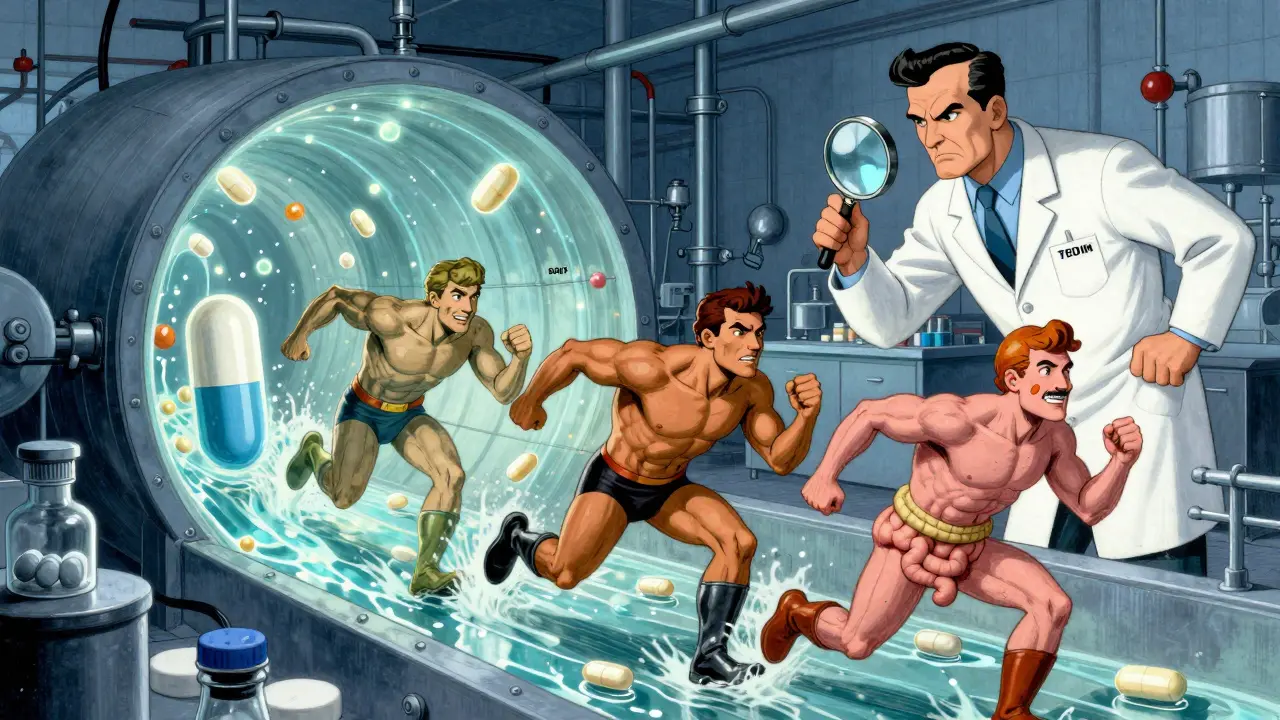
Traditional dissolution methods use simple buffers at fixed pH. That’s fine for aspirin. Not for a complex extended-release tablet.Biorelevant dissolution testing changes the game. It uses fluids that mimic stomach and intestinal conditions-varying pH, bile salts, enzymes, and even food residues. Research from the University of Maryland in 2019 showed these methods improve correlation accuracy by 40-60% for modified-release products.
The FDA and EMA now expect it. By 2025, the American Association of Pharmaceutical Scientists predicts 75% of new IVIVC submissions will use biorelevant media. If you’re still using water or pH 6.8 buffer alone, your submission is already behind the curve.
Who’s Doing It Right-and Who’s Falling Behind?
Only five of the top ten generic manufacturers have dedicated IVIVC teams: Teva, Mylan, Sandoz, Sun Pharma, and Lupin. Smaller companies? Most can’t afford the $2-3 million investment or the 12-18 month timeline.Regulatory approval rates tell the story:
- 58% for oral extended-release products
- 32% for complex injectables
- 19% for ophthalmic formulations
Why the drop-off? Injectables and eye drops have more variables: absorption pathways, tissue binding, local metabolism. IVIVC for these is still experimental. But the FDA’s June 2023 draft guidance on topical products signals a clear push: IVIVC is expanding beyond oral drugs.
The Future: Machine Learning and Regulatory Shifts
The 2024 EMA-FDA joint workshop on complex generics spotlighted one emerging trend: machine learning. Instead of manually fitting curves, AI models now analyze hundreds of dissolution and PK datasets to find hidden patterns. Early results show faster, more accurate models.But regulators aren’t buying black boxes. Transparency is non-negotiable. You can’t just say “the algorithm says yes.” You must explain how it works, what inputs it uses, and how it handles variability.
Looking ahead, McKinsey & Company projects IVIVC-supported biowaivers will rise from 22% of modified-release approvals in 2022 to 35-40% by 2027. The FDA’s GDUFA III plan includes $15 million in funding for IVIVC research. The message is clear: this isn’t a niche tool anymore. It’s becoming the standard.
When IVIVC Still Won’t Work
Don’t assume IVIVC is the answer for everything. It fails in three key cases:- Narrow therapeutic index drugs (like warfarin, lithium, cyclosporine): Even tiny differences in absorption can be dangerous. Human testing is still required.
- Non-linear pharmacokinetics: When dose changes don’t scale predictably with blood levels, lab models can’t capture the complexity.
- Drugs with erratic absorption: Those affected by gut motility, pH swings, or food interactions. If the body’s behavior is too unpredictable, the lab can’t mimic it reliably.
In these cases, no amount of fancy modeling replaces real human data. Regulators won’t bend on safety.
How to Start Building an IVIVC
If you’re considering IVIVC, here’s the realistic path:- Start early. Don’t wait until the end of development. Begin during Phase 2 trials for new drugs or prototype design for generics.
- Build a dissolution method that matters. Use biorelevant media. Test at least three formulations with different release rates.
- Collect dense PK data. Minimum 12 blood time points per subject. At least 3 studies with 12-24 subjects each.
- Validate, don’t just fit. Use one dataset to build the model. Test it on a completely different set of data.
- Get expert help. If you don’t have a pharmacokinetics specialist on staff, hire a CRO with proven IVIVC success.
The whole process takes 12-18 months. It’s not quick. But if you’re making a modified-release drug, it’s the only way to avoid endless clinical trials.
Final Thought: It’s Not About Cutting Corners
IVIVC isn’t a shortcut. It’s a deeper dive. You’re replacing one kind of complexity-human trials-with another: advanced modeling, precise testing, and scientific rigor. The companies that succeed aren’t the ones trying to save money. They’re the ones committed to understanding their drug’s behavior at every level.The future of generic drugs isn’t just cheaper. It’s smarter. And IVIVC is leading the way.
What is the main purpose of IVIVC in generic drug development?
The main purpose of IVIVC is to establish a reliable link between how a drug dissolves in a lab setting and how it behaves in the human body. This allows regulators to approve generic drugs without requiring costly and time-consuming clinical bioequivalence studies in healthy volunteers, as long as the dissolution profile predicts in vivo performance accurately.
Can IVIVC be used for all types of drugs?
No. IVIVC works best for oral extended-release formulations. It’s not suitable for drugs with narrow therapeutic indexes (like warfarin), non-linear pharmacokinetics, or erratic absorption. Injectable, ophthalmic, and topical products are still experimental in IVIVC applications, though regulatory interest is growing.
What’s the difference between Level A and Level C IVIVC?
Level A provides a point-to-point match between dissolution and blood concentration at every time point, allowing full prediction of the drug’s behavior. Level C only links one dissolution value (like % dissolved at 1 hour) to one pharmacokinetic parameter (like Cmax), offering limited predictive power. Level A is required for full biowaivers; Level C may be accepted only with additional evidence.
Why do most IVIVC submissions get rejected?
Most rejections happen because the dissolution test doesn’t reflect real human physiology-using plain water instead of biorelevant media. Other top reasons: not testing enough formulation variations and failing to validate the model on independent data. Regulatory agencies demand robust, reproducible science.
How long does it take to develop a successful IVIVC?
Developing a Level A IVIVC typically takes 12 to 18 months. This includes 3-6 months for dissolution method development, 6-9 months for pharmacokinetic studies with multiple formulations, and 3-6 months for modeling and validation. Rushing the process leads to failure.
Is IVIVC becoming more accepted by regulators?
Yes. FDA approval rates for IVIVC submissions rose from 15% in 2018 to 42% in 2022. The EMA and FDA are actively expanding guidance to include complex products like implants and topical formulations. With $15 million in new funding and growing use of machine learning, IVIVC is moving from a niche tool to a standard part of regulatory strategy.
Sinéad Griffin
December 16, 2025 AT 12:04Rulich Pretorius
December 16, 2025 AT 22:22Thomas Anderson
December 18, 2025 AT 20:50Dwayne hiers
December 19, 2025 AT 13:32Jonny Moran
December 20, 2025 AT 16:23Alexis Wright
December 20, 2025 AT 17:57jeremy carroll
December 22, 2025 AT 08:16Natalie Koeber
December 23, 2025 AT 08:30Wade Mercer
December 24, 2025 AT 01:24Sarthak Jain
December 25, 2025 AT 07:50Tim Bartik
December 25, 2025 AT 12:26Edward Stevens
December 27, 2025 AT 05:52Daniel Thompson
December 27, 2025 AT 19:01Daniel Wevik
December 28, 2025 AT 23:55