

- 14
When you take a pill or use a medical device, you expect it to be safe. But behind every product on the shelf, there’s a factory-and if that factory cuts corners, people can get hurt. The FDA doesn’t wait for harm to happen. It sends inspectors into manufacturing sites around the world, looking for the same mistakes over and over. In 2025, these mistakes aren’t just technical-they’re cultural.
Aseptic Processing: The Silent Killer in Clean Rooms
The most common issue the FDA finds? Aseptic processing failures. Nearly half of all warning letters in 2025 pointed to problems in sterile manufacturing. This isn’t about dirty floors. It’s about failing to prove that your clean room actually stays clean during production.
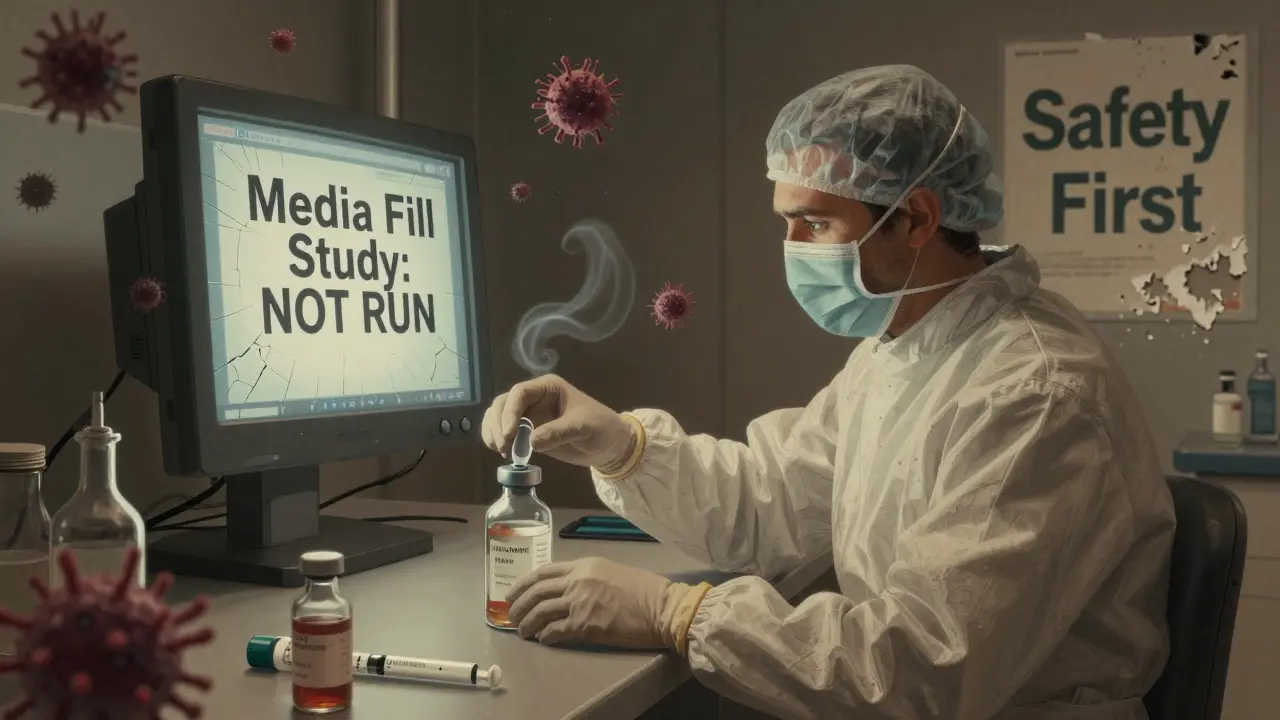
Take Health and Natural Beauty USA Corp. The FDA found they didn’t run proper media fill studies-tests that simulate filling sterile products without actual medicine. Without these, you have no proof that your workers, tools, or air flow won’t introduce bacteria into a vial of injectable drug. One inspection found employees reaching over open containers during filling. No gloves. No sterilization. Just speed.
These aren’t rare events. In 2025, 47% of warning letters cited this exact problem. The FDA doesn’t just say “fix it.” They require re-validation of your entire aseptic process. That means running at least three consecutive successful batches under real production conditions, with every step monitored and documented. And you can’t just do it once. You have to prove you can do it every single day.
Data Integrity: When Records Are Made Up
It’s not enough to have good processes. You have to prove you followed them. That’s where data integrity comes in-and it’s the second most common violation.
Guangxi Yulin Pharmaceutical Group Co. Ltd. got a warning letter because their UV-Vis and IR instruments had no audit trails. That means no record of who changed a result, when, or why. Someone could’ve altered a test value to make a failed batch look good. And they did it without leaving a trace.
Other cases? Production records written on laminated paper with erasable markers. Electronic logs with shared passwords. Users deleting entries. The FDA calls this a violation of ALCOA+: data must be Attributable, Legible, Contemporaneous, Original, and Accurate-with Plus for completeness and consistency.
Fixing this isn’t just buying new software. It’s changing how people work. The FDA requires validated audit trails that can’t be turned off. User access must be unique. Every change must be logged with a timestamp and reason. Records must be kept for at least 180 days. And if you’re using cloud systems? You better have controls for who can access them-and proof you’re monitoring that access.
Material Control: Poison in the Ingredients
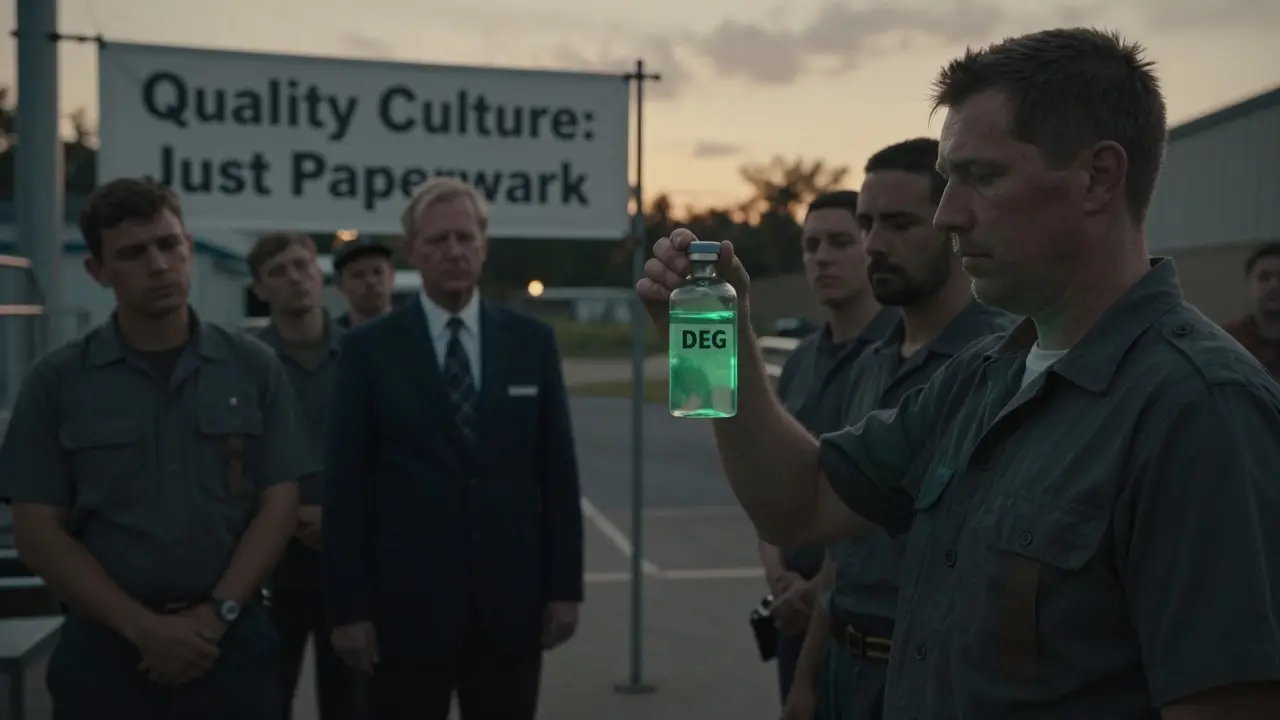
Some of the deadliest mistakes happen before production even starts. The FDA found glycerin and sorbitol-common ingredients in syrups and creams-were contaminated with diethylene glycol (DEG). DEG is toxic. It caused kidney failure and death in the 2007-2009 heparin crisis.
Health and Natural Beauty USA Corp. didn’t test their raw materials for DEG. They trusted their supplier’s certificate of analysis. That’s not enough. The FDA now requires manufacturers to test high-risk materials themselves, using methods that can detect DEG at 0.1% concentration or lower. That’s not a guess. It’s a scientifically validated test, following USP General Chapter <1085>.
And it’s not just about testing. It’s about supplier oversight. Foshan Yiying Hygiene Products Co., Ltd. got cited because they didn’t verify if their suppliers were even doing the tests they claimed. The FDA expects you to audit your suppliers. Not once. Not every few years. Regularly. With documentation.
Process Validation: Making Things Up Without Proof
Just because you’ve been making toothpaste the same way for 10 years doesn’t mean it’s scientifically sound. The FDA wants proof-data-that your process consistently produces safe, effective products.
Health and Natural Beauty USA Corp. had no validation study for their toothpaste line. No testing of hardness, fluoride distribution, or microbial stability. They just assumed it worked. That’s not manufacturing. That’s guessing.
For drugs, the FDA requires three consecutive batches to meet all pre-defined acceptance criteria. You need to know your critical process parameters: temperature, mixing time, pressure, humidity. You need to prove you can control them. And you need to document it all. No exceptions.
Even simple things like analytical methods matter. If you’re measuring active ingredients, your method must be validated. Not “we’ve always done it this way.” Validated. With precision, accuracy, specificity, and robustness data. Otherwise, you don’t know how much medicine is in the pill.
Quality Culture: The Root of All Failures
Here’s the truth: 78% of companies cited in 2025 warning letters had a broken quality culture. That means leadership rewarded speed over safety. Managers ignored red flags. Employees were afraid to speak up.
Foshan Yiying’s warning letter had a line that said it all: “This site does not prepare batch production records for every batch of our listed drug.” That’s not a mistake. That’s a mindset. If you don’t document every batch, you’re not managing quality-you’re pretending to.
The FDA is shifting from checking boxes to checking culture. Their Quality Management Maturity (QMM) program, launched in 2024, now looks at how leaders talk about quality, how they respond to errors, and whether frontline staff feel safe reporting problems. Facilities that improved their culture saw 63% fewer repeat findings and got through inspections 41% faster.
It’s not about hiring more quality staff. It’s about giving them real authority. In China, 3 warning letters in 2025 cited a lack of independent Quality Units. In India, 4 letters pointed to weak data controls. In Malaysia, 9 cited poor oversight of quality teams. The pattern? Quality isn’t a department. It’s a responsibility that starts at the top.
Where the Problems Are-and Why
It’s not random. The FDA’s 2025 inspection data shows clear geographic trends:
- Chinese facilities: Most cited for analytical method validation failures (28 letters). They often skip scientific validation to save time.
- Indian facilities: Top for data integrity issues (24 letters). Shared passwords, no audit trails, manual records.
- Malaysian facilities: 9 letters for weak Quality Unit authority. Quality teams report to production managers-conflict of interest built in.
The FDA has responded by ramping up unannounced inspections-up 40% in 2025. Sixty-eight percent of these targeted Asian facilities. In 2026, they’re expanding unannounced checks to U.S. sites too. No more warning. No more notice. Just inspectors walking in.
What Happens When You Fail
Getting a warning letter isn’t the end. It’s the beginning of a long, expensive fix. The FDA requires 92% of violators to hire an independent CGMP consultant. That’s not optional. That’s mandatory.
Remediation takes 6 to 18 months. You need to:
- Redesign your quality system
- Train every employee from the ground up
- Validate every process
- Install audit trails
- Test every high-risk material
- Prove you’ve changed your culture
And if you don’t fix it? Your products get blocked at the border. As of November 2025, 147 facilities are on Import Alert 66-40. That means every shipment is physically inspected before it can enter the U.S. That’s not a delay. That’s a stop. And it costs millions.
What You Can Do Now
If you’re in manufacturing, don’t wait for an inspection. Ask yourself:
- Do we run media fill studies for sterile products? And are they done by someone independent?
- Can we prove every data entry has an audit trail? Or are we using paper records that can be erased?
- Do we test raw materials ourselves-or just trust a supplier’s paper?
- Have we validated our processes with three consecutive batches? Or are we relying on history?
- Does our quality team report to production-or to the CEO?
Spending on CGMP compliance hit $4.7 billion in Q3 2025. That’s because the cost of failure is higher than ever. The FDA isn’t trying to shut you down. They’re trying to protect patients. If your quality system is just paperwork, you’re not just at risk-you’re already failing.
What are the most common FDA manufacturing deficiencies in 2025?
The top three are aseptic processing failures (47% of warning letters), data integrity issues (39%), and material control problems (35%). These include inadequate sterile testing, missing audit trails, and unverified raw material testing-especially for high-risk ingredients like glycerin that can be contaminated with toxic substances.
What does the FDA mean by ALCOA+?
ALCOA+ stands for Attributable, Legible, Contemporaneous, Original, and Accurate-with the “+” meaning Complete, Consistent, Enduring, and Available. It’s the standard for data integrity. Every record must show who made it, when, and why. No erasures. No shared logins. No deleted files. If you can’t prove it, the FDA considers it false.
How does the FDA check for data integrity violations?
Inspectors examine electronic systems for audit trails, user access logs, and backup procedures. They test if records can be altered without detection, check for shared passwords, and review instrument settings. They also request raw data files-not just summaries-and compare them to final reports. If there’s a mismatch, it’s a violation.
What happens if a facility gets on Import Alert 66-40?
All shipments from that facility are automatically detained at U.S. ports. The FDA physically inspects every single package before allowing entry. This can delay shipments for weeks or months. To get off the alert, you must prove full compliance through a successful FDA re-inspection and submit a detailed corrective action plan.
Why is quality culture so important to the FDA now?
The FDA has found that technical fixes alone don’t prevent repeat violations. If leadership pushes for speed over compliance, employees will hide mistakes. Facilities with strong quality cultures-where staff feel safe reporting errors and quality has real authority-have 63% fewer repeat findings and fix problems 41% faster. The FDA now assesses culture as part of inspections.
Can a company fix a warning letter without hiring a consultant?
Technically, yes-but the FDA requires it in 92% of cases because internal teams often lack the objectivity or experience to fix deep systemic issues. Consultants bring proven frameworks, audit experience, and credibility with the FDA. Trying to fix major CGMP violations alone usually leads to incomplete fixes and repeat citations.
Katelyn Slack
January 6, 2026 AT 11:08i just read this and my stomach dropped. i work in pharma and we had a near-miss last year with a media fill. no one noticed until the inspector showed up. we fixed it, but man, the fear of getting caught is real.
also, typos are my middle name. sorry.
Melanie Clark
January 8, 2026 AT 04:40THEY’RE LYING TO US. THIS IS ALL A COVER FOR BIG PHARMA TO CONTROL THE SUPPLY CHAIN. WHY DO YOU THINK THEY TARGET ASIA BUT NEVER CHECK THEIR OWN PLANTS IN OHIO? THEY WANT YOU TO THINK IT’S ‘FOREIGN’ PROBLEMS. BUT THE FDA IS IN BED WITH THE BIG COMPANIES. I SAW A REPORT WHERE THEY IGNORED CONTAMINATION IN A NEW JERSEY FACILITY FOR 18 MONTHS. NO ONE TALKS ABOUT THAT.
ALCOA+? MORE LIKE ALCOA+ LIES
Harshit Kansal
January 9, 2026 AT 04:02bro this is wild. we got a similar situation back home in Hyderabad. one guy was writing batch records on napkins and scanning them. no joke. the boss said ‘it’s fine, we’ve done it this way for 15 years’.
now they’re hiring consultants. too late. but hey, at least we’re trying.
Vinayak Naik
January 9, 2026 AT 11:03let me tell you something - data integrity isn’t just about software. it’s about pride. when you’re working 12-hour shifts and your manager says ‘just tweak the numbers so we hit the deadline’, you either become part of the machine or you get sidelined.
i’ve seen good people quit because they refused to falsify logs. and yeah, the FDA’s right - it’s not about tech. it’s about courage. and if your culture rewards silence, you’re already dead.
also, DEG in glycerin? that’s not negligence. that’s greed. someone knew. and they didn’t care.
Kiran Plaha
January 10, 2026 AT 02:35so if i’m reading this right, the main problem is people not documenting stuff? like, literally just not writing things down?
why does that even happen? isn’t it easier to write it than to get fined?
Matt Beck
January 10, 2026 AT 07:57…so we’re all just… living in a simulation where quality is a performance art? 🤔
the FDA isn’t policing factories - they’re policing *belief systems*. if you don’t believe in documentation, you won’t document. if you don’t believe in safety, you won’t test.
the real violation isn’t the missing audit trail… it’s the silence after the alarm.
🫡 #qualityisnotacostit’saculture
Stuart Shield
January 11, 2026 AT 13:53my cousin works in a sterile facility in Manchester. they got a warning letter last year over glove changes. not because they didn’t change them - because they didn’t log *when* they changed them. one timestamp was off by 37 seconds. they spent six months rebuilding their entire SOP library.
it’s not about being perfect. it’s about being honest when you’re not.
the people who fix this? they’re the quiet ones. no fanfare. just paperwork. and they deserve way more respect.
Indra Triawan
January 12, 2026 AT 05:58isn’t it strange how we demand perfection from factories but never ask why people are so afraid to speak up? the system doesn’t punish failure - it punishes truth.
we’re not fixing processes. we’re just getting better at hiding the cracks.
Lily Lilyy
January 13, 2026 AT 15:40to everyone reading this - if you work in manufacturing, please take a moment today to thank the person who double-checks the logs, who asks the hard questions, who stays late to run the media fill.
they’re not heroes. they’re just doing their job.
and they’re keeping you alive.
you’re welcome.
Susan Arlene
January 14, 2026 AT 11:33so the whole thing boils down to this: write it down or you’re lying
also why is everyone so scared to say no
Joann Absi
January 14, 2026 AT 19:07AMERICA IS THE ONLY COUNTRY THAT ACTUALLY CARES ABOUT THIS. CHINA? INDIA? THEY’RE JUST OUT TO MAKE MONEY. THEY DON’T CARE IF YOU DIE. THE FDA IS THE ONLY THING STANDING BETWEEN US AND A TOXIC WORLD.
STOP SENDING US POISON FROM OVERSEAS. BUILD IT HERE. PAY THE PRICE. IT’S WORTH IT.
🇺🇸 #AMERICANMADE #FDAFOREVER
Mukesh Pareek
January 16, 2026 AT 00:42the root cause analysis here is fundamentally flawed. the issue isn’t culture - it’s the lack of enforceable regulatory alignment across jurisdictions. the FDA’s ALCOA+ framework is robust, but without harmonized GxP enforcement in emerging markets, you’re playing whack-a-mole with systemic non-conformities.
you need a global audit framework with real teeth, not just reactive inspections.
Ashley S
January 16, 2026 AT 21:08why do we even care? people die from car crashes, heart disease, bad sushi. but we’re losing our minds over some lab records? this is just fearmongering.
also, i’m pretty sure my Advil is fine.
Jeane Hendrix
January 18, 2026 AT 04:05just read the part about supplier audits. we do them every 6 months. but honestly? we send a form, they email back a COA, and we file it. no site visits. no questions.
we’re not bad people. we’re just tired.
but now i’m wondering - are we the problem too?