

Imagine needing to understand your diabetes medication schedule, but all the instructions are printed on paper. Or walking into a hospital for the first time, with no way to know which way to turn for the lab. For millions of people with vision loss, this isn’t hypothetical-it’s daily reality. Yet there’s a powerful, often overlooked solution: audio resources.
Why Audio Matters in Healthcare
Visual information dominates healthcare. Prescriptions, appointment slips, lab results, diagrams of anatomy, hospital maps-all designed for sighted people. But when you can’t see them, these tools become barriers. Not just inconvenient. Dangerous. A 2024 study in JAMA Internal Medicine found that visually impaired patients experience 2.3 times more medication errors than sighted patients when audio alternatives aren’t provided. That’s not a small gap. That’s a life-or-death divide. Audio resources fix that. They turn written health information into spoken words. They guide patients through hospital corridors. They read test results aloud. They let people with vision loss understand their own care-without depending on someone else to interpret it for them.What Audio Resources Are Available Today
Not all audio tools are the same. Some are free. Some cost money. Some work in hospitals. Others work at home. Here’s what’s actually out there in 2025.- BARD Mobile by the National Library Service for the Blind and Physically Handicapped (NLS) offers over 120,000 audiobooks and medical guides-free to eligible users. It’s the largest collection of health-related audio content in the U.S., updated daily. You need to apply through the Braille Institute and prove vision loss, but once approved, there’s no cost.
- Voice Dream Reader ($29.99) reads any text you feed it: PDFs, emails, websites, even scanned doctor’s notes. It supports 100+ voices and 30+ languages. Many patients use it to listen to discharge instructions or insurance letters.
- KNFBReader ($99) uses your phone’s camera to scan printed text-like a pill bottle label or a blood sugar log-and reads it aloud in under three seconds. Accuracy is 98.7%, according to the developers. It’s a game-changer for people who still get paper prescriptions.
- RightHear’s Talking Signage is installed in hospitals like Johns Hopkins and Cleveland Clinic. Bluetooth beacons in the walls whisper directions to your phone: “Turn left toward the elevators,” “Lab 3 is ahead on your right.” Hospitals using it report 47% fewer requests for staff assistance.
- CRIS Radio and Spectrum Access are free, nonprofit radio services that broadcast health news, medication alerts, and patient education programs. They’re great for older adults who aren’t comfortable with smartphones.
What Works Best in a Hospital Setting
A smartphone app is useless if you can’t find the lab. That’s why hospital-specific audio navigation is becoming critical. RightHear’s system works without Wi-Fi. It uses tiny Bluetooth transmitters placed near doors, elevators, and check-in desks. Your phone picks them up and tells you where you are-no GPS needed. That’s important because hospital buildings are concrete jungles. GPS doesn’t work indoors. Compare that to Google Maps. It’s great for walking to the grocery store. But in a 10-story hospital with 200 rooms? Users take 22% longer to find their destination. That’s extra stress, extra risk, extra time when you’re feeling unwell. And it’s not just navigation. Audio versions of consent forms, treatment plans, and discharge summaries are now required under the 21st Century Cures Act. By December 2024, every electronic health record system in the U.S. must include audio output. That’s a big shift. Hospitals can’t just ignore this anymore.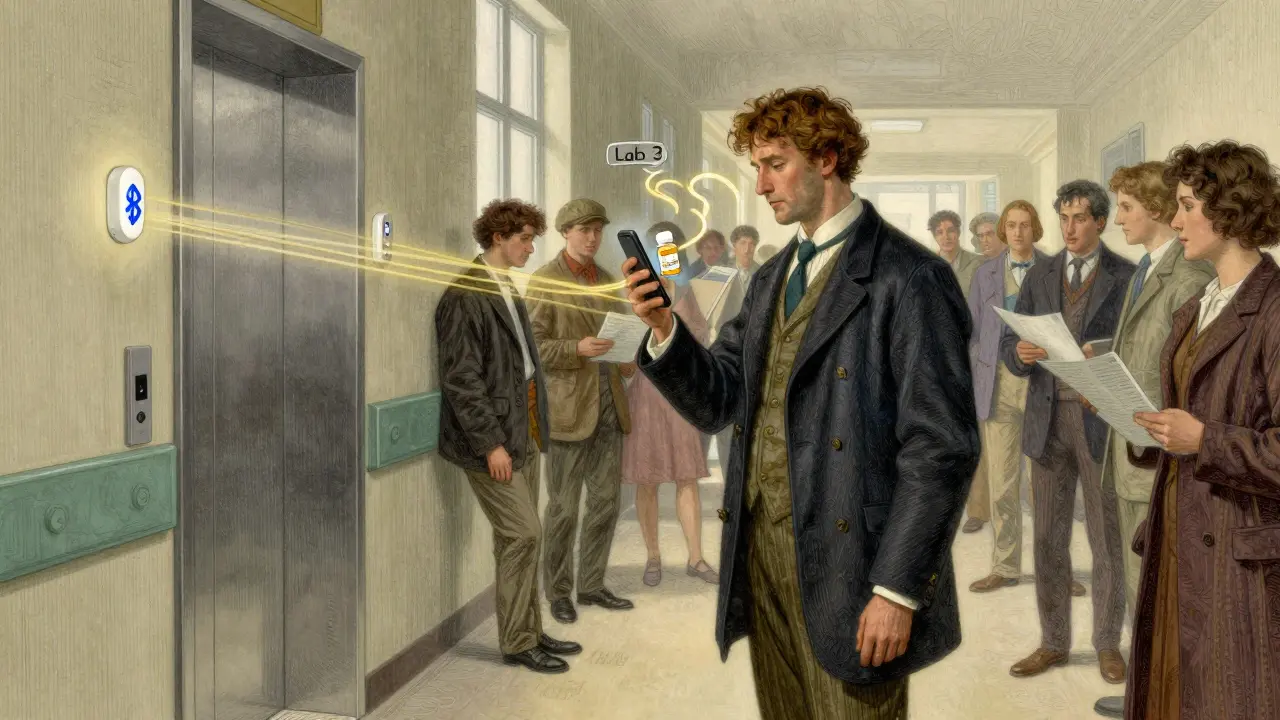
How Patients Are Using These Tools
Real stories show the difference. One patient on Reddit, ‘AccessibilityAdvocate2023,’ shared that after St. Jude’s Hospital rolled out their VisionConnect™ audio system, their confusion before appointments dropped from 67% to 12%. That’s not just convenience. That’s reduced anxiety, fewer missed visits, better outcomes. Another case documented by CMS in 2022 involved a diabetic patient who avoided a hypoglycemic emergency because their audio medication guide reminded them to eat before insulin-something the printed sheet didn’t say clearly. The audio version had emphasis, tone, pauses. It made the difference. But it’s not all success. A 2024 survey by the National Federation of the Blind found that 63% of visually impaired patients still get inconsistent access to audio materials. One hospital gives you a CD. Another says, “Just ask the nurse.” Some don’t have any system at all.Common Problems and Why They Happen
The biggest problem isn’t the tech. It’s the people. A 2023 Lighthouse Guild survey found that 58% of visually impaired patients said hospital staff didn’t know what audio resources were available. Nurses, receptionists, even some doctors never got trained on how to help. So patients are left to figure it out themselves. Then there’s quality. Some hospitals record instructions using robotic, low-quality voices. Others upload files in formats that don’t work with screen readers. A 2023 study found 17% of audio files failed compatibility tests. That’s like giving someone a book in a language they can’t read. Older patients face another hurdle: digital literacy. Only 43% of visually impaired people over 65 feel comfortable using smartphone apps. That’s why free radio services and simple voice-activated systems still matter.
How to Get Started
If you’re a patient or caregiver, here’s how to begin:- Ask your doctor or hospital if they offer audio versions of medical documents. Don’t assume they do.
- Apply for BARD Mobile through the Braille Institute. It’s free and has the most medical content.
- Try Voice Dream Reader or KNFBReader on your phone. Both offer free trials.
- If you’re going to a new hospital, ask if they use RightHear or similar navigation tools.
- Request that your discharge summary be emailed as a text file or sent as an audio recording-not just a printed sheet.
- Train your staff. Simple. Just 30 minutes a month on what audio tools exist and how to refer patients.
- Partner with NLS or Braille Institute to get free audio content.
- Use the CMS OMH checklist for communication access plans. It’s free and covers everything from signage to consent forms.
- Don’t just buy one app. Combine tools: audio navigation + document reader + medical audiobooks.
The Future Is Here
In 2025, things are getting smarter. Mayo Clinic is testing AI that summarizes your medical record into a 90-second audio clip-personalized, plain language, no jargon. You get it by text or voice call after your appointment. CMS is also planning a 2025 rule that will require real-time audio translation for non-English speaking visually impaired patients. That means if you speak Spanish and can’t see, you’ll get your diagnosis in Spanish-spoken aloud, not written. The market for assistive tech is growing fast-$18.9 billion by 2027. But money alone won’t fix this. What fixes it is making sure every patient, no matter how they see the world, gets the same chance to understand their health.Frequently Asked Questions
Are audio resources free for visually impaired patients?
Yes, many are. The National Library Service for the Blind (NLS) offers over 120,000 medical audiobooks and health guides at no cost to eligible users. Apps like CRIS Radio and Spectrum Access are also free. Some tools like Voice Dream Reader and KNFBReader cost money, but they often have free trials. Hospitals are required by law to provide free audio alternatives upon request.
Can I use my phone to listen to my medical records?
Absolutely. Apps like Voice Dream Reader and KNFBReader let you scan or import documents-lab reports, prescriptions, discharge summaries-and have them read aloud. Many electronic health record systems now include audio output as of 2024, thanks to federal law. You can also ask your provider to email your records as a plain text file, which works better with screen readers than PDFs.
What if my hospital doesn’t have audio resources?
Under the Americans with Disabilities Act and Section 504 of the Rehabilitation Act, hospitals must provide auxiliary aids-including audio materials-upon request. If they refuse, ask to speak with their accessibility coordinator. If that doesn’t work, file a complaint with the U.S. Department of Health and Human Services Office for Civil Rights. You have a legal right to accessible information.
Do audio resources work for people who are not tech-savvy?
Yes. Not all solutions require smartphones. CRIS Radio and Spectrum Access broadcast health information over the air-just like a regular radio station. Many hospitals still offer recorded CDs or phone-based systems where you call a number and hear your test results. These low-tech options are often more reliable for older adults or those unfamiliar with apps.
How do I know if an audio file will work with my screen reader?
Look for files in .txt, .mp3, or .wav formats. Avoid PDFs unless they’re tagged for accessibility. Ask the provider if the file was created with screen reader compatibility in mind. If you’re unsure, test it with a free app like Voice Dream Reader or Apple’s VoiceOver. If it reads clearly and in order, it’s usable. If it skips or stutters, ask for a different format.
Is there help for non-English speakers who are visually impaired?
Currently, options are limited, but that’s changing. In 2025, federal rules will require hospitals to provide real-time audio translation for non-English speaking patients with vision loss. Until then, ask if your hospital has bilingual staff or if they can connect you with a telephonic interpreter who can read your documents aloud in your language. Some nonprofit groups, like Lighthouse Guild, offer multilingual audio health guides.
Nancy Kou
December 20, 2025 AT 16:07Audio resources in healthcare aren’t just nice to have-they’re a lifeline. I’ve seen family members struggle with printed discharge papers while blindfolded just to understand how overwhelming it is. The fact that RightHear reduces staff requests by nearly half speaks volumes. This isn’t charity. It’s basic human dignity.
Aboobakar Muhammedali
December 21, 2025 AT 20:48in india we dont even have proper braille signs in hospitals but this post made me realize how much we are missing out on simple tech like voice dream reader. my grandma uses a basic mp3 player for her meds and it works better than anything else. why cant hospitals just give us audio cds instead of making us download apps? not everyone has data or smartphones. just give us the voice. that's all.
Alana Koerts
December 22, 2025 AT 07:16Let’s be real-this whole audio thing is just another government mandate that hospitals will ignore until someone sues them. The 21st Century Cures Act? Yeah right. I’ve been to three hospitals in the last year. Not one offered audio. They just handed me a printed sheet and said ‘call if you have questions.’ Like that’s helpful when you can’t read it.
Meenakshi Jaiswal
December 24, 2025 AT 02:05KNFBReader is a game changer. I used it last month to scan my insulin box when the label was faded. It read the dosage clearly and even emphasized ‘take with food.’ That pause saved me from a bad reaction. If you’re struggling with paper meds-download the free trial. It’s not magic, but it’s close.
Hussien SLeiman
December 25, 2025 AT 22:44Look, I get the sentiment, but this whole post feels like a Silicon Valley PR stunt wrapped in empathy. You list apps like they’re miracles, but what about the 70-year-old woman in rural Ohio who doesn’t own a smartphone? Or the guy who lost his vision after a stroke and can’t afford $99 for an app? You talk about accessibility like it’s a feature, not a right. And don’t even get me started on ‘audio output required by law’-lawyers write laws, not caregivers. The real problem isn’t the tech, it’s that nobody in administration actually talks to the people who need this stuff. You’re preaching to the choir while the choir is still lost in the hospital hallway.
Edington Renwick
December 26, 2025 AT 23:41Did you know that in some states, hospitals are still allowed to charge patients for audio copies of their records? That’s not accessibility. That’s exploitation. And the FDA hasn’t even regulated the quality of these voice synthesizers. I’ve heard recordings that sound like a robot reading a cereal box in a tornado. How is that acceptable? We’re talking about life-or-death information here, and we’re outsourcing it to the cheapest text-to-speech engine on the market. This isn’t innovation. It’s negligence dressed up as progress.
Sarah McQuillan
December 28, 2025 AT 16:05Canada has this stuff. Why doesn’t the US? We’re falling behind. I work in public health and I’ve seen how Europe and Australia are rolling out voice-guided hospital maps as standard. Meanwhile, American hospitals are still printing stuff in tiny font and calling it ‘accessible.’ This isn’t a tech problem-it’s a cultural one. We don’t value disabled people enough to invest in real solutions. And don’t give me that ‘it’s too expensive’ crap. We spend billions on pointless hospital upgrades. Audio? It’s pennies. We just don’t care.
Laura Hamill
December 28, 2025 AT 22:34Who’s really behind all this audio tech? I’ve heard rumors that Google and Apple are pushing this so they can collect voice data on sick people. You think they care about your diabetes? No. They want your voiceprints. Your breathing patterns. Your panic when you can’t find the lab. This is surveillance with a smiley face. And the ‘free’ apps? They’re not free. They’re harvesting your health data so they can sell it to insurers. Wake up.
Tim Goodfellow
December 30, 2025 AT 05:23RightHear is brilliant, but here’s the twist nobody mentions-it only works if your phone’s Bluetooth is on and you’ve got the app installed. What if you’re in a panic? What if your battery dies? What if you’re in a hospital with a thousand rooms and no one tells you the system exists? I’ve seen people stand frozen at a crosswalk in a hospital, whispering ‘where am I?’ because no one bothered to explain the tech. We need human backup. Always. Tech is a tool, not a replacement for care.
Elaine Douglass
December 31, 2025 AT 19:56my dad used to get his meds read to him over the phone by a volunteer from the local blindness org. it wasn’t fancy, but it worked. he trusted them. we need more of that. not apps. people. just a warm voice on the other end saying ‘here’s what your doctor said.’
Lynsey Tyson
January 2, 2026 AT 10:16the fact that we’re still debating whether audio should be mandatory in 2025 is just sad. imagine if we treated mobility the same way-‘oh, you use a wheelchair? here’s a printed map of the stairs.’ we wouldn’t tolerate that. why do we tolerate this?
Connie Zehner
January 3, 2026 AT 08:38you think this is about accessibility? no. this is about liability. hospitals are scared of lawsuits, so they’re slapping on audio like a band-aid. they don’t care if it’s clear, if it’s accurate, if it’s helpful. they just want to check the box. and the worst part? they’ll still blame you if you miss a dose because the voice sounded robotic and you didn’t understand. it’s all performative. they don’t want you to be independent. they just want to be legally safe.
Mahammad Muradov
January 3, 2026 AT 11:35if you’re poor and blind in america you’re not supposed to know about BARD Mobile. you’re supposed to suffer quietly. the fact that this post makes it sound like everyone can just apply and get help is laughable. the waiting list is 18 months. the application requires notarized documents. you need internet to apply. you need someone to help you fill it out. so who gets it? the ones who already have help. the rest? they’re left with paper and prayers. this isn’t progress. it’s a cruel joke.