


- 12
Biologic drugs have transformed how we treat cancer, autoimmune diseases, and rare conditions. But while these medications save lives, their prices often leave patients struggling to afford them. The reason? A legal and regulatory system designed to delay competition from biosimilars - cheaper, highly similar versions of these complex drugs. In the U.S., that delay can last up to 12 years after a biologic first hits the market. That’s not a mistake. It’s the rule.
How Long Must You Wait for a Biosimilar?
The Biologics Price Competition and Innovation Act (BPCIA) of 2009 set the rules. Under this law, once the FDA approves a new biologic - say, Humira or Enbrel - the manufacturer gets two layers of protection. First, there’s a 4-year data exclusivity period. During this time, no biosimilar company can even submit an application to the FDA. Then comes the 12-year market exclusivity period. Even if a biosimilar application gets submitted after year four, the FDA can’t approve it until 12 years have passed.
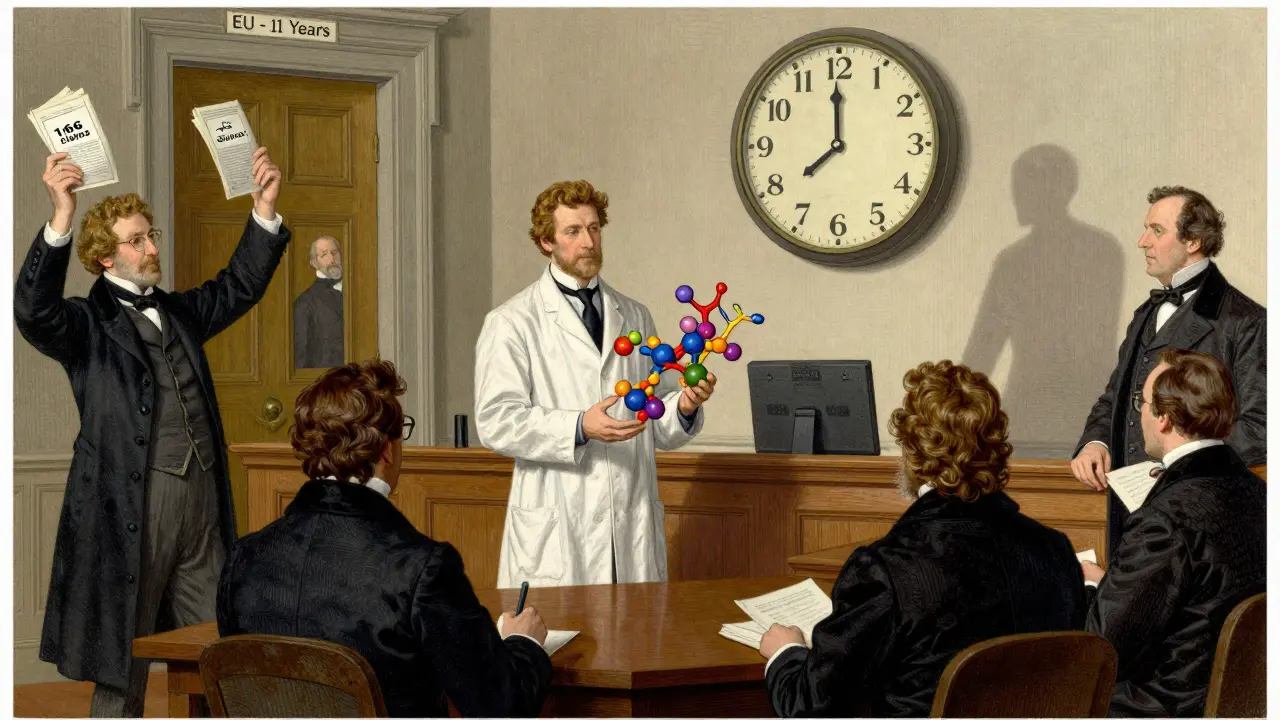
This isn’t just paperwork. It’s a 12-year monopoly. And it’s longer than almost anywhere else. In the European Union, biosimilars can enter after 10 years of data protection plus one year of market exclusivity - 11 total. Japan matches the U.S. at 12 years. South Korea gives 10 years of data protection but no extra market delay. The U.S. system was built to reward innovation, but it’s also built to delay competition.
The Patent Dance: A Legal Maze
Even after the 12-year clock starts ticking, biosimilar companies face another hurdle: the "patent dance." This isn’t a dance at all - it’s a multi-step legal process that can drag on for years.
When a biosimilar maker submits its application, it must send all its manufacturing and clinical data to the original drugmaker within 20 days. The original company then has 60 days to list every patent they think might be violated. The biosimilar maker responds with a detailed legal argument for why each patent is invalid or doesn’t apply. Then both sides enter 15 days of negotiations to pick which patents to fight over in court.
It sounds fair. But in practice, it’s a tool for delay. Take Humira. Its main patent expired in 2016. But AbbVie, the maker, piled on 166 additional patents - many covering minor changes in dosage, delivery, or manufacturing. Each one became a new legal battle. By the time the first U.S. biosimilar entered in 2023, Humira had been on the market for 22 years. In Europe, biosimilars started appearing in 2018. American patients paid 300% more during that gap.
Why Are So Few Biosimilars Coming?
Developing a biosimilar isn’t like making a generic pill. You can’t just copy the formula. Biologics are made from living cells - proteins, antibodies, sometimes entire cell therapies. Even tiny changes in how they’re made can affect safety or effectiveness. So manufacturers must prove they’re "highly similar" with "no clinically meaningful differences." That means expensive lab work, complex clinical trials, and years of testing.
According to Pfizer’s 2022 manufacturing report, it takes 5 to 9 years and over $100 million to bring a biosimilar to market. For the most complex biologics - like antibody-drug conjugates or gene therapies - costs can hit $250 million. That’s 50 to 100 times more than a typical generic drug.
And the payoff isn’t always worth it. A 2023 report from the Biosimilars Council found that 88% of biologics with orphan drug status - meaning they treat rare diseases - have no biosimilars in development. Why? Because the patient pool is small. Companies don’t see enough profit to justify the risk. Meanwhile, 118 biologics are set to lose patent protection between 2025 and 2034. But only 12 of them currently have biosimilars being developed.
The Cost to Patients
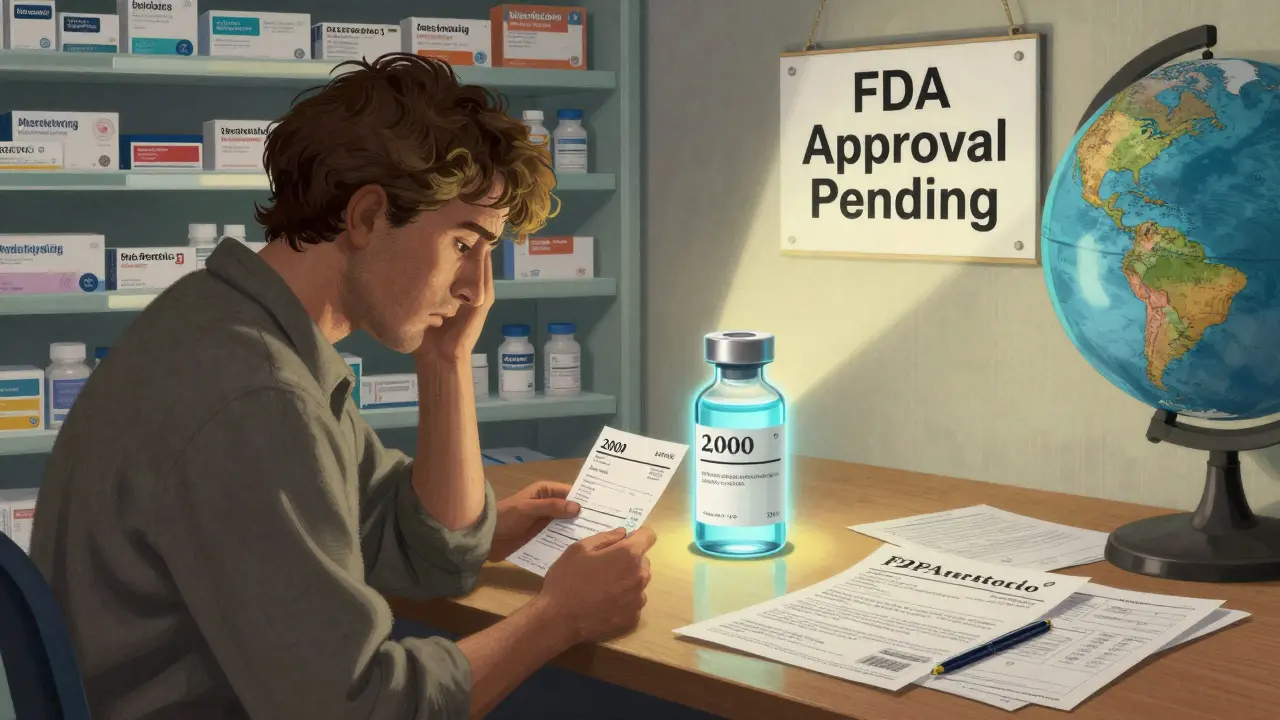
Patients aren’t just paying more. They’re skipping treatment entirely. A 2022 survey by the National Community Pharmacists Association found that 63% of pharmacists had patients who stopped using their biologic because they couldn’t afford it. One patient with rheumatoid arthritis might pay $2,000 a month for Humira in the U.S. - the same drug costs $500 in Germany after biosimilars entered.
Between 2012 and 2022, Humira’s list price in the U.S. jumped 470%. In Europe, it stayed flat. That gap isn’t about innovation. It’s about monopoly power. The Congressional Budget Office estimated that if we removed the barriers slowing biosimilars, the U.S. could save $158 billion over the next decade. Under current rules? Just $71 billion.
What’s Being Done?
The FDA has tried. Their 2022 Biosimilars Action Plan promised better communication, faster reviews, and more market support. But progress has been slow. Since 2015, the U.S. has approved only 38 biosimilars. Europe has approved 88. And while the FDA is working on streamlining the process, Congress hasn’t passed meaningful reform. A bill in 2022 to reduce regulatory burdens stalled in committee.
Meanwhile, innovator companies keep filing new patents. Some are legitimate. Many are not. The system rewards legal strategy over patient access. And with 16 complex biologics - including next-generation cancer drugs and gene therapies - set to expire between 2025 and 2034, we’re staring at another wave of delayed competition.
What’s Next?
There’s no magic fix. But change is possible. If the U.S. shortened the exclusivity period to 10 years - matching Europe - biosimilars would enter years earlier. If regulators gave more clarity on what "highly similar" really means, developers could cut costs. If payers and pharmacies started pushing biosimilars as much as generics, demand would rise.
Right now, the system protects profits more than patients. But the science is here. The demand is real. And the cost of waiting is measured in lives - and lost treatments.
How long does it take for a biosimilar to enter the U.S. market after a biologic is approved?
Under U.S. law, a biosimilar cannot be approved until 12 years after the original biologic was first approved by the FDA. However, biosimilar manufacturers can submit their application after 4 years. The 12-year clock starts on the date of the reference product’s first licensure, and this period can be extended by 6 months if the manufacturer conducts pediatric studies.
What’s the difference between a biosimilar and a generic drug?
Generics are exact copies of small-molecule drugs, made from chemical compounds. Biosimilars are highly similar versions of complex biologic drugs made from living cells. They’re not identical - even small changes in manufacturing can affect their behavior. That’s why biosimilars require more testing, including clinical trials, to prove they work the same way in patients.
Why are there so few biosimilars for rare disease drugs?
Most rare disease biologics have small patient populations, which means limited sales potential. Developing a biosimilar costs over $100 million and takes 5-9 years. For drugs treating only a few hundred patients, that investment rarely makes financial sense. As a result, 88% of expiring biologics with orphan drug status have no biosimilars in development.
Can biosimilars be used interchangeably with the original biologic?
The FDA can designate a biosimilar as "interchangeable," meaning it can be substituted for the original without a doctor’s approval. But so far, only a handful of biosimilars have received this status. Most require a prescription for the specific product. Pharmacists cannot automatically swap them unless they’re labeled as interchangeable.
Do other countries have shorter exclusivity periods?
Yes. The European Union offers 10 years of data exclusivity and 1 year of market exclusivity - 11 total. Japan matches the U.S. at 12 years. South Korea gives 10 years of data exclusivity with no additional market delay. The U.S. has one of the longest exclusivity periods in the world, which is why many biologics enter European markets years before the U.S.
Donnie DeMarco
March 13, 2026 AT 06:17Bro, 12 years is insane. I get patents are supposed to incentivize innovation, but when your drug costs $2k/month and people are skipping insulin because of it, we’re not talking science-we’re talking corporate greed in a lab coat.
And don’t even get me started on the ‘patent dance.’ It’s not a dance, it’s a slow-motion chokehold. AbbVie filed 166 patents on Humira? That’s not innovation-that’s legal jiu-jitsu. Meanwhile, patients are dying on waiting lists while lawyers sip lattes.
Europe got biosimilars in 2018. We got them in 2023. And we still act like we’re the global health leader? Nah. We’re the land of overpriced Band-Aids with PhDs.
It’s not that biosimilars are hard to make-it’s that the system is rigged to make them hard to *sell*. Pharma doesn’t fear competition. They fear transparency.
I’ve seen friends choose between rent and their biologics. That’s not a healthcare system. That’s a casino with IV drips.
And yeah, developing biosimilars costs a fortune. But $250M? For a drug that’s literally just a protein with a different label? Come on. That’s not R&D-that’s extortion by R&D.
Why aren’t we screaming about this? Why is this not on the nightly news? Because the lobbyists own the airwaves. And the patients? We’re just noise in the system.
Someone needs to burn the whole playbook down. Not reform. Not tweak. Burn it. Then rebuild it around patients, not profit margins.
Also-why does the FDA approve 38 biosimilars while Europe approves 88? Are we just bad at our jobs? Or is it intentional?
I’m not mad. I’m just… disappointed. And honestly? That’s worse.
LiV Beau
March 13, 2026 AT 23:01Okay but can we talk about how wild it is that we’re still having this conversation in 2025? 🤯
I mean, we have AI that can predict protein folding now. We have labs that can replicate complex biologics with 99.9% accuracy. Yet we’re stuck in a 12-year legal quagmire because someone decided ‘monopoly = innovation’?
And the ‘interchangeable’ status? Only a handful have it? That’s like saying ‘this generic painkiller is safe to swap’ but ‘this lifesaving biologic? Nah, better stick with the original, even if it’s 4x the price.’
Also-88% of orphan drug biosimilars aren’t even being developed? That’s not a market failure. That’s a moral failure.
Why aren’t we incentivizing these? Tax breaks? Government funding? Patent pools? We could fix this. We just choose not to.
And don’t even get me started on how the ‘patent dance’ is just a way to drag out litigation until the patient gives up. 😔
It’s not that I’m angry. It’s that I’m tired. And I’m so, so tired of being told ‘this is how it is’ when it’s clearly not how it should be.
Adam Kleinberg
March 15, 2026 AT 01:33Let’s be real-this whole biosimilar thing is just Big Pharma’s way of keeping the public dumbed down while they siphon off billions
And don’t tell me about ‘complex manufacturing’-they’ve been lying about that since the 90s. You think they can’t replicate a protein? Please. They’ve had the tech for 20 years. They just don’t want to
12 years? That’s not a law. That’s a bribe. Paid to Congress. Paid to FDA. Paid to every lobbyist with a Yale degree
And now they’re using ‘orphan drugs’ as an excuse? Oh please. That’s just a smokescreen. They don’t care about rare diseases. They care about the ones that make the most money
Meanwhile, people in Canada and Germany are paying 1/3 the price and living longer
So who’s really the enemy here? Not the manufacturers. Not the regulators
It’s the system. And the system is corrupt
Wake up. This isn’t healthcare. It’s a racket
Denise Jordan
March 16, 2026 AT 03:28So… we’re mad because drugs are expensive? Newsflash: everything’s expensive.
Why not just make your own biologic? It’s not like it’s rocket science.
Also, why are we even talking about this? Isn’t there, like, a TikTok trend or something more important?
Gene Forte
March 16, 2026 AT 23:17Every innovation deserves protection-but not at the cost of human life.
Biologics have changed the trajectory of cancer survival, autoimmune care, and rare disease outcomes. That’s monumental.
But when the price of progress becomes a barrier to survival, we must ask: what are we protecting?
The answer is not innovation. It’s profit.
We have the science. We have the capacity. We have the moral obligation.
Reducing exclusivity from 12 to 10 years wouldn’t kill innovation-it would redirect it.
Imagine if the same energy spent on patent stacking were spent on next-generation therapies.
Imagine if biosimilar manufacturers had clearer pathways, not legal labyrinths.
Imagine if pharmacists could substitute without fear.
This isn’t about lowering standards. It’s about raising access.
Let’s not confuse corporate strategy with public health.
We can do better. We must.
Chris Bird
March 17, 2026 AT 22:46USA is just too soft on pharma. They get 12 years? In Nigeria, if you fake a drug, you go to jail
Here? You get a press conference and a tax break
Why? Because Americans love to pay
They don’t care about cost. They care about brand
Humira? Yeah, it’s expensive. But it’s *their* Humira
That’s the real problem
Not the law. The culture
Alexander Erb
March 18, 2026 AT 12:08Just want to say-I work in biotech logistics. We ship biosimilar components daily. The science is there. The factories are ready. The demand is screaming.
The only thing holding us back? Paperwork. And lawyers.
One of our clients spent 3 years just navigating the ‘patent dance’ before they could even start clinical trials.
Meanwhile, their CEO was on the phone with patients who couldn’t afford their meds. One woman said, ‘I’m choosing between my kid’s college fund and my arthritis shot.’
We could fix this. We’re not trying.
Also-side note: biosimilars aren’t ‘copies.’ They’re *recreations*. Like a symphony played by a different orchestra. Same notes. Different soul.
And yeah, they’re expensive to make. But so was the first iPhone. Now you can buy one for $200.
Competition lowers prices. Always.
Let’s stop pretending this is about safety. It’s about supply chains and shareholder meetings.
Tom Bolt
March 18, 2026 AT 19:2612 years. 166 patents. $158 billion in potential savings. And yet Congress can’t even pass a bill that says ‘maybe stop letting drug companies turn the FDA into a legal chessboard.’
This isn’t just broken. It’s an insult.
Every time a patient skips a dose because they can’t afford it, someone in a boardroom in New Jersey does a happy dance.
And we call this ‘innovation’?
No. We call it theft.
With a patent.
Shourya Tanay
March 19, 2026 AT 23:44As someone who works in biologics R&D in India, I can confirm the technical feasibility of biosimilar development is not the barrier-it’s the regulatory ambiguity and IP entanglement.
The term ‘highly similar’ lacks operational clarity. What does ‘no clinically meaningful difference’ actually mean in practice? Is it statistical equivalence? Non-inferiority? Real-world outcomes?
Without standardized biomarkers or surrogate endpoints, developers are flying blind.
And the orphan drug exclusion? It’s not just about small markets-it’s about risk aversion. The cost of failure is catastrophic. No investor wants to fund a $200M project that might get blocked by a 10-year-old patent on a vial label.
We need a global harmonization framework. Not more U.S.-centric rules.
Also-the ‘patent dance’ is a regulatory artifact. It predates modern biologics. It’s like using a rotary phone to code AI.
Time for a protocol update.
Kenneth Zieden-Weber
March 21, 2026 AT 10:56Ohhh so now we’re surprised that when you give a monopoly 12 years of monopoly pricing… they *use it*? 🤡
Shockingly, corporations behave like corporations.
They didn’t build 166 patents because they’re noble. They did it because they could.
And we let them.
So now we’re shocked that patients can’t afford treatment?
Let me guess-next you’ll be mad that the sun rises in the east.
Maybe instead of crying about it, we should start demanding structural reform.
Like, you know, breaking up Big Pharma.
Just a thought.
David L. Thomas
March 22, 2026 AT 20:51One thing I’ve noticed: the FDA’s approval timeline for biosimilars has actually improved since 2020. Review times are down 30%.
But the bottleneck isn’t the FDA-it’s the litigation. The patent dance alone adds 2–4 years.
And with orphan drugs, the issue isn’t just cost-it’s heterogeneity. A biosimilar for a rare autoimmune condition might need 10,000 patient-years of real-world data to prove equivalence. That’s not feasible.
Maybe we need tiered pathways: accelerated approval for high-impact biosimilars, with post-market surveillance instead of pre-market perfection.
Also-patients don’t care if it’s ‘identical.’ They care if it works and if they can afford it.
Let’s stop letting perfect be the enemy of possible.
Bridgette Pulliam
March 23, 2026 AT 06:26As a former oncology nurse, I’ve watched patients cry because they couldn’t afford their biologics.
I’ve held hands while they chose between rent and their infusion.
I’ve seen families sell their cars.
This isn’t policy. This is trauma.
The science is ready. The need is urgent.
The only thing missing? The will.
We have the tools to fix this.
What we lack is the courage to use them.