
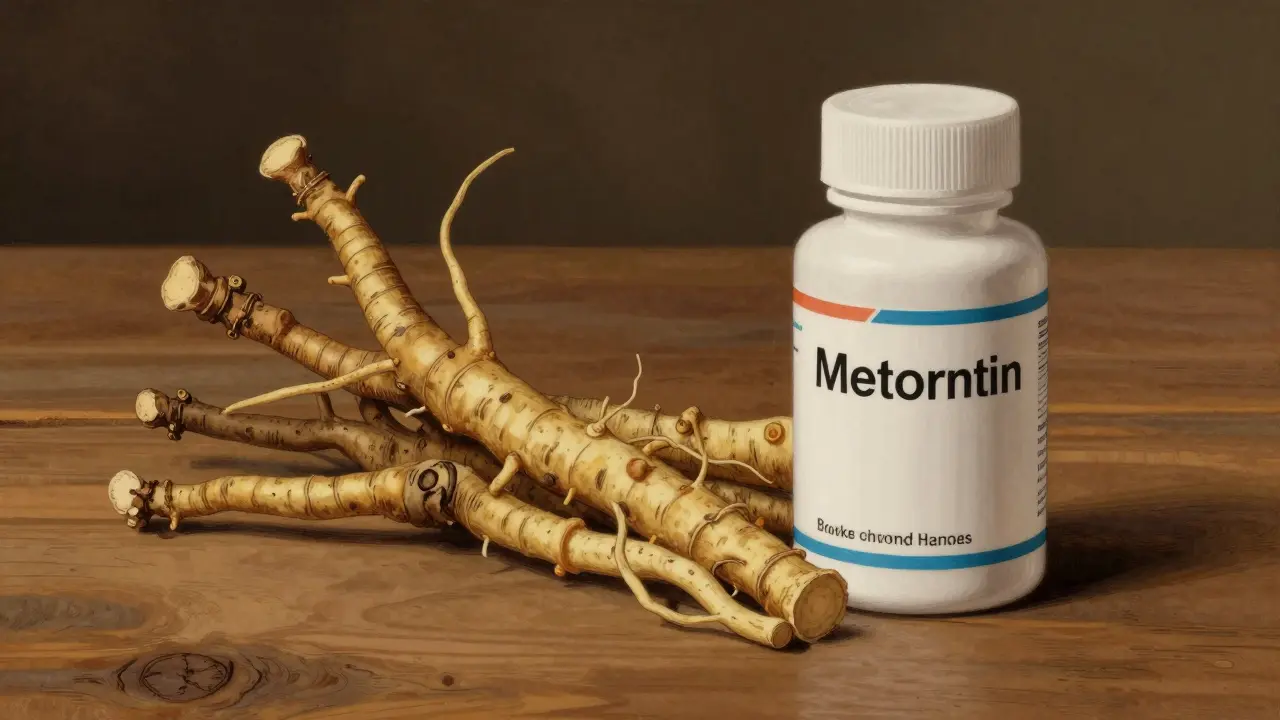

The core of the problem is that Goldenseal doesn't just sit quietly in your stomach. It interferes with the way your gut moves Metformin into your bloodstream. This isn't about your liver or kidneys failing; it's a transport issue. Essentially, the herb blocks the "doors" (known as intestinal transporters) that the medicine needs to enter your system. If the medicine can't get in, it can't do its job of lowering your glucose.
How Goldenseal Changes Your Medication Levels
Not everyone experiences this interaction in the same way. Research shows that the risk depends heavily on how much Metformin you take. In a clinical study published in 2025, researchers found that the interaction is most aggressive at lower doses. If you're taking 500 to 750 mg daily, Goldenseal can drop the maximum concentration of the drug in your blood by about 25%. That is a significant chunk of your medication simply vanishing before it ever reaches your system.
Interestingly, the effect fades as the dose increases. For those on moderate doses (1000-1500 mg), the drop is smaller, around 14%. If you're on a high dose (over 2000 mg), the interaction almost disappears entirely. This happens because the transport mechanisms in your gut eventually get saturated-basically, there is so much medication that the Goldenseal can't block it all.
| Metformin Daily Dose | Reduction in Max Concentration (Cmax) | Interaction Risk Level |
|---|---|---|
| 500 - 750 mg | ~25% Decrease | High |
| 1000 - 1500 mg | ~14% Decrease | Moderate |
| 2000 - 2550 mg | ~0% (No significant change) | Low/None |
The Berberine Paradox: Good or Bad?
Here is where it gets confusing. Goldenseal contains Berberine, a compound that is actually famous for lowering blood sugar on its own. This creates a "tug-of-war" in your body. On one hand, Goldenseal blocks Metformin, which could make your blood sugar rise. On the other hand, the Berberine inside the Goldenseal may lower your blood sugar independently.
In some patients, this creates a masking effect. You might see your HbA1c (your three-month average blood sugar) stay stable or even improve, even though there is less Metformin in your blood. This is dangerous because it gives a false sense of security. You might think your medication is working perfectly, while in reality, your body is relying on an unregulated supplement to keep you stable. If you suddenly stop taking the supplement, your blood sugar could spike unexpectedly.
Why Your Gut Transporters Matter
To understand why this happens, we have to look at Organic Cation Transporter 1 (OCT1). Think of OCT1 as a specialized shuttle service in your intestinal wall that carries Metformin from your gut into your blood. Goldenseal competes for the same shuttle. When Goldenseal occupies the shuttle, Metformin gets left behind and is eventually flushed out of your system without ever being absorbed.
This is a different mechanism than how grapefruit juice works. Grapefruit interferes with enzymes in the liver (like CYP3A). Goldenseal does that too, but for Metformin, the real action is happening in the intestines. This means that no matter how healthy your liver is, the interaction still happens because it occurs before the drug even hits your bloodstream.
Signs Your Supplements Are Interfering
Since the interaction can be subtle, you have to watch for specific red flags. If you've started a new herbal regimen and notice a steady climb in your fasting glucose levels, it's a sign that your Metformin levels might be dipping. Even if you haven't changed your diet or exercise, a supplement like Goldenseal can either mimic or counteract your meds.
The MSD Manual Professional Edition warns that this combination can hinder glucose control. Because the effect becomes statistically significant after about six days of use, you might not notice a change immediately. Keep a close eye on your glucose logs during the first two weeks of starting any new botanical supplement.
Practical Steps for Safe Management
If you are currently taking both, don't panic, but do take action. The most important step is transparency with your doctor. Many people don't list herbal supplements on their medical forms because they don't think they count as "drugs," but as we've seen, they absolutely affect drug chemistry.
- Audit your supplements: Check your labels for "Hydrastis canadensis" (the scientific name for Goldenseal).
- Monitor glucose: Use a continuous glucose monitor (CGM) or a finger-stick meter more frequently when starting or stopping supplements.
- Discuss dosing: If you are on a low dose of Metformin (under 1000 mg), you are at the highest risk for this interaction.
- Consider alternatives: If you want the blood-sugar-lowering benefits of berberine, ask your doctor about standardized berberine extracts, which may be more predictable than whole-root Goldenseal.
The Bigger Picture of Herbal Risks
This interaction highlights a broader issue in diabetes care. Roughly 35-40% of people with diabetes use some form of herbal supplement. While the desire to integrate natural remedies is understandable, the lack of regulation in the supplement industry means the potency of Goldenseal can vary wildly between brands. One bottle might have a mild effect, while another could significantly slash your Metformin absorption.
The American Diabetes Association recommends a routine assessment of all supplements as part of a care plan. This isn't about avoiding natural health, but about ensuring that your natural choices aren't accidentally sabotaging your medical treatment.
Will Goldenseal cause my blood sugar to crash?
It is possible. Because Goldenseal contains berberine, which has its own glucose-lowering effects, it can act additively with Metformin. Even though it reduces the amount of Metformin in your blood, the berberine itself might lower your sugar too much, leading to hypoglycemia.
Can I just take Goldenseal and Metformin at different times of the day?
While spacing them out might help some medications, the interaction with intestinal transporters like OCT1 can be more persistent. The most reliable way to avoid the risk is to consult your physician about whether the supplement is necessary for your specific health goals.
Is berberine a safe replacement for Metformin?
Berberine shows promise in lowering fasting glucose and HbA1c, but it is not a regulated replacement for prescription Metformin. You should never swap your medication for a supplement without a doctor's supervision, as this can lead to severe hyperglycemia.
Does this interaction affect my kidneys?
No. Clinical research indicates that renal clearance and the elimination half-life of Metformin remain unchanged. The interaction happens exclusively during the absorption phase in the intestines.
Why does the interaction disappear at high doses of Metformin?
This is due to "saturable transport." Your gut has a limited number of OCT1 transporters. At high doses of Metformin, there is so much medication that it overwhelms the transporters, leaving plenty of room for the drug to be absorbed even if Goldenseal is trying to block the way.