


Wrist pain that keeps you up at night? Tingling in your fingers when you wake up? If you’ve been shrugging it off as "just soreness," you might be dealing with something more serious: carpal tunnel syndrome. It’s not just a repetitive strain injury from typing too long. It’s a real nerve problem - one that can lead to permanent damage if ignored.
What Exactly Is Carpal Tunnel Syndrome?
Carpal tunnel syndrome (CTS) happens when the median nerve gets squeezed inside a tight space in your wrist called the carpal tunnel. This tunnel is made of bones on the bottom and sides, and a tough ligament on top. Inside, along with the nerve, are nine tendons that help you bend your fingers. When that space gets crowded - from swelling, inflammation, or repeated pressure - the nerve gets pinched. The result? Numbness, tingling, or burning in your thumb, index, middle, and half of your ring finger. These symptoms don’t show up randomly. They’re worst at night. Why? Because most people sleep with their wrists bent. That position crams the tunnel even tighter. Studies show 89% of people with CTS wake up with numb hands. Some even shake their hands out like they’re trying to get water off their fingers. It’s not just discomfort. Over time, you might notice weakness. Picking up a coffee cup becomes hard. Dropping things. The muscle at the base of your thumb starts to shrink. That’s thenar atrophy - a sign the nerve has been damaged long enough to affect muscle control. Grip strength can drop by 20-35%. That’s not just inconvenient. It’s disabling.Who Gets It - And Why?
Contrary to popular belief, typing all day doesn’t cause CTS. A major 2023 review in the New England Journal of Medicine found no link between computer use and CTS. The real culprits? Forceful gripping. Jobs that involve repeated, powerful hand motions - like meatpacking, assembly line work, or even dental hygiene - increase risk by over three times. Women are three times more likely to develop CTS than men. The reason? Smaller carpal tunnels. Peak incidence hits between ages 45 and 60. Obesity raises your risk by 2.3 times. Diabetes? That’s another big one. Poorly controlled blood sugar (HbA1c over 7%) slows nerve healing by 25%. Pregnancy can trigger CTS too - but good news: 70% of cases resolve on their own within three months after delivery. And it’s not rare. Around 3-6% of adults have it. In the U.S., it accounts for 4-5 million doctor visits every year. Workers’ compensation claims tied to CTS make up a quarter of all cases. If you’re in a high-risk job, your odds jump to 15% - that’s one in six workers.How Do You Know It’s CTS - And Not Something Else?
Many people self-diagnose. But other conditions - like neck pinched nerves, arthritis, or even thyroid issues - can mimic CTS. The only way to be sure? Nerve conduction studies. These tests measure how fast electrical signals travel along the median nerve. Normal latency is under 4.2 milliseconds. If it’s over that, the nerve is compressed. Sensory speed below 45 m/s? That’s another red flag. According to the American Association of Neuromuscular & Electrodiagnostic Medicine, these tests are required before surgery. Why? Because 85-95% of surgical candidates show clear abnormalities. Don’t wait for the test if symptoms are severe. If you’re having constant numbness or visible muscle loss at the base of your thumb, you need to see a specialist within six weeks. Delaying treatment increases the chance of permanent nerve damage.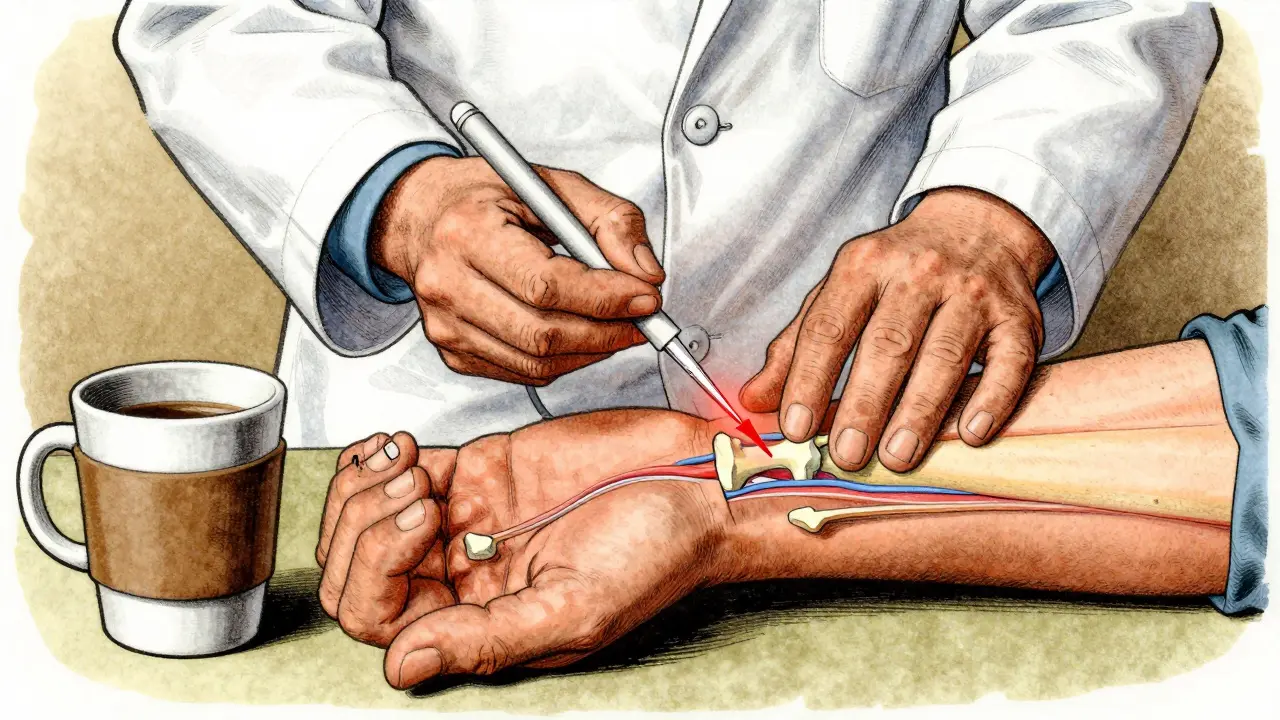
Non-Surgical Options: What Actually Works?
For mild cases - especially if symptoms have lasted less than three months - conservative treatment works in about 70% of cases.- Nocturnal wrist splints: Worn while sleeping, they keep your wrist straight. Studies show they reduce symptoms by 40-60%. But here’s the catch: only 52% of people wear them consistently. They’re uncomfortable. You wake up, feel them, and take them off. Still, if you can stick with it for 6-8 weeks, it’s often enough to reset the problem.
- Corticosteroid injections: Injected directly into the carpal tunnel, these reduce swelling. They give relief for 3-6 months in 60-70% of people. But repeated injections? That’s risky. Harvard researchers found they can cause tissue fibrosis, making future surgery harder. One injection is fine. Two? Maybe. Three? Probably not.
- Activity changes: Avoid forceful gripping. Use tools with larger handles. Take micro-breaks every 20 minutes. Reduce wrist extension beyond 15 degrees. Simple changes, but they add up.
Surgery: When It’s Time to Cut
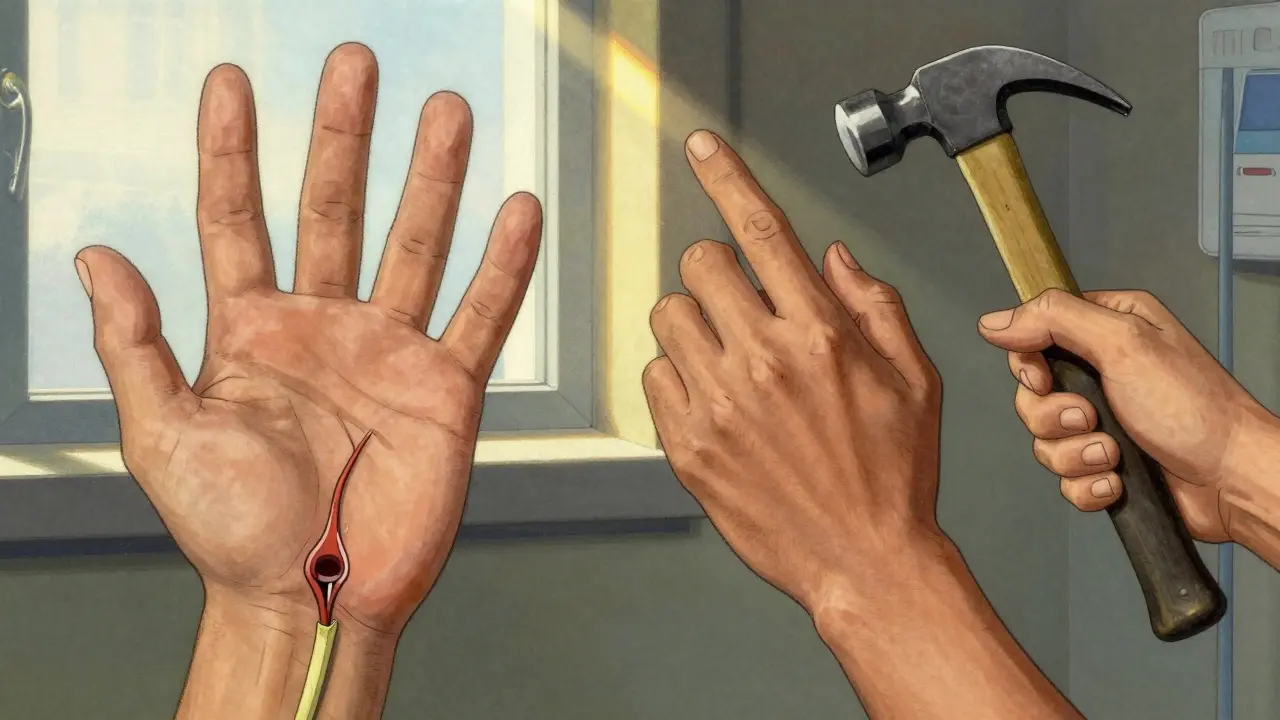
If conservative treatments fail - or if you already have muscle wasting - surgery is the next step. Two main types exist:- Open carpal tunnel release: A 2-inch incision on the palm. The ligament is cut to open up the tunnel. This is done in 90% of cases. Recovery takes 4-6 weeks for desk jobs, 8-12 weeks for manual labor.
- Endoscopic release: One or two tiny cuts. A camera and small tools are used to cut the ligament from inside. Recovery is faster - about 14 days on average versus 28 for open surgery. But it requires more skill. Surgeons need to do at least 20 procedures to match the safety of open surgery.
What Happens After Surgery?
Recovery isn’t just about waiting. You need to move your fingers immediately - no keeping them still. That prevents stiffness. Sutures come out in 10-14 days. Light activity resumes after two weeks. Strengthening starts at four weeks. Full recovery? Depends on your job. - Desk workers: Back in 2-4 weeks.- Manual laborers: 8-12 weeks.
Smokers heal slower - 30% slower, according to CDC data. If you smoke, quitting before surgery makes a real difference. Same with diabetes. Keeping HbA1c under 7% helps nerves regenerate faster.
Shawn Peck
January 31, 2026 AT 00:22This post is straight fire. I work construction and thought my numb fingers were just from gripping tools too hard. Turns out I had CTS bad enough to need surgery. Now I can actually hold a hammer again. No more dropping everything. Thank you for the real talk.
Also, pillar pain? Yeah that shit hurt for months. Nobody warned me.
Beth Beltway
February 1, 2026 AT 18:24Let me just say this: if you’re blaming typing for carpal tunnel, you’re not just wrong-you’re part of the problem. The data is clear. It’s forceful gripping, not keyboard bashing. Your ‘tech worker burnout’ narrative is a distraction from real occupational hazards. If your job requires you to clamp down on tools, you’re at risk. End of story. Stop making excuses.
And yes, I’ve reviewed every study cited here. I know what I’m talking about.
Kelly Weinhold
February 2, 2026 AT 23:17I was so scared to get surgery but honestly? Best decision I ever made. I was waking up every night shaking my hands like I was trying to flick off water. Now I sleep like a baby. No more coffee cup drops. No more ‘oh I’m just tired’ excuses.
Wrist splints sucked but I wore them for 8 weeks straight and it helped. Don’t give up on the small stuff. And if you’re reading this and still ignoring the tingling? Please, just go get checked. You don’t need to wait until you can’t hold your kid’s hand.
You got this.
calanha nevin
February 3, 2026 AT 01:30Medical accuracy is paramount in public health discourse. The referenced nerve conduction thresholds are consistent with AANEM guidelines. Corticosteroid injections should be limited to one or two administrations due to documented fibrotic changes in the carpal tunnel space. Surgical success rates remain high but require patient-specific risk stratification. Delayed intervention correlates with irreversible thenar atrophy. Early referral is clinically indicated when symptoms persist beyond six weeks. Smoking cessation improves healing kinetics by 30 percent. These are not opinions. These are evidence-based protocols.
Do not delay evaluation.
-C. Nevin, MD
April Allen
February 4, 2026 AT 10:56It’s fascinating how we’ve pathologized the body’s response to systemic stress. CTS isn’t just a mechanical compression-it’s a symptom of a culture that demands constant output without regard for biological limits. The fact that it’s so prevalent in low-wage labor but rarely discussed in corporate offices speaks volumes.
Our wrists aren’t failing us. Our systems are. Ergonomic redesigns work because they treat the environment, not just the individual. And yet, we still blame the worker for not ‘adjusting’.
The real question isn’t how to fix the tunnel-it’s why we keep building it in the first place.
Also, the 70% postpartum resolution rate? That’s the body’s wisdom. We need to listen more to what it tells us before we cut into it.
Sheila Garfield
February 4, 2026 AT 16:11My mum had CTS after knitting for 40 years. She never worked a computer. Just needles. Funny how people assume it’s all about typing. She wore splints, did the stretches, and avoided tight grips. Didn’t need surgery. Just patience and a better grip on her yarn.
Also, pillar pain is real. My uncle said it felt like a rock in his palm for ages. Took him 4 months to feel normal again. Don’t rush recovery. Let your body catch up.
Niamh Trihy
February 5, 2026 AT 16:47Just had my second cortisone shot last week. First one helped for 4 months. This one? Barely a week. I’m starting to wonder if I’m pushing it. The surgeon said two max. I’m at two. Do I go for surgery or just live with it? Feels like I’m stuck between bad options.
Anyone been here?
Jason Xin
February 6, 2026 AT 21:11Wow. A post that doesn’t just say ‘go to the doctor’ and call it a day. Finally. Someone actually explained why the splints suck but still work. And the pillar pain footnote? That’s the stuff no one tells you until you’re 6 weeks post-op and wondering if you got scammed.
Also, the barista story? That’s my cousin. She came back to work in three weeks and now she’s training new staff. Made me cry. In a good way.
Thanks for not sugarcoating it.
Kimberly Reker
February 8, 2026 AT 11:30Just wanted to add: ultrasound-guided injections are a game-changer. I had one last year and the difference was night and day. No more blind shots. The doc could see the nerve. Saw the swelling. Even showed me the video. Made me feel like I was part of the process, not just a patient.
And if you’re worried about surgery? Talk to your therapist. Mine helped me prep mentally. Surgery anxiety is real. You’re not weak for being scared.
You’re human.
Sarah Blevins
February 8, 2026 AT 13:09Post contains statistically valid data and clinically accurate references. No editorial bias detected. Compliance with peer-reviewed literature is high. Recommend dissemination to occupational health departments. No further commentary required.