


- 9
When you pick up a generic drug at the pharmacy, you expect it to work just like the brand-name version. That’s the promise. But for some medicines - especially those that are complex - proving they’re truly equivalent isn’t just hard. It’s often like trying to reverse-engineer a locked safe without the combination, or matching a recipe you’ve never seen, just by tasting the final dish.
What Makes a Generic Drug "Complex"?
Not all generics are the same. Most are simple copies of small-molecule drugs - pills with one active ingredient and a few common fillers. These are easy to test. You give them to volunteers, measure how much of the drug shows up in their blood over time, and compare it to the brand-name version. If the numbers match within strict limits (80% to 125% for AUC and Cmax), the FDA approves it. But complex generic formulations are different. These are drugs that don’t just enter the bloodstream. They act locally - on the skin, in the lungs, in the eye, or deep inside the body via special delivery systems. Think of asthma inhalers, topical creams for eczema, eye drops for glaucoma, or injectable gels that release medicine slowly over weeks. These aren’t just pills with a different label. They’re engineered systems. The FDA defines complex generics as products with:- Complex active ingredients - like peptides, proteins, or natural extracts
- Complex formulations - liposomes, nanoparticles, emulsions, or gels
- Complex delivery routes - inhalers, transdermal patches, eye/ear/nose sprays
- Complex dosage forms - extended-release injectables or metered-dose inhalers
- Drug-device combinations - inhalers with precise actuators, auto-injectors, or patch systems
The Bioequivalence Problem: Blood Levels Don’t Tell the Whole Story
Bioequivalence means the generic drug delivers the same amount of medicine, at the same speed, to the same place as the brand. For oral pills, that’s measured in blood. But for a topical cream meant to treat psoriasis? The drug doesn’t need to enter the bloodstream. It needs to penetrate the top layers of skin and stay there. Measuring blood levels tells you nothing about whether the cream works. Same goes for inhalers. The goal isn’t to get drug into your blood - it’s to get the right particle size into your lungs. Too big? The drug hits your throat and gets spit out. Too small? It goes too deep and gets absorbed too fast. But how do you measure that? Standard blood tests can’t capture it. And there’s no universal way to test aerosol particle size across labs or countries. Even when you can measure something - like how much drug is absorbed through the skin - the methods vary wildly. One lab uses tape-stripping. Another uses microdialysis. A third uses imaging. No two methods agree perfectly. And regulators in the U.S., Europe, and elsewhere often demand different data. That means a company might spend $50 million developing a generic inhaler - only to have the FDA reject it because the testing method didn’t match their latest guidance.
Manufacturing: One Ingredient Off, the Whole Thing Fails
Complex generics aren’t just hard to test. They’re hard to make. A simple tablet might have five ingredients. A complex topical gel? It can have 15 or more. Each one matters. The type of emulsifier. The viscosity of the base. The particle size of the active ingredient. Even the order in which ingredients are mixed can change how the drug behaves. Take a liposomal injection. These are tiny fat bubbles that carry the drug to specific tissues. If the liposome is 10% too big - or if the coating is 0.5% off - the drug might not reach its target. Or it might leak too fast. Or it might trigger an immune reaction. And here’s the kicker: generic manufacturers don’t get the brand’s recipe. They don’t know which excipient the original maker used, or how long the mixing process took, or what temperature the oven was set to. So they have to reverse-engineer it. This is called “de-formulation.” It’s like trying to rebuild a Swiss watch by only having the time it keeps. One study found that developing a complex generic takes 2.5 to 3 times longer than a simple one. And failure rates? Over 70% at the bioequivalence stage. That’s not because companies are sloppy. It’s because the margin for error is microscopic.Regulatory Chaos: One Country’s Rule Is Another’s Roadblock
The FDA has tried to help. They created the Complex Generic Drug Products Committee. They’ve published 15 new guidance documents since 2022 - on topical corticosteroids, inhaled budesonide, testosterone gels. They’re funding research into new tools: in vitro lung models, skin imaging, and computer simulations that predict how a drug behaves without needing human trials. But the European Medicines Agency (EMA) doesn’t always agree. For some inhalers, the FDA accepts a specific aerosol test. The EMA requires a different one. So a company might have to run two separate development programs - one for the U.S., one for Europe. That doubles the cost. Many smaller manufacturers just give up. A 2020 survey of generic drug makers found that 89% said bioequivalence testing was their biggest challenge. Seventy-six percent struggled with stability. Sixty-eight percent couldn’t characterize their formulations reliably. And 78% said they wanted more help with complex injectables - the very products that could save billions in healthcare costs.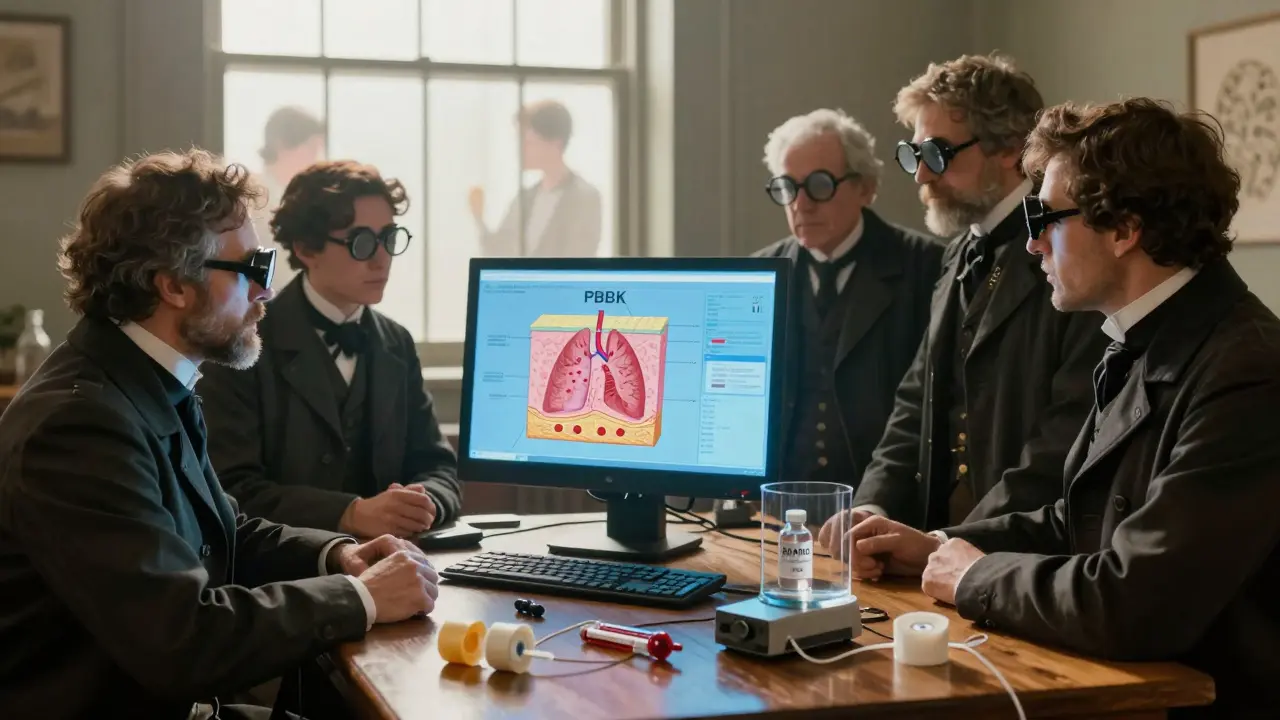
The Path Forward: New Tools, Better Collaboration
The good news? Science is catching up. Physiologically-based pharmacokinetic (PBPK) modeling is one breakthrough. Instead of testing in people, scientists use computer models to simulate how a drug moves through the body - based on its physical properties, not just blood levels. For some complex drugs, this could cut bioequivalence studies by 40% to 60%. The Center for Research on Complex Generics (CRCG) has published 12 new analytical protocols since 2022 - standard ways to test particle size, coating thickness, spray patterns, and release rates. These aren’t just academic. They’re being used by manufacturers to get approvals. And early engagement with regulators works. Companies that talk to the FDA early in development - before they spend millions - have a 35% higher chance of approval. That’s not luck. It’s strategy.Why This Matters: Cost, Access, and Equity
Complex drugs aren’t just for rare diseases. They’re used for asthma, diabetes, eczema, arthritis, cancer, and hormone replacement. Many are lifelong treatments. And they’re expensive. A single inhaler can cost over $500. A monthly injection? $2,000. If we can’t get generics for these, patients pay more. Insurance companies pay more. The whole system pays more. The market for complex generics is worth $120 billion in the U.S. alone. By 2028, it could hit $45 billion - growing at over 24% a year. But that growth depends on solving the bioequivalence problem. Right now, the system is broken. It’s too slow, too expensive, too inconsistent. But the tools are here. The science is advancing. And the pressure to cut costs is real. The question isn’t whether complex generics can be approved. It’s whether regulators, manufacturers, and researchers will work together fast enough to make them accessible before patients are priced out of care.Why can’t we just use blood tests for complex generics like we do for regular ones?
Blood tests measure how much drug enters the bloodstream, but complex generics often don’t need to enter the blood to work. For example, an asthma inhaler must deliver medicine directly to the lungs. A topical cream must penetrate the skin. Measuring blood levels in these cases gives false results - it shows little or no drug, even if the treatment is working perfectly at the site of action.
What’s the biggest challenge in developing a complex generic?
The biggest challenge is proving bioequivalence without knowing the original product’s exact formulation. Generic manufacturers must reverse-engineer the brand-name drug - often with no access to its ingredients, manufacturing process, or quality controls. This requires years of trial and error, advanced lab techniques, and expensive testing that may still fail under regulatory scrutiny.
How do regulators like the FDA and EMA differ in their requirements?
The FDA and EMA often require different testing methods for the same product. For example, the FDA may accept an in vitro aerosol test for an inhaler, while the EMA requires a clinical endpoint study. This forces manufacturers to run duplicate development programs, increasing costs and delays. Harmonization efforts are underway, but progress is slow.
Are there any new technologies helping to solve this problem?
Yes. Physiologically-based pharmacokinetic (PBPK) modeling uses computer simulations to predict how a drug behaves in the body based on its physical properties, reducing the need for human trials. Advanced imaging techniques now allow scientists to visualize how drugs penetrate skin or lung tissue. Standardized analytical methods for particle size, spray patterns, and release rates are also being adopted globally.
Why are so few complex generics on the market if the demand is so high?
Because the development cost and failure rate are extremely high. Developing a complex generic can take 18-24 months longer than a simple one, cost 3-5 times more, and still fail at the bioequivalence stage over 70% of the time. Many companies can’t justify the investment when the payoff is uncertain and regulatory pathways are unclear.
Kal Lambert
March 18, 2026 AT 07:58Linda Olsson
March 18, 2026 AT 11:36Ayan Khan
March 19, 2026 AT 07:28Emily Hager
March 20, 2026 AT 20:06Melissa Starks
March 22, 2026 AT 05:35Lauren Volpi
March 22, 2026 AT 15:43Melissa Stansbury
March 24, 2026 AT 01:43Prathamesh Ghodke
March 24, 2026 AT 14:43Paul Ratliff
March 26, 2026 AT 09:13