

Drug-Supplement Interaction Checker
Check for Potential Interactions
Enter your medication and supplement to see if there's a dangerous interaction. Remember: "natural" doesn't mean safe.
Every year, millions of people in the U.S. take supplements alongside their prescription medications-often without knowing if it’s safe. You might pop a vitamin D pill with your blood pressure med, or grab a turmeric capsule before bed while on blood thinners. The label says “natural” and “supports immunity”, so you assume it’s harmless. But here’s the truth: supplement labels rarely warn you about dangerous drug interactions, and that’s by design.
Why Supplement Labels Don’t Tell You the Whole Story
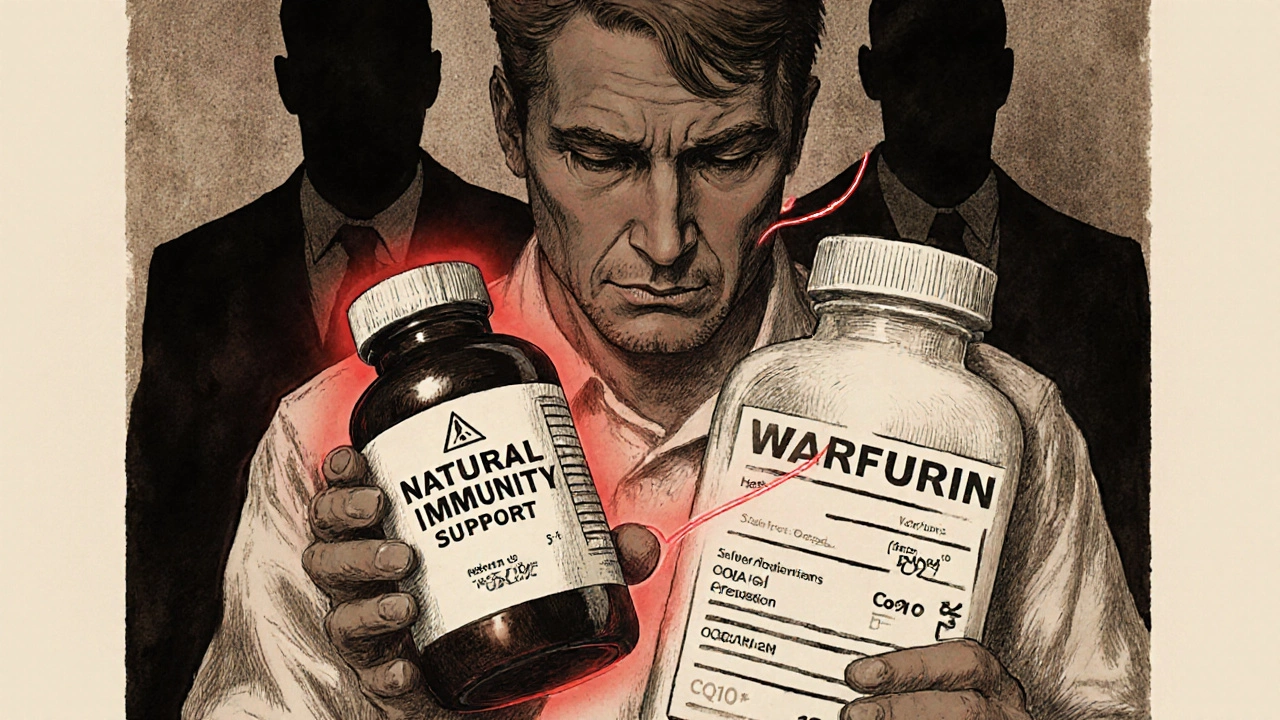
Unlike prescription or even over-the-counter drugs, dietary supplements aren’t required by law to list potential interactions with medications. The Dietary Supplement Health and Education Act (DSHEA) of 1994 let supplement makers sell products without proving they’re safe or effective before they hit shelves. The FDA only steps in after someone gets hurt. That means if you’re taking warfarin, metformin, or digoxin, and you start a new supplement, the bottle might not say a word about risk. In fact, a 2021 FDA review of 500 popular supplements found that only 12.7% included any drug interaction warning. Compare that to prescription drugs-where 97.3% list interactions-or OTC meds, where 94% do. Supplements operate in a legal gray zone.What You’ll Actually See on a Supplement Label
Every supplement must have a Supplement Facts panel. This looks similar to a nutrition label, but it’s not as strict. Here’s what’s required:- Serving size - Often misleading. One capsule might be labeled as one serving, but the bottle says “take two.” You’re doubling your dose without realizing it.
- Amount per serving - The actual quantity of each ingredient. Watch out for ingredients listed in milligrams (mg) or micrograms (mcg). High doses of vitamin C (over 1,000 mg/day) can reduce the effectiveness of some HIV meds by 22%.
- % Daily Value (%DV) - Only applies to a few nutrients like vitamin D, calcium, iron. Most supplement ingredients don’t have a %DV because there’s no official daily recommendation.
- Other ingredients - This is where it gets tricky. This section lists fillers, binders, and flavorings. But if you see “proprietary blend,” you’re being kept in the dark. A 2023 ConsumerLab analysis found 38% of supplements use blends to hide how much of each ingredient they actually contain. That’s a problem if you’re allergic to soy or taking a drug that reacts with even small amounts of an herb like St. John’s wort.
Also, the label must list the eight major allergens: milk, eggs, fish, shellfish, tree nuts, peanuts, wheat, and soy. If you’re allergic, this is your only protection.
How Drug Labels Are Different (And Why You Should Check Them Too)
Prescription and OTC drug labels follow strict FDA rules. They use the Drug Facts format with seven clear sections:- Active Ingredients - What the drug actually contains and how much.
- Purpose - What it’s for (e.g., “pain reliever”).
- Uses - Approved conditions it treats.
- Warnings - This is the most important part. It tells you when not to take it, who shouldn’t use it, and which other drugs it interacts with.
- Directions - How much and how often to take it.
- Other Information - Things like sodium content or storage instructions.
- Inactive Ingredients - Fillers, dyes, preservatives.
Some prescription drugs even have a Black Box Warning - the FDA’s strongest safety alert. Around 500 medications carry one. These are usually for life-threatening risks like liver failure, heart rhythm problems, or suicidal thoughts. If your med has one, you need to be extra careful about what else you take.
Real-World Examples: What Happens When Supplements Clash With Medications
You don’t need to guess whether a supplement is risky. We know exactly what happens when certain ones mix with common drugs:- Warfarin (blood thinner) + Vitamin K or CoQ10 - Vitamin K (found in green tea extract, some multivitamins) can make warfarin less effective. CoQ10 does the same. Studies show prothrombin time drops by 15-25%, raising your risk of dangerous clots.
- St. John’s wort + Digoxin (heart medication) - This herbal remedy for depression can lower digoxin levels by 26%. That means your heart condition isn’t being controlled. People have ended up in the ER with irregular heartbeats because of this combo.
- Milk thistle + Metformin (diabetes drug) - Milk thistle is popular for liver health, but it can boost metformin’s effect too much. One user on the American Diabetes Association forum reported blood sugar dropping to 42 mg/dL - a life-threatening low.
- Calcium + Levothyroxine (thyroid medication) - Calcium supplements, even antacids, can block thyroid hormone absorption. You might think your dose isn’t working, but it’s the calcium interfering. Take them at least 4 hours apart.
And here’s a sneaky one: red yeast rice. It’s sold as a “natural” cholesterol reducer. But it contains monacolin K - the exact same compound as the prescription statin lovastatin. If you’re already on a statin, adding this supplement could cause muscle damage or kidney failure.
How to Protect Yourself: A Simple 5-Step System
You can’t rely on labels alone. You need a system:- Take a photo of every supplement label - Save it on your phone. Show it to your pharmacist or doctor during appointments. Don’t rely on memory.
- Use the Medscape Drug Interaction Checker - It’s free, reliable, and checks over 24,000 drug pairs. Type in your prescription and the supplement name. If it says “major interaction,” stop and call your doctor.
- Never assume “natural” means safe - Just because something comes from a plant doesn’t mean it won’t interfere with your meds. Herbs are powerful. They’re not candy.
- Ask your pharmacist every time - Pharmacists are trained to spot interactions. They see hundreds of drug-supplement combos every week. Don’t be shy. Say: “I’m taking [medication]. I want to start [supplement]. Is this safe?”
- Check for USP verification - The USP mark means an independent lab tested the product for purity, strength, and accuracy. Only 18% of supplements have it - but those that do are far more trustworthy.
What’s Being Done? And Why It’s Not Enough
The supplement industry is huge - $53.1 billion in sales in 2023. About 77% of Americans use at least one supplement. But the FDA’s Office of Dietary Supplement Programs has a budget of just $4.7 million. That’s 0.03% of the FDA’s total budget. They can’t inspect every product. In 2024, the FDA released a draft guidance suggesting supplement makers voluntarily add interaction warnings. But without a law, most won’t. A bill called the Dietary Supplement Listing Act of 2022 would have required pre-market review. It failed in Congress. Some companies are starting to use QR codes on labels that link to updated interaction data. The FDA is testing this now. But until laws change, you’re still the last line of defense.Final Warning: Don’t Wait for a Crisis
In 2022, the FDA recorded 1,960 adverse events linked to supplements. Nearly 28% involved drug interactions. That’s not a small number. That’s people in hospitals because they didn’t know. You don’t need to stop taking supplements. But you do need to stop assuming they’re harmless. Your meds are carefully calibrated. Supplements aren’t. That imbalance puts you at risk. If you’re on any prescription drug - especially for heart, thyroid, diabetes, blood pressure, or mental health - treat every supplement like a new medication. Ask questions. Check interactions. Document everything. Your health isn’t a gamble.Do supplement labels have to list drug interactions?
No. Unlike prescription and over-the-counter drugs, supplement manufacturers are not required by U.S. law to list potential drug interactions on their labels. While some brands voluntarily include warnings, most do not. This is a major gap in consumer safety under the current Dietary Supplement Health and Education Act (DSHEA).
What should I do if my supplement label says ‘proprietary blend’?
A proprietary blend hides the exact amount of each ingredient. This makes it impossible to know if you’re getting a safe or effective dose - or if it might interact with your meds. Avoid supplements with blends unless you trust the brand and can verify ingredients through third-party testing (like USP or ConsumerLab). If you’re unsure, skip it.
Can I trust supplements labeled as “natural” or “organic”?
No. “Natural” has no legal definition in supplement labeling. “Organic” only applies to how ingredients were grown, not to safety or interactions. Red yeast rice is natural - but it contains the same active ingredient as the prescription statin lovastatin. Just because something comes from a plant doesn’t mean it’s safe with your medication.
Which supplements are most likely to interact with medications?
The top interactors include St. John’s wort, vitamin K, CoQ10, milk thistle, garlic, ginkgo biloba, and high-dose vitamin C. These can affect blood thinners, antidepressants, diabetes drugs, heart medications, and chemotherapy. Always check interactions before taking any new supplement, even if it seems harmless.
How can I tell if a supplement is high quality?
Look for the USP Verified mark. This means an independent lab tested the product for accurate ingredient amounts, purity, and disintegration. USP-certified supplements have 92% accuracy in labeling, compared to just 67% for non-certified ones. Also, check for third-party testing from ConsumerLab or NSF International. Avoid brands with no transparency.
Should I tell my doctor about the supplements I take?
Yes - and bring the actual bottles or photos of the labels. Many doctors don’t ask, but you should volunteer the information. The American Medical Association now recommends doctors spend 3-5 minutes reviewing supplements during annual checkups. Your supplement use could be affecting your lab results, medication effectiveness, or causing side effects you didn’t realize were linked.
Curtis Ryan
November 29, 2025 AT 11:20Man i just started taking turmeric for my knees and didn't even think about my blood pressure med lol
Thanks for the wake up call. Going to screenshot this and show my pharmacist tomorrow. Never again assuming 'natural' = safe.
Rajiv Vyas
November 30, 2025 AT 22:40LOL the FDA is just a puppet of Big Pharma. Supplements are safer than their poison pills. They don't want you to know you can heal yourself without their $500 monthly prescriptions. The real danger is pharmaceutical greed, not some herbal capsules.
farhiya jama
December 2, 2025 AT 07:51Ugh i'm so tired of this. I just want to take my vitamins and not feel like i'm playing russian roulette with my health every time i open a bottle. Why does everything have to be so complicated??
Astro Service
December 2, 2025 AT 14:27Why are we letting foreigners and hippies control our medicine? We got real science in america. You don't need some herbal nonsense when you got FDA approved pills. This whole supplement thing is just a scam to make weak people feel better about not taking real medicine.
DENIS GOLD
December 3, 2025 AT 06:15Oh wow, a 12.7% warning rate? That's practically a guarantee someone's gonna die. Who's surprised? The same people who think 'organic' means 'magic fairy dust.' The FDA's budget is smaller than my coffee habit. We're all just one bad combo away from becoming a statistic.
Ifeoma Ezeokoli
December 4, 2025 AT 00:36Y'all are so quick to panic, but let's not forget this is about empowerment, not fear. I've been on metformin for 8 years and take milk thistle - i checked with my pharmacist, used Medscape, and took it slow. Knowledge is power. Don't let fear silence your health journey. We can be smart and safe without being scared.
Sachin Agnihotri
December 4, 2025 AT 06:49...I've been using the Medscape checker for years...and yes, it's free...and yes, it's better than guessing...but...did you know...that some supplements contain heavy metals...and that's not even listed...on the label...?...You really need to dig deeper...than just interactions...
Allison Reed
December 5, 2025 AT 19:20This is exactly why I always bring my supplement bottles to my appointments. My doctor didn't even know I was taking CoQ10 until I showed him the label. He adjusted my warfarin dose right then and there. Don't be embarrassed to talk about it - your health is worth the 2 minutes.
Jacob Keil
December 7, 2025 AT 14:19you think the government cares about you? no. they care about profits. the dshea was written by supplement lobbyists. the fda is asleep at the wheel. your 'natural' vitamin d? could be laced with fillers from a factory in china that doesn't even have running water. you're a lab rat and you don't even know it.
Rosy Wilkens
December 9, 2025 AT 08:11While I appreciate the general sentiment of this article, I must point out that the statistical data presented lacks proper citation of primary sources. The 2021 FDA review referenced is not publicly accessible in its entirety, and the 38% proprietary blend statistic from ConsumerLab appears to be misinterpreted from their 2023 report, which specifically analyzed 247 products - not 500. Furthermore, the assertion that 'supplements operate in a legal gray zone' is misleading; DSHEA is clear law, not ambiguity. The real issue is consumer education, not regulatory failure. I urge readers to consult peer-reviewed journals before acting on anecdotal forum claims.