

- 8
MAOI Tyramine Safety Checker
Tyramine Safety Checker
Check if foods are safe to eat while taking MAOIs. The safety threshold is 6 mg of tyramine per serving.
Why MAOIs Are Still Used Despite Their Risks
Most people start antidepressants with the hope of feeling better without a ton of rules. But if you’ve tried SSRIs, SNRIs, or other common meds and nothing worked, your doctor might mention something older - and more complicated - called a monoamine oxidase inhibitor, or MAOI. These aren’t the first choice. They’re not even the second. But for about 1 in 5 people with treatment-resistant depression, they’re the only thing that works.
MAOIs like phenelzine (Nardil), tranylcypromine (Parnate), and the selegiline patch (Emsam) were the first antidepressants ever made. Back in the 1950s, doctors noticed patients taking a tuberculosis drug called iproniazid started feeling happier. That accidental discovery led to a whole new class of drugs. Today, less than 1% of antidepressant prescriptions in the U.S. are for MAOIs. But that small number includes people who’ve tried five or more other meds and still feel stuck.
The reason MAOIs work where others fail? They don’t just tweak one neurotransmitter. They boost serotonin, norepinephrine, and dopamine all at once by blocking the enzyme that breaks them down. That’s a broader, deeper effect than SSRIs, which only target serotonin. For people with atypical depression - the kind with heavy fatigue, oversleeping, and emotional sensitivity - MAOIs often produce life-changing results. One 2023 meta-analysis found they’re nearly twice as effective as SSRIs for this subtype, with a number needed to treat (NNT) of just 4.2. That means for every four people treated, one gets real relief that other drugs couldn’t deliver.
The Tyramine Trap: Why Your Cheese Plate Could Be Dangerous
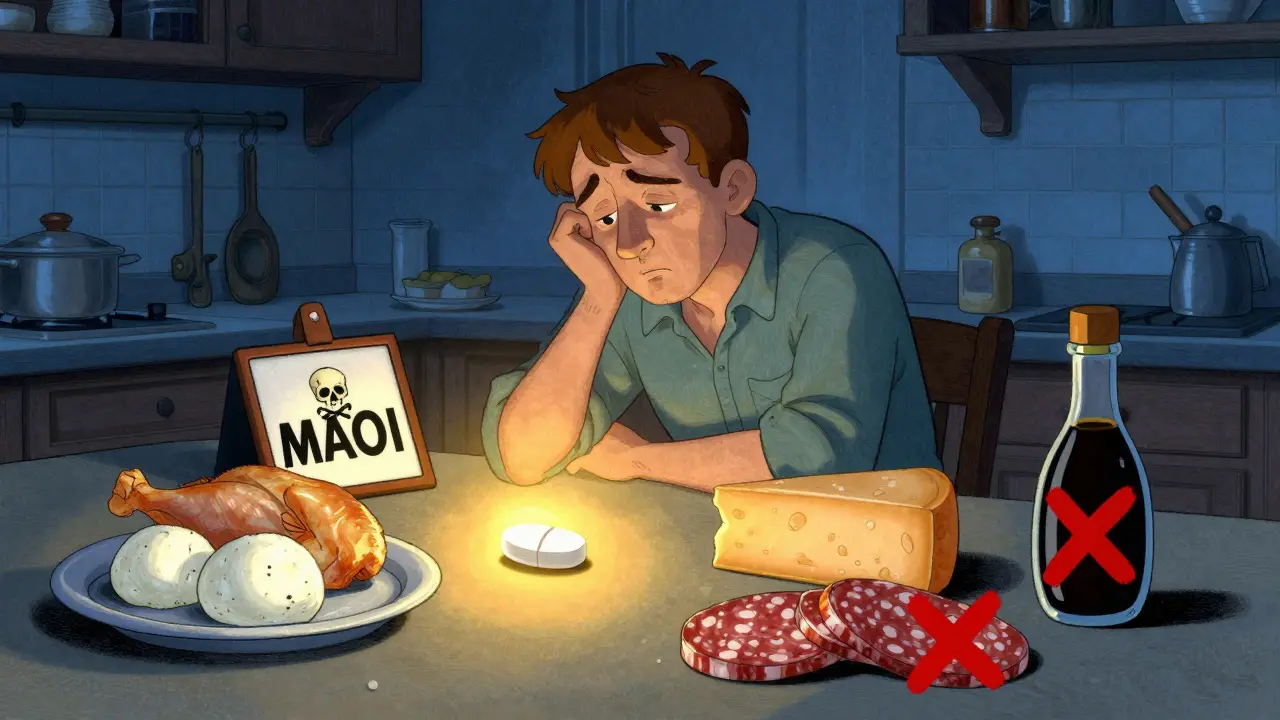
If you’ve ever been told to avoid aged cheese, cured meats, or soy sauce while on an MAOI, it’s not just a suggestion. It’s a life-or-death rule.
Here’s why: your body normally breaks down tyramine - a compound found in fermented, aged, or spoiled foods - using an enzyme called MAO-A. When you take an MAOI, that enzyme is shut down. Tyramine builds up in your bloodstream and forces your body to release massive amounts of norepinephrine. That spike can send your blood pressure soaring past 200 mmHg in minutes. That’s not a headache. That’s a hypertensive crisis: stroke, heart attack, or death.
You don’t need to go hungry. Fresh cheeses like cottage cheese, mozzarella, or cream cheese are fine. Fresh meat, poultry, and fish are safe. But anything aged, fermented, or stored too long? Avoid it. That includes:
- Aged cheeses (Parmesan, blue cheese, cheddar over 48 hours old)
- Cured meats (salami, pepperoni, hot dogs)
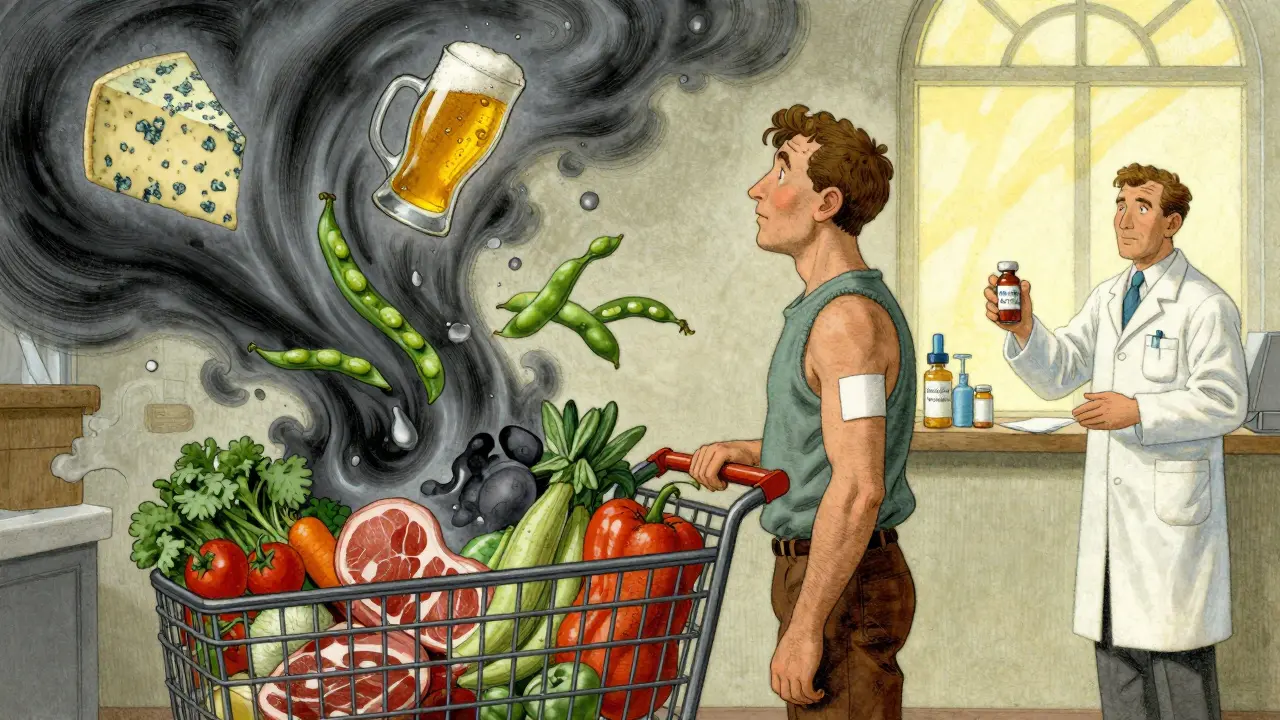
- Tap beer, homebrewed beer, and some wines
- Soy sauce, miso, and fermented tofu
- Overripe bananas, fava beans, and sauerkraut
The cutoff is simple: if a food has more than 6 mg of tyramine per serving, skip it. That’s why dietitians who specialize in MAOIs spend hours teaching patients how to read labels, check expiration dates, and cook from scratch. One 2022 study found nearly 30% of people on oral MAOIs had at least one hypertensive episode in their first year - often from eating something they thought was “just a little old.”
Drug Interactions: The Hidden Minefield
MAOIs don’t just clash with food. They clash with dozens of common medications - some you might not even think of as drugs.
Take decongestants. A single 30 mg pill of pseudoephedrine (found in Sudafed) can trigger a hypertensive emergency in someone on an MAOI. Same goes for dextromethorphan (in cough syrups like Robitussin DM), certain painkillers like meperidine (Demerol), and even some herbal supplements like St. John’s wort.
The biggest danger? Mixing MAOIs with SSRIs or SNRIs. If you switch from an SSRI like sertraline to an MAOI without waiting long enough, you risk serotonin syndrome. That’s when your brain gets flooded with too much serotonin. Symptoms include confusion, rapid heartbeat, muscle rigidity, fever, and seizures. A 2022 study showed 15-20% of people who didn’t wait the full washout period developed this condition. The rule? Wait at least two weeks after stopping an SSRI before starting an MAOI. And if you’re going the other way - from MAOI to SSRI - wait five weeks. That’s not a suggestion. It’s protocol.
Even over-the-counter cold meds, allergy pills, and migraine treatments can be risky. Always check with your pharmacist or psychiatrist before taking anything new.

The Patch That Changed the Game: Emsam
One major breakthrough came in 2006 with the FDA approval of Emsam - a skin patch that delivers selegiline through the skin instead of swallowing a pill. Why does that matter? Because when MAOIs are taken orally, they hit the gut first, where MAO-A is busy breaking down tyramine. But the patch bypasses the gut. That means at the lowest dose (6 mg/24hr), you don’t need to follow the strict tyramine diet at all.
Studies show only 8% of people on the 6 mg patch need dietary changes. That’s a huge drop from the 92% who do on oral MAOIs. At higher doses (9 mg and 12 mg), dietary restrictions return. But for many, the low-dose patch is a game-changer. It’s not cheap - $850 to $1,200 a month - but for someone who’s tried everything else and can’t handle the diet, it’s worth it.
There’s another benefit: steady delivery. Oral MAOIs spike and drop in your system. The patch gives you consistent levels, which can mean fewer side effects like dizziness or insomnia.
Real People, Real Stories
Reddit’s r/antidepressants has over 1,200 posts from people on MAOIs. The tone? Mixed, but honest.
One user, ChronicDepressor87, wrote: “After 12 years of failing every other drug, Parnate brought me back to life. Then I ate a piece of blue cheese I thought was fresh. My blood pressure hit 220/110. I spent the night in the ER.” He’s been on it for three years now. He cooks everything. He checks every label. He carries phentolamine - an emergency blood pressure reducer - in his wallet.
Another user, NeurochemNerd, said: “Dating is impossible. You can’t just say, ‘Hey, I’m on antidepressants.’ You have to say, ‘I can’t have soy sauce, wine, or aged cheese. And if you order pizza with pepperoni, I can’t eat it.’”
But the positive stories are just as strong. Nearly 80% of users on Drugs.com who’ve tried MAOIs say they’re “life-changing.” For people with treatment-resistant depression, that’s not just hope - it’s survival.
Who Should Consider an MAOI?
MAOIs aren’t for everyone. But they’re not just for the “last resort” crowd either. The American Psychiatric Association recommends them as a second-line option for:
- Atypical depression (oversleeping, overeating, mood reactivity)
- Depression that hasn’t responded to two or more other antidepressants
- People who can’t tolerate the side effects of SSRIs (like sexual dysfunction or emotional blunting)
They’re also being studied for bipolar depression. Early results from a 2022 pilot study showed 55% of patients went into remission - something SSRIs often can’t do in bipolar cases.
But you need to be ready. Are you willing to:
- Read every food label for the rest of your life?
- Call your pharmacist before taking any new medication?
- Carry emergency medication in case of a crisis?
- Accept that your social life might change?
If yes - and you’ve tried everything else - MAOIs might be your best shot.
What’s Next for MAOIs?
Research is moving fast. A new experimental MAO-A inhibitor called AZD7325 showed a 70% reduction in tyramine sensitivity in early trials. That could mean a future version that works like today’s MAOIs - but without the diet.
The National Institute of Mental Health is funding $4.2 million in research through 2025 to explore MAOIs for bipolar depression and other hard-to-treat cases. And in Europe, moclobemide - a reversible MAOI - is already widely used because it’s safer and doesn’t require strict dieting.
For now, MAOIs remain a niche tool. But they’re not disappearing. They’re evolving. And for the people who’ve been told there’s no hope, they’re still the most effective option we have.
Bob Hynes
February 2, 2026 AT 22:35Ellie Norris
February 3, 2026 AT 21:40larry keenan
February 5, 2026 AT 03:41Nick Flake
February 5, 2026 AT 10:41Akhona Myeki
February 6, 2026 AT 15:14Chinmoy Kumar
February 8, 2026 AT 05:14Brett MacDonald
February 9, 2026 AT 18:47jay patel
February 11, 2026 AT 01:02