


When a patient walks into the ER with shortness of breath, the clock starts ticking. Is it heart failure? COPD? A pulmonary embolism? Or just anxiety? In the past, doctors relied on chest X-rays, EKGs, and sometimes guesswork. Now, there’s a single blood test that can cut through the noise: NT-proBNP.
Why NT-proBNP Is the Go-To Test for Suspected Heart Failure
NT-proBNP isn’t just another lab order. It’s a direct signal from the heart. When the heart’s ventricles stretch under pressure-like when they’re failing to pump effectively-they release this hormone fragment into the bloodstream. The higher the level, the more strain the heart is under. Unlike symptoms that can mimic other conditions, NT-proBNP gives you an objective number. The test’s power lies in what it can rule out. If NT-proBNP is below 300 pg/mL, the chance that the patient has acute heart failure is less than 2%. That’s not a small margin-it’s a near-certainty. In emergency departments, this single value can prevent unnecessary hospitalizations, avoid costly echocardiograms, and stop patients from undergoing invasive procedures they don’t need. According to the European Society of Cardiology, NT-proBNP testing is a Class I recommendation-the highest level of endorsement-for diagnosing heart failure. The American College of Cardiology and the American Heart Association agree. It’s not optional. It’s standard.When to Order NT-proBNP: The Clinical Scenarios That Demand It
You don’t order this test for every patient with a cough. But there are clear, evidence-backed moments when it changes everything.- Acute dyspnea in the ER: Any adult presenting with sudden shortness of breath, especially if they’re over 65 or have a history of heart disease. NICE guidelines in the UK require it. CMS data shows hospitals that follow this protocol reduce unnecessary echocardiograms by 19%.
- Unexplained fatigue or swelling: An elderly patient with puffy ankles and tiredness might be written off as "just aging." But if NT-proBNP is over 900 pg/mL in someone over 75, heart failure becomes likely-even if they have no chest pain.
- Worsening chronic heart failure: If a patient on diuretics starts gaining weight or feels worse, a repeat NT-proBNP tells you if their condition is deteriorating or if something else (like kidney issues or infection) is to blame.
- Post-acute coronary syndrome: New 2024 guidelines recommend NT-proBNP testing after a heart attack to assess risk. Patients with elevated levels have a 35% higher chance of death or hospitalization in the next year.
- Before starting certain heart drugs: Medications like SGLT2 inhibitors or ARNIs are now first-line for heart failure. But you need to confirm the diagnosis before prescribing them. NT-proBNP confirms the underlying condition.
How to Interpret the Numbers: Age, Kidneys, and Obesity Matter
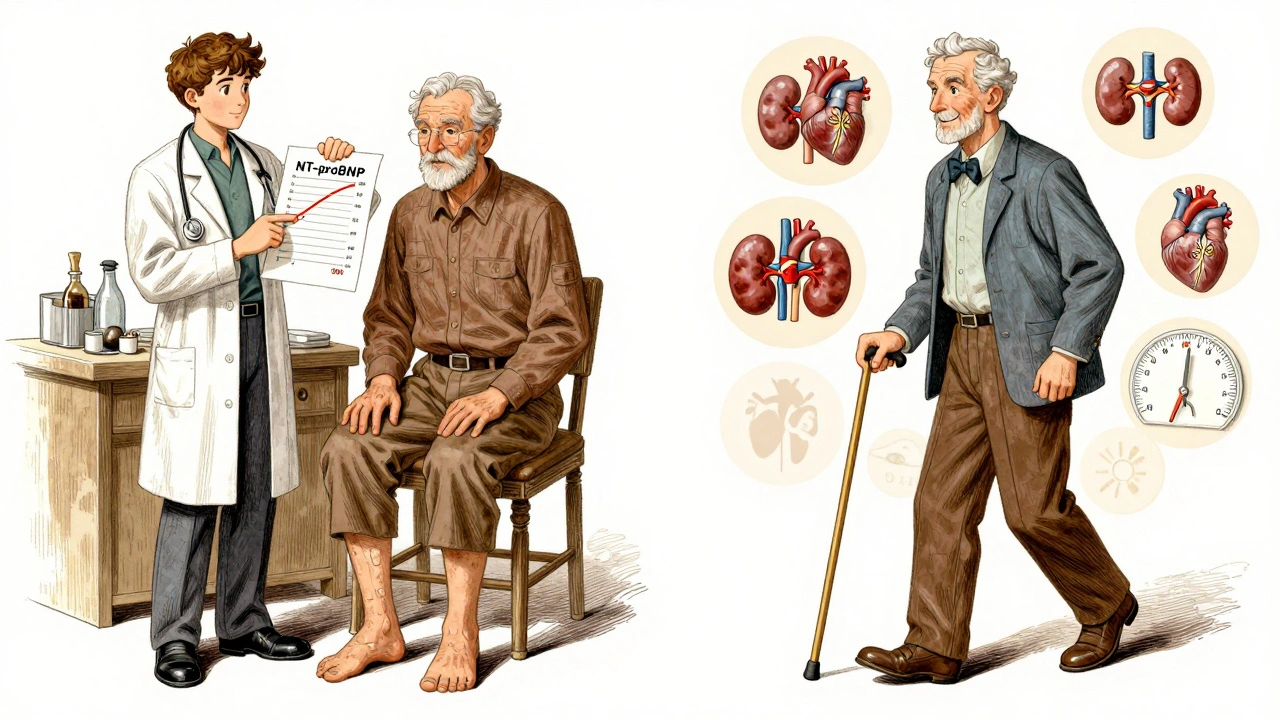
NT-proBNP isn’t a simple yes-or-no test. The number means different things depending on who the patient is.- Age adjustments: Levels naturally rise with age. For patients under 50, a cutoff of <450 pg/mL rules out heart failure. For those over 75, it’s <900 pg/mL. Ignore this, and you’ll overdiagnose in older adults.
- Kidney disease: If a patient has stage 3 or worse chronic kidney disease, NT-proBNP levels can be 28-40% higher-even without heart failure. Use a higher rule-out threshold: <1,200 pg/mL for CKD stage 3-5.
- Obesity: Fat tissue suppresses NT-proBNP. For every 5-point increase in BMI, levels drop 25-30%. A "normal" result in a very overweight patient doesn’t rule out heart failure-it might mean the problem is worse than the number suggests.
- Atrial fibrillation: This common arrhythmia raises NT-proBNP independently. A level of 850 pg/mL in an 80-year-old with AFib could mean heart failure… or just AFib. You need clinical context: Is there fluid overload? Crackles in the lungs? Elevated jugular venous pressure?
NT-proBNP vs. BNP: Why One Outperforms the Other
You might wonder: Why not just use BNP? Both are natriuretic peptides. But NT-proBNP has real advantages.- Stability: NT-proBNP lasts 60-120 minutes in the blood. BNP breaks down in 20 minutes. If your sample sits for an hour before testing, BNP might give you a false low. NT-proBNP won’t.
- Accuracy: A 2020 meta-analysis showed NT-proBNP had a higher diagnostic accuracy (AUC 0.91) than BNP (AUC 0.88). It correlates better with echocardiogram findings.
- Market dominance: In the U.S., 68% of natriuretic peptide tests ordered are NT-proBNP. Roche’s Elecsys assay is used in over 70% of hospitals.
Pitfalls and Common Mistakes
Even experienced clinicians mess this up.- Ordering it for asymptomatic patients: Medicare data shows 18% of NT-proBNP tests are ordered in people with no symptoms. That’s wasteful. Insurance may soon require prior authorization for this.
- Ignoring comorbidities: A level of 1,500 pg/mL in a 78-year-old with CKD and AFib? Don’t assume heart failure. Look at volume status, recent weight gain, and lung sounds.
- Thinking a normal level means "no heart disease": NT-proBNP rules out heart failure-not all cardiac issues. A patient can have diastolic dysfunction or valvular disease with normal levels.
- Not retesting when needed: One test gives you a snapshot. If symptoms change, repeat it. Trends matter more than single values.

What’s Next? The Future of NT-proBNP Testing
The technology is getting faster. In 2023, the FDA cleared Roche’s Cobas h 232 point-of-care device. It delivers results in 12 minutes-right at the bedside. That’s a game-changer for ERs and ICUs. The 2024 ACC/AHA/HFSA guidelines will expand NT-proBNP’s role to include risk stratification after heart attacks and in patients with diabetes. Research is also exploring its use in predicting atrial fibrillation onset and monitoring response to new heart failure drugs. But the biggest threat isn’t competition-it’s overuse. Without clear protocols, NT-proBNP becomes a reflex test instead of a diagnostic tool. Hospitals that implemented standardized ordering rules saw inappropriate testing drop by 33%.Bottom Line: Use It Right, and It Saves Lives
NT-proBNP isn’t magic. It’s a tool. Used well, it prevents misdiagnosis, cuts costs, and reduces unnecessary stress for patients. Used poorly, it adds noise to an already cluttered clinical picture. If you’re seeing a patient with unexplained breathlessness, especially if they’re older or have heart disease, order NT-proBNP. Don’t wait for an echo. Don’t delay. Let the blood tell you what the lungs and heart can’t. And remember: The number alone doesn’t tell the story. Age, kidney function, BMI, and clinical signs do. Combine the test with the patient in front of you-and you’ll make the right call more often than not.What is a normal NT-proBNP level?
There’s no single "normal"-it depends on age. For patients under 50, levels below 450 pg/mL rule out acute heart failure. For those 50-75, it’s below 900 pg/mL. For patients over 75, the cutoff is below 1,800 pg/mL. In patients with chronic kidney disease (stage 3-5), use a higher rule-out threshold of below 1,200 pg/mL.
Can NT-proBNP be elevated without heart failure?
Yes. NT-proBNP rises in conditions like kidney disease, atrial fibrillation, severe infections, pulmonary hypertension, and even with advanced age. Obesity can lower it. That’s why interpretation requires context: Is there fluid overload? Crackles? Elevated jugular pressure? The test tells you something’s wrong-but not always what.
How long does it take to get NT-proBNP results?
In most hospital labs, results are ready in about 47 minutes. With newer point-of-care devices like the Roche Cobas h 232, results can be available in just 12 minutes-ideal for emergency departments and ICUs.
Is NT-proBNP testing covered by insurance?
Yes. Medicare reimburses $18.42 per test as of 2023. Most private insurers follow similar rates. However, starting January 2025, Medicare will require prior authorization for NT-proBNP tests ordered in asymptomatic patients to reduce low-yield testing.
Should I order NT-proBNP for every patient with shortness of breath?
No. Order it when heart failure is a plausible diagnosis-especially in patients over 60, with a history of heart disease, hypertension, or diabetes. Don’t order it for young, healthy patients with asthma or anxiety. It’s not a screening tool. It’s a diagnostic tool for specific clinical scenarios.
Can NT-proBNP predict how a heart failure patient will do?
Yes. Higher levels correlate strongly with worse outcomes: more hospitalizations, higher risk of death. A drop in NT-proBNP after treatment (like starting an SGLT2 inhibitor or ARNI) predicts better survival. Many cardiologists now use it to track treatment response, not just make the diagnosis.
Josh Bilskemper
December 3, 2025 AT 09:28NT-proBNP isn't magic it's math. Below 300 pg/mL you're not in heart failure. Period. Stop ordering echo's like it's 2005. If you're still using chest X-rays as your primary tool you're doing patients a disservice
Storz Vonderheide
December 4, 2025 AT 13:31Really appreciate this breakdown. I've seen too many elderly patients get labeled as 'just aging' when their puffy ankles and fatigue were actually early heart failure. NT-proBNP changed the game in my clinic. One test saved a woman from three unnecessary hospital trips last month. Thanks for highlighting the real-world impact
dan koz
December 6, 2025 AT 10:47Man in Lagos we dont even have access to this test regularly. We get a stethoscope and a prayer. If you guys in the US are still debating whether to order this you're living in the future while we're stuck in the 1980s. This test should be in every primary care clinic worldwide
Ethan McIvor
December 6, 2025 AT 11:15It's fascinating how a single molecule can carry so much weight. The heart doesn't lie. When it's struggling it screams in biochemistry. NT-proBNP is like listening to the heart's secret diary. And yet we still treat it like an optional footnote. Maybe medicine needs to stop treating labs as tools and start treating them as voices
Chris Jahmil Ignacio
December 6, 2025 AT 18:16They're pushing this test because it's profitable. Hospitals make money on echos and admissions. If you just use NT-proBNP and send people home you lose revenue. The guidelines were written by pharma-backed committees. Watch how soon they start requiring this test before you can prescribe any new heart drug. It's not about patient care it's about control. And don't get me started on how they manipulate age cutoffs to justify more testing
Paul Corcoran
December 8, 2025 AT 16:15Love this. Just had a resident ask me why we don't test everyone with shortness of breath. I showed them the 2% rule. Their eyes lit up. This is exactly the kind of evidence-based clarity we need in EM. No more guessing. No more 'maybe'. Just numbers. And yeah the age and kidney adjustments matter too. This isn't one-size-fits-all medicine it's smart medicine
Colin Mitchell
December 9, 2025 AT 19:14Big fan of NT-proBNP. I tell my patients it's like a heart stress test in a vial. If it's low we can breathe easy literally. If it's high we know where to look next. And the best part? It helps avoid scary procedures that aren't needed. I've had patients cry because they thought they were dying and the test said otherwise. That's powerful stuff
dylan dowsett
December 9, 2025 AT 23:19Wait-so you're saying we should just trust a blood test over clinical judgment? What about obesity? Renal function? Medications? You're reducing human suffering to a single number? And you call this medicine? This is dehumanizing. You're turning doctors into lab technicians. And why are you ignoring the fact that NT-proBNP levels can be falsely low in obese patients? You're putting lives at risk with this oversimplification! Someone needs to stop this madness before it becomes standard!