


- 12
When you pick up a prescription, you might see a little sticker on the bottle: generic. It’s cheaper. Maybe half the price. But do you wonder if it’s really the same? You’re not alone. Many people worry that switching from a brand-name drug to a generic means they’re getting a lesser version - weaker, unsafe, or less effective. The truth? Most of those fears are based on myths, not science. Let’s cut through the noise.
What Exactly Is a Generic Drug?
A generic drug isn’t a copycat. It’s not a knockoff. It’s the exact same medicine, chemically, as the brand-name version. Same active ingredient. Same strength. Same way it’s taken - pill, injection, cream, whatever. The only differences? The color, shape, flavor, or filler ingredients. Those don’t affect how the drug works in your body.
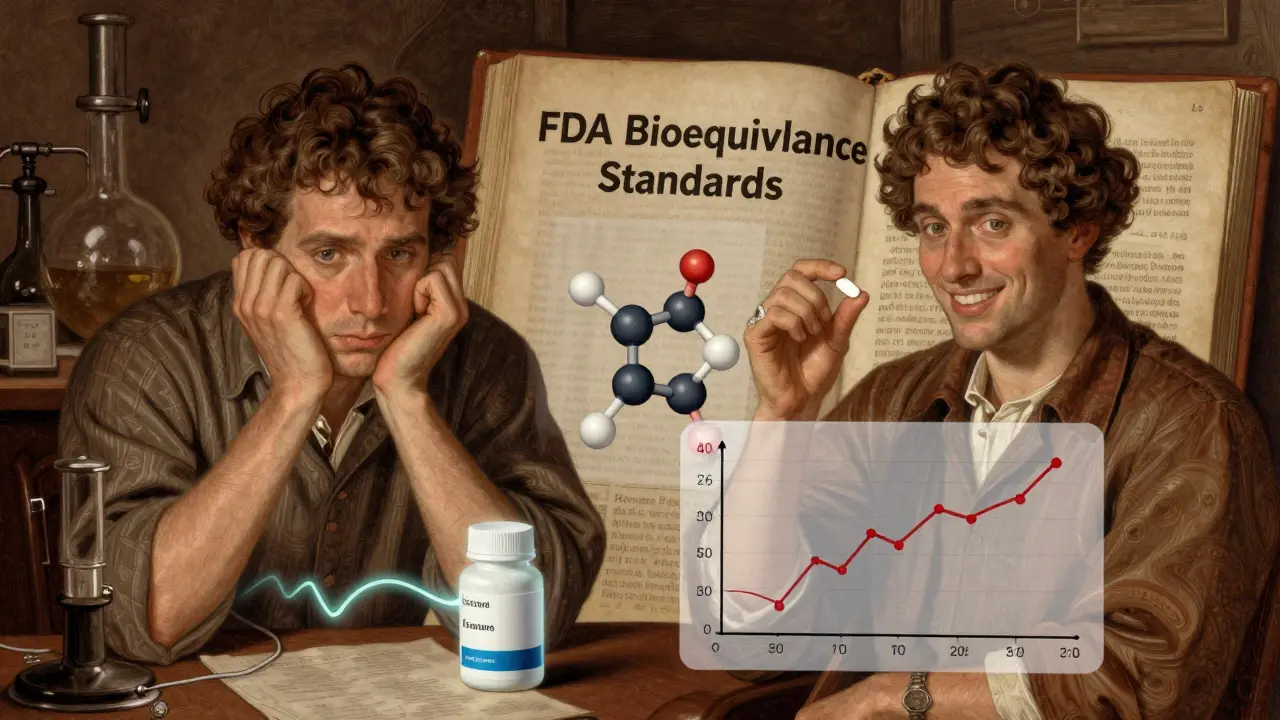
The U.S. Food and Drug Administration (FDA) doesn’t approve generics lightly. Before a generic hits the shelf, it must prove it’s bioequivalent to the brand-name drug. That means when you take it, your body absorbs it at the same rate and to the same extent. The FDA requires the levels of the drug in your blood to fall within 80% to 125% of the brand-name version. That’s not a wide gap - it’s a tight, scientifically proven range. In fact, 99.8% of approved generics meet or exceed this standard.
And here’s something most people don’t know: the same factories that make brand-name drugs often make generics. The FDA inspects both. In 2022, 98.7% of generic manufacturing sites passed inspection - compared to 97.3% for brand-name sites. So if you trust your brand-name pill, you’re already trusting the same quality control for the generic.
Myth: Generics Are Less Effective
It’s a common fear: “If I take the cheaper version, will it just not work?” The answer, backed by real-world data, is no - not for most drugs.
A 2020 study in Nature looked at 17 cardiovascular drugs. Researchers analyzed over 100,000 patients and found that generics performed just as well - and in some cases, better - than brand-name versions. For drugs like metformin and gliclazide, patients on generics had fewer heart attacks and strokes. Another study of amlodipine (a blood pressure pill) showed patients on the generic version had a 9% lower risk of major heart events.
Even in high-stakes areas like epilepsy, the data isn’t as scary as headlines suggest. While one 2022 study reported higher seizure rates with generic levetiracetam, a larger 2023 study in JAMA Network Open found no difference in outcomes between brand and generic clopidogrel - a drug used after heart attacks. The truth? Most generics work just fine. The rare cases where they don’t are usually tied to very specific drugs, not generics as a whole.
Myth: All Generics Are Created Equal
Here’s where things get tricky. Not all generics are identical - but not because of the active ingredient. The problem lies in the formulation. For most drugs, that doesn’t matter. But for drugs with a narrow therapeutic index (NTID), tiny changes can have big effects.
NTID drugs include things like warfarin (blood thinner), levothyroxine (thyroid hormone), and phenytoin (seizure control). For these, the difference between too little and too much can be dangerous. That’s why the FDA requires tighter bioequivalence standards for these - 90% to 112% - instead of the usual 80% to 125%.
And here’s the real issue: if you switch between different generic brands - say, from Mylan to Teva to Sandoz - your body might react slightly differently. Why? Because even though the active ingredient is the same, the way it’s made - the crystal structure, the particle size, the binders - can affect how fast it dissolves. For most people, it’s invisible. For a few, it’s noticeable. That’s why doctors often recommend sticking with the same generic manufacturer if you’re on an NTID drug.
One patient on Reddit shared how switching from brand Synthroid to a generic levothyroxine caused erratic TSH levels - requiring three dose adjustments over six months. That’s not common, but it happens. The fix? Talk to your pharmacist. Ask if your generic is from the same maker. If you feel off after a switch, don’t assume it’s all in your head. Get your levels checked.
Myth: Generics Are Only for Poor People
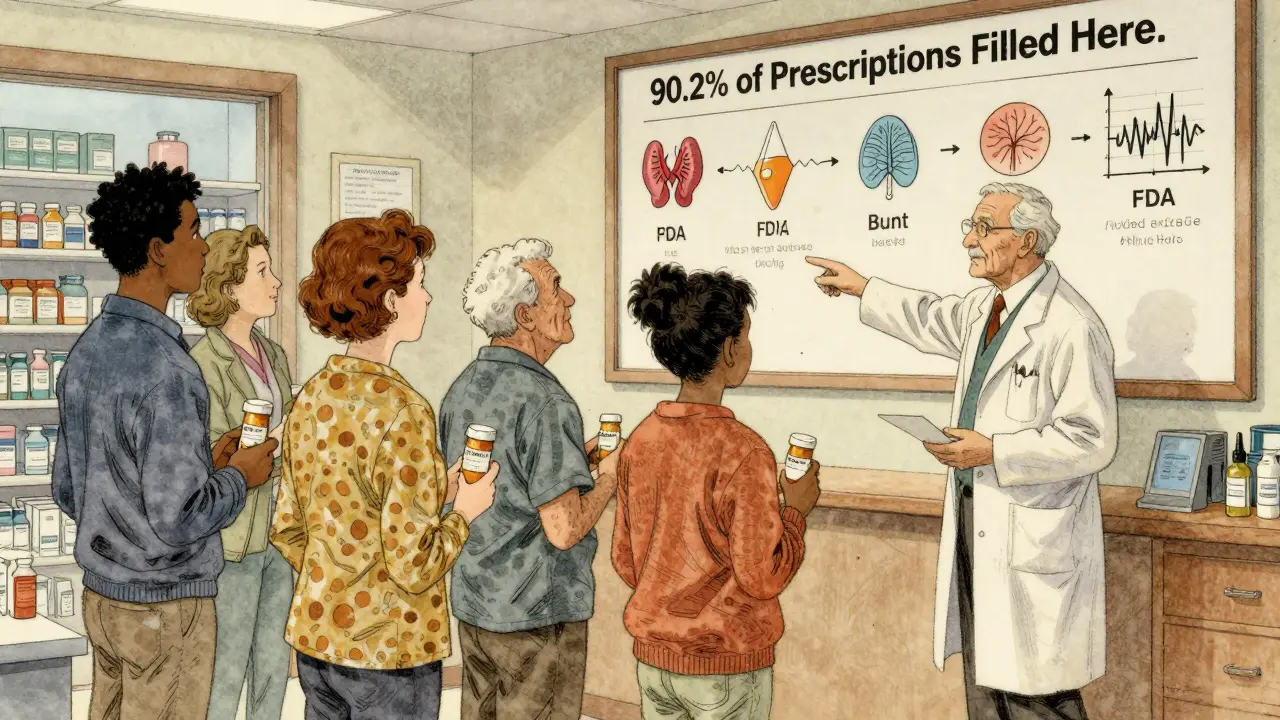
Generics aren’t a last resort. They’re the standard. In the U.S., 90.2% of all prescriptions filled are for generics. That’s not because people can’t afford the brand - it’s because doctors and pharmacies know generics work. Hospitals use them as first-line treatment for almost everything. Medicare and private insurers push them because they save billions.
Between 2010 and 2020, generics saved the U.S. healthcare system $2.29 trillion. That’s not a rounding error. That’s enough to cover healthcare for millions. And globally, the generic drug market is growing fast - projected to hit $725 billion by 2028.
So when you choose a generic, you’re not choosing second-best. You’re choosing smart. You’re choosing a system designed to give you the same medicine, at a fraction of the cost, without sacrificing safety.
When Should You Be Cautious?
Generics are safe for 99% of people. But there are a few situations where you should pause and talk to your doctor:
- You’re on a narrow therapeutic index drug (warfarin, levothyroxine, phenytoin, digoxin, cyclosporine). Stick with the same brand or generic if possible.
- You’ve had a bad reaction after switching - like seizures, mood swings, or unstable blood levels. Document it. Bring it up.
- You have known allergies to fillers. Generic labels don’t always list inactive ingredients clearly. Ask your pharmacist for the full list.
- You’re taking a complex drug - like an inhaler, topical cream, or injectable. These are harder to copy, and the FDA is still refining standards.
For the rest? No need to worry. The science is clear: generics work.
Why Do Some People Swear Generics Don’t Work?
It’s not always about the drug. Sometimes, it’s about expectations.
When you switch from a pill you’ve taken for years - say, a blue capsule with a logo you recognize - to a white oval with no name, your brain can trick you. You start noticing every little change: a new headache, a little fatigue, a mood dip. You assume it’s the generic. But it might just be stress, sleep, or something else.
Consumer Reports surveyed 1,200 people who switched to generics. 82% said they noticed no difference. Only 7% reported a problem. That’s not a high rate. But those 7%? They’re loud. And their stories stick.
There’s also the issue of inconsistent labeling. The FDA found that only 67% of generic drug labels clearly list inactive ingredients, compared to 99% for brand-name drugs. If you’re allergic to lactose, red dye, or gluten, you might not know unless you ask. Always check the full ingredients list with your pharmacist - whether it’s brand or generic.
What You Can Do
You don’t have to guess. Here’s what actually works:
- Ask your pharmacist - “Is this generic the same manufacturer as last time?” If you’re on a sensitive drug, consistency matters.
- Check the FDA’s Orange Book - it lists all approved generics and their equivalence ratings. You don’t need to be a doctor to use it.
- Track your symptoms - if you feel different after a switch, write it down. Note the date, the drug name, the manufacturer. Bring it to your doctor.
- Don’t assume the worst - most changes you feel aren’t caused by the generic. But if something feels off, speak up.
And remember: the FDA doesn’t approve a generic just because it’s cheap. They approve it because it meets the same standards as the brand. The only difference? The price tag.
Final Thought: It’s Not About Cheap. It’s About Smart.
Choosing a generic isn’t settling. It’s choosing to use a system that’s been tested, reviewed, and proven by millions of people over decades. It’s choosing to save money without sacrificing health. It’s choosing to trust science - not fear.
Generics aren’t perfect. No medicine is. But for the vast majority of people, they’re just as safe and effective as the brand-name version - and they’ve helped millions stay healthy while keeping healthcare affordable.
If you’re unsure, talk to your doctor or pharmacist. But don’t let myths keep you from a medicine that could help you - and save you hundreds - without any risk.
Are generic drugs as safe as brand-name drugs?
Yes. Generic drugs must meet the same FDA standards for safety, strength, purity, and quality as brand-name drugs. They use the same active ingredients and are made in the same type of facilities. The FDA inspects both equally, and 99.8% of generics meet or exceed bioequivalence requirements.
Why do some people say generics don’t work for them?
In rare cases, switching between different generic manufacturers - especially for narrow therapeutic index drugs like levothyroxine or warfarin - can cause small changes in how the drug is absorbed. This isn’t because generics are inferior, but because slight differences in inactive ingredients or manufacturing can affect dissolution. If you notice a change after switching, talk to your doctor. You may need to stick with one manufacturer.
Can I switch back and forth between brand and generic?
For most drugs, yes - and it’s safe. But for drugs with a narrow therapeutic index (like thyroid or seizure meds), frequent switching between brands or generics can cause unstable blood levels. Doctors usually recommend sticking with one version - whether brand or generic - to avoid potential fluctuations.
Do generics take longer to work?
No. Bioequivalence testing ensures generics enter your bloodstream at the same rate and to the same extent as the brand-name drug. If a generic took longer to work, it wouldn’t pass FDA approval. Any perceived delay is usually psychological or due to unrelated factors like diet or stress.
How do I know if my generic is from a reliable manufacturer?
Ask your pharmacist for the manufacturer’s name. You can also check the FDA’s Orange Book online to see which manufacturers are approved for your drug. Most generics sold in the U.S. come from reputable companies, even if the name isn’t familiar. The FDA doesn’t allow unsafe or unapproved products on the market.
Are generics tested on humans?
Yes. Before approval, every generic must go through bioequivalence studies with 24-36 healthy volunteers. These are clinical trials that measure how the drug is absorbed and processed in the body. The results must match the brand-name drug within strict limits. This is not a lab test - it’s real human data.
Why are generics so much cheaper?
Generics don’t have to repeat the expensive clinical trials that brand-name drugs do. The original manufacturer already proved the drug is safe and effective. Generic companies only need to prove their version works the same way - which costs far less. They also don’t spend millions on advertising. Those savings are passed to you.
Can I ask my doctor to prescribe only brand-name drugs?
Yes. You can request a brand-name prescription, and your doctor can write it. But your insurance may charge you more - sometimes a lot more. In some cases, the doctor may need to write “Do Not Substitute” on the prescription. For most drugs, there’s no medical reason to avoid generics.
What’s Next?
If you’re on a chronic medication - blood pressure, diabetes, thyroid, depression - and you’ve been using a generic without issues, keep going. You’re doing fine. If you’ve noticed changes after a switch, don’t ignore it. Talk to your doctor. Get your levels checked. But don’t assume the worst. The system works - most of the time, for most people.
Generics are one of the most successful public health innovations of the last 40 years. They’ve made life-saving drugs accessible to millions. The science supports them. The data backs them. And the savings? They’re real.
Don’t let myths cost you peace of mind - or your wallet. Choose smart. Trust the data. And talk to your pharmacist when in doubt.
Carolyn Benson
December 20, 2025 AT 07:50Let’s be real - if your thyroid meds start making you feel like a zombie after switching generics, it’s not ‘in your head.’ The FDA’s 80-125% bioequivalence range is a joke when you’re trying to keep your TSH stable. I’ve been on levothyroxine for 12 years. Switched generics three times. Each time, my doctor had to readjust my dose. That’s not science - that’s pharmaceutical roulette.
And don’t get me started on how pharmacies rotate generics like they’re trading baseball cards. No one asks if you’re okay with it. You just wake up one day holding a different pill and wonder why you’re suddenly crying in the shower.
They call it ‘cost-saving.’ I call it medical negligence dressed up as capitalism.
Chris porto
December 21, 2025 AT 19:14It’s funny how we treat pills like they’re magic. You take a generic, feel a little off, and suddenly it’s the drug’s fault. But you changed your sleep schedule, started drinking more coffee, got stressed at work - none of that matters. It’s always the pill.
I’ve taken generics for blood pressure, cholesterol, and depression. Never had an issue. The body adapts. If you’re constantly looking for something to blame, you’ll find it - even in a white oval pill with no brand name.
Erica Vest
December 21, 2025 AT 23:37For drugs with a narrow therapeutic index (NTID), such as levothyroxine, warfarin, and phenytoin, the FDA mandates a stricter bioequivalence range of 90–112% compared to the standard 80–125%. This is not arbitrary - it’s based on pharmacokinetic modeling and clinical outcomes data. Studies show that when patients are maintained on a consistent generic manufacturer, clinical outcomes remain stable.
However, switching between manufacturers - even among FDA-approved generics - can introduce variability in dissolution profiles due to differences in excipients, particle size, or crystalline form. These are not ‘inferior’ products, but they are not identical at a microstructural level.
Patients on NTID drugs should be advised to request the same manufacturer by name from their pharmacist. Documentation and communication are key. The system works when patients and providers collaborate.
Chris Davidson
December 22, 2025 AT 00:49Kinnaird Lynsey
December 22, 2025 AT 10:02Wow. So the person who wrote this article clearly has never had to switch from Synthroid to a generic and then spent six months bouncing between 88 and 140 TSH levels while their doctor shrugged and said ‘it’s probably just stress.’
I get the data. I get the statistics. But real people aren’t data points. I’m a real person who cried in the pharmacy aisle because I couldn’t afford the brand anymore - and then couldn’t sleep for weeks because my body didn’t recognize the pill.
Maybe the system works for most. But for the 7% who get screwed? We’re not outliers. We’re the warning label you ignored.
benchidelle rivera
December 23, 2025 AT 09:15Let me be clear: if you’re on a medication that requires precise dosing - thyroid, blood thinners, seizure meds - you do not play Russian roulette with generics. The FDA’s approval standards are a baseline, not a guarantee.
I’ve worked in pharmacy for 18 years. I’ve seen patients go from stable to crashing because a new batch of generic levothyroxine dissolved too slowly. The manufacturer changed the binder. The pill looked the same. The label said the same. But the body knew.
Doctors don’t always know this. Pharmacies don’t always tell you. So you, the patient, have to be your own advocate. Ask for the manufacturer. Track your labs. Write it down. Don’t wait until you’re in the ER to realize you were lied to by a sticker.
Isabel Rábago
December 23, 2025 AT 21:39How dare you suggest that generics are just as good? You’re clearly someone who’s never had to watch their child have a seizure because the pharmacy switched their epilepsy med to the cheapest generic available. You think statistics matter when your kid’s brain is on fire? You think FDA inspections mean anything when your insurance forces you to take a pill that makes your loved one feel like a ghost?
It’s not about cost. It’s about control. And the pharmaceutical industry doesn’t care about your life - they care about their profit margin. Generics are not a public health win. They’re a corporate win wrapped in a lie.
Matt Davies
December 23, 2025 AT 22:52Man, I used to think generics were just for broke college students. Then I got my first prescription for metformin after my diabetes diagnosis. I was terrified - thought I’d be some kind of medical guinea pig.
Turns out, I felt better on the generic than I ever did on the brand. No weird stomach cramps. No brain fog. Just steady blood sugar and a lighter wallet.
Turns out, the system actually works. And it’s not because I’m lucky - it’s because science is solid. We just let fear and marketing blur the line.
Also, I now buy my vitamins as generics. Same ingredients. Half the price. No regrets.
Mike Rengifo
December 25, 2025 AT 04:27My grandma’s on warfarin. Switched generics last year. Her INR went wild for a month. Doctor said ‘maybe it’s the pill.’ She switched back to the old generic - stable again.
So yeah, sometimes it’s the pill. Not always. But sometimes.
Just sayin’. Don’t assume. Check your labs. Talk to your pharmacist. It’s not that hard.
bhushan telavane
December 25, 2025 AT 23:51In India, generics are everything. We don’t even have brand names for most drugs - just the chemical name. I’ve taken generic antibiotics, antihypertensives, even insulin for years. My dad’s been on generic clopidogrel since 2012. No issues.
People here don’t have the luxury of choosing. But guess what? We’re alive. We’re healthy. We don’t need Hollywood marketing to trust a pill.
Maybe the real problem isn’t the generic. It’s that Americans are addicted to branding. Even their medicine.
Mahammad Muradov
December 27, 2025 AT 22:03holly Sinclair
December 28, 2025 AT 08:42I spent six months deep-diving into bioequivalence studies after my own levothyroxine switch. What I found was astonishing - and terrifying. The FDA’s bioequivalence range was designed for drugs with wide therapeutic windows, not NTIDs. For drugs like levothyroxine, where a 0.5 mcg difference can throw your entire endocrine system out of whack, the 90-112% standard is still too broad. Why? Because the trials are done on healthy volunteers, not people with hypothyroidism.
And here’s the kicker: the same manufacturer’s generic can vary between batches. The FDA doesn’t require post-market bioequivalence testing. Once it’s approved, they assume consistency - even though manufacturing processes change, raw materials shift, and environmental conditions alter dissolution rates.
So yes, generics are ‘approved.’ But ‘approved’ doesn’t mean ‘identical.’ It means ‘close enough for regulatory purposes.’
The real question isn’t whether generics work - it’s whether we’re okay with treating human biology like a variable in a spreadsheet. And if we are… who gets to decide who’s the sacrifice?