


Imagine taking a deep breath and feeling a sharp, stabbing pain rip through your chest, followed instantly by the terrifying sensation that you simply cannot get enough air. This isn't just a bad cramp or heartburn; it could be a pneumothorax, a condition where air leaks into the space between your lung and chest wall. When this happens, the pressure squeezes the lung, preventing it from expanding properly. In the medical world, we call this a collapsed lung, but the reality is much more urgent. It is a respiratory emergency that demands immediate recognition and action to prevent life-threatening complications.
Understanding this condition is not just for medical students. If you or someone you know experiences sudden chest pain or breathlessness, knowing the signs can save a life. This guide breaks down exactly what a pneumothorax is, how to spot the symptoms, and what happens in the emergency room when treatment is required.
What Is a Pneumothorax?
At its core, Pneumothorax is a medical condition where air escapes from the lung tissue into the pleural space between the lung and chest wall. Normally, this space contains a tiny amount of fluid that helps the lung glide smoothly against the chest wall during breathing. When air enters this space, it creates pressure. This pressure pushes against the lung, causing it to collapse partially or completely. Without intervention, this pressure can build up rapidly, compressing the heart and major blood vessels, a dangerous state known as tension pneumothorax.
This condition is not new to medicine. It was first formally described in 1819 by René Laennec, the physician who invented the stethoscope partly to diagnose such conditions more effectively. Today, it remains a critical respiratory emergency. According to the American Thoracic Society's 2023 clinical practice guidelines, pneumothorax affects approximately 7.4 to 18 per 100,000 people annually for primary spontaneous cases. While that number might seem small, the impact on the individual is massive, and the risk is higher for specific groups like tall, thin young men or older adults with underlying lung disease.
Recognizing the Symptoms
The symptoms of a collapsed lung are distinct and usually appear suddenly. You cannot ignore them. The most consistent symptom across all medical reviews is acute pleuritic chest pain. This pain is described as sharp, stabbing, and localized to one side of the chest. It often gets worse when you take a deep breath or cough. In 92% of clinical case studies, this pain radiates to the shoulder on the same side as the collapse.
Breathing difficulties are the next major red flag. Shortness of breath occurs in 85-92% of cases. The severity depends on how much of the lung has collapsed. If more than 30% of the lung is collapsed, patients typically report difficulty breathing even while sitting still. If the collapse is less than 15%, you might only feel breathless during moderate exertion. Physical signs that doctors look for include decreased or absent breath sounds on the affected side, which is present in 98.7% of confirmed cases. In severe cases, the skin may turn blue (cyanosis), and the neck veins may become swollen.
Types of Pneumothorax
Not all collapsed lungs happen the same way. Medical professionals classify them into specific types to determine the right treatment. Knowing the difference helps in understanding the urgency.
- Primary Spontaneous Pneumothorax: This occurs without any known lung disease. It often happens in tall, thin young men, sometimes triggered by a small air sac on the lung bursting.
- Secondary Spontaneous Pneumothorax: This happens in people with underlying lung conditions, such as COPD, asthma, or cystic fibrosis. It is more dangerous because the patient has less lung reserve to begin with.
- Traumatic Pneumothorax: Caused by injury to the chest, such as a car accident, a stab wound, or a broken rib puncturing the lung.
- Iatrogenic Pneumothorax: This results from medical procedures, like inserting a chest tube or a central line, where air is accidentally introduced.
The most critical distinction is between a simple pneumothorax and a tension pneumothorax. Tension pneumothorax is a life-threatening complication where air continues to enter the chest cavity but cannot escape. This builds massive pressure that pushes the heart and windpipe to the opposite side. It can develop within minutes and requires immediate decompression.
| Type | Common Cause | Typical Patient | Urgency Level |
|---|---|---|---|
| Primary Spontaneous | Burst air sac | Tall, thin young men | High (Monitor closely) |
| Secondary Spontaneous | Underlying lung disease | Older adults with COPD | Very High (Medical Emergency) |
| Traumatic | Physical injury | Accident victims | Critical (Immediate Care) |
| Tension | Pressure buildup | Any severe case | Life-Threatening (Instant Action) |
Diagnosis in the Emergency Room
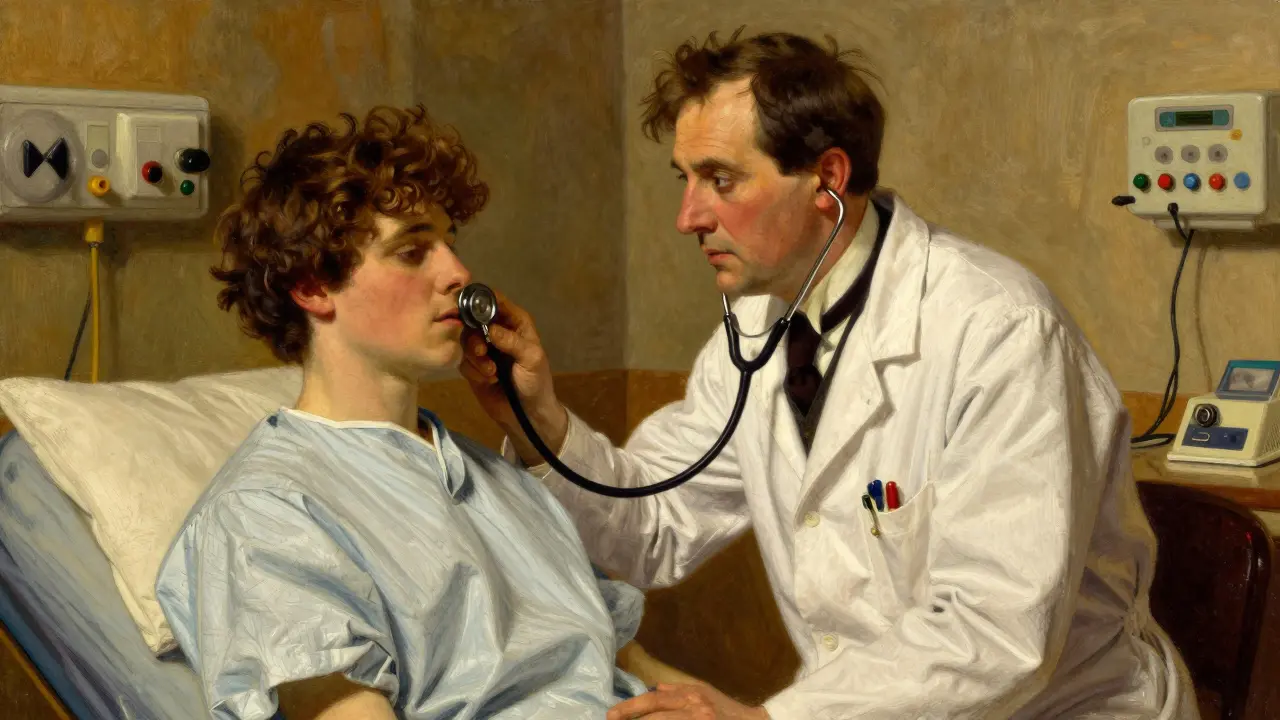
When you arrive at the hospital with these symptoms, time is critical. The medical team needs to confirm the diagnosis quickly. A chest X-ray remains the initial diagnostic standard, with 85-94% sensitivity for detecting pneumothorax. However, it is not perfect. In patients lying flat (supine) due to trauma, its sensitivity drops significantly. For this reason, doctors often use other tools to get a clearer picture.
Computed Tomography (CT) scans are the gold standard. They can detect as little as 50mL of air and have near 100% sensitivity. However, they involve radiation and take time to schedule. In recent years, point-of-care ultrasound has become a vital tool in emergency departments. Studies show experienced physicians achieve 94.3% sensitivity using the 'lung point' sign. This allows for a diagnosis at the bedside without moving the patient to radiology.
For unstable patients showing signs of tension pneumothorax-such as a heart rate over 134 beats per minute or blood pressure below 90 mmHg-doctors do not wait for an X-ray. The Eastern Association for the Surgery of Trauma's 2022 position paper emphasizes that tension pneumothorax is a clinical diagnosis requiring immediate intervention. Waiting for imaging in these cases can be fatal.
Emergency Treatment Protocols
Treatment depends entirely on the size of the collapse and the patient's stability. There is no one-size-fits-all approach. For small primary spontaneous pneumothoraces (less than 2 cm rim or less than 30% collapse), the American Thoracic Society's 2023 management guidelines recommend observation with supplemental oxygen. This simple approach achieves spontaneous resolution in 82% of cases within 14 days. The oxygen helps the body absorb the trapped air faster, increasing the resolution rate from 1.25% to 4.2% volume reduction per hour.
If the collapse is larger or the patient is struggling to breathe, more invasive steps are needed. Needle aspiration involves inserting a needle into the chest to remove air. It has a 65% immediate success rate for larger primary pneumothoraces. If that fails, or if the case is traumatic or secondary, a chest tube is inserted. A chest tube is a flexible plastic tube placed between the ribs and the lung to drain the air. It achieves a 92% success rate but carries a risk of infection or other complications.
In the case of tension pneumothorax, the protocol is drastic. The American Heart Association's 2023 Emergency Cardiovascular Care Guidelines mandate immediate needle decompression within 2 minutes of identification. This involves pushing a large needle into the chest to release the pressure instantly, saving the patient's life before a chest tube can be placed.
Recovery and Prevention
Once the immediate danger has passed, the focus shifts to recovery and preventing it from happening again. Recurrence is a significant concern. The NIH StatPearls medical review documents that primary spontaneous pneumothorax has a recurrence rate of 15-40% within 2 years. Smoking is the biggest risk factor, with an odds ratio of 22.1 for those with over 10 pack-years of smoking history. Quitting smoking reduces recurrence risk by 77% within 1 year.
Activity restrictions are also crucial during recovery. You should not fly for 2-3 weeks after the lung has fully resolved, as the change in cabin pressure can cause the lung to collapse again. Scuba diving is generally discouraged indefinitely without surgical intervention due to the high risk of recurrence under water pressure. Follow-up protocols require a chest X-ray at 4-6 weeks post-resolution to confirm complete healing. Studies show 8% of patients develop delayed complications if they are not monitored properly.
For those with recurrent cases, surgery might be the definitive solution. Video-assisted thoracoscopic surgery (VATS) represents the definitive treatment for recurrent cases with a 95% success rate at 1 year. While it requires a hospital stay of 2-4 days, it reduces the recurrence risk to just 3-5%.
How do I know if I have a collapsed lung?
The most common signs are sudden, sharp chest pain on one side that gets worse when you breathe deeply, and shortness of breath. If you also have a rapid heart rate, blue lips, or feel faint, seek emergency help immediately.
Can a collapsed lung heal on its own?
Small pneumothoraces (less than 30% collapse) can often heal on their own with observation and supplemental oxygen. However, larger collapses or those causing severe symptoms require medical intervention like needle aspiration or a chest tube.
Is a collapsed lung life-threatening?
It can be. A tension pneumothorax, where pressure builds up and compresses the heart, is a life-threatening emergency that requires immediate decompression. Without treatment, it can lead to cardiac arrest within minutes.
How long does it take to recover from a pneumothorax?
Recovery varies. For small cases treated with observation, it may take up to 14 days. For those requiring a chest tube or surgery, hospital stays range from a few days to a week, with full recovery taking several weeks.
Can I fly after having a collapsed lung?
You should wait at least 2-3 weeks after the lung has fully resolved and a follow-up X-ray confirms it. Flying too soon can cause the lung to collapse again due to pressure changes in the cabin.
When to Call Emergency Services
Do not wait to see if the pain goes away. If you experience sudden, severe chest pain accompanied by difficulty breathing, call emergency services immediately. Specific warning signs requiring immediate return to the hospital include sudden worsening of chest pain, new onset of cyanosis (oxygen saturation below 90%), and the inability to speak in full sentences due to breathlessness. These symptoms suggest the condition is progressing and needs urgent care.
The single most important factor in pneumothorax outcomes is time to definitive care. Each 30-minute delay increases complication risk significantly. If you suspect a collapsed lung, treat it as a medical emergency. Rapid recognition and appropriate intervention prevent the progression to life-threatening tension pneumothorax and ensure the best possible outcome.
Seth Eugenne
March 26, 2026 AT 22:44stay safe everyone and listen to your body 🙏
Alex Arcilla
March 27, 2026 AT 19:17another medical scare artcile lol just chill out
Zola Parker
March 28, 2026 AT 21:58most of this is overblown honestly :P
florence matthews
March 29, 2026 AT 00:47lets all hope nobody needs this info soon :)
Kenneth Jones
March 29, 2026 AT 04:04stop panicking and go to the hospital if you feel this
Natasha Rodríguez Lara
March 30, 2026 AT 06:54this is super important info for everyone to know!
Caroline Bonner
March 31, 2026 AT 18:58I remember when my brother went through this exact situation years ago. It was a scary time for our whole family honestly. He was just playing basketball and suddenly doubled over in pain. The doctors said it was a spontaneous pneumothorax right away. They had to rush him into surgery immediately to fix it. He spent a long time in the hospital recovering from the procedure. The chest tube was really uncomfortable for him to deal with. We were told not to fly for at least three weeks after. He had to stop smoking completely to prevent it from coming back. The risk of recurrence is actually quite high if you ignore that. He ended up getting VATS surgery later to seal the leak. That surgery reduced the risk of it happening again significantly. It is really important to watch for the breathing signs early. Cyanosis is a major red flag that you should never ignore. If the veins in the neck look swollen you need help now. Waiting for an X-ray can be dangerous if the patient is unstable. Immediate decompression is the only way to save a life sometimes. Please share this information with your friends and family.
Chris Farley
April 1, 2026 AT 17:41our healthcare system handles this better than others anyway
Sean Bechtelheimer
April 3, 2026 AT 08:22they want you scared so you pay for tests :)
Namrata Goyal
April 3, 2026 AT 09:32only the educated understand the nuance of this conditon
Brandon Shatley
April 4, 2026 AT 13:28i had this once and it hurt like hell
Caroline Dennis
April 5, 2026 AT 00:43pleural space dynamics require immediate decompression in tension scenarios
Marissa Staples
April 5, 2026 AT 05:09guess i should keep an eye out for that