


Most people think stomach ulcers are caused by stress or spicy food. That’s not true. The real culprits are far more specific-and treatable. Peptic ulcer disease (PUD) is a break in the lining of the stomach or the first part of the small intestine, and it affects about 8 million people worldwide. The good news? If you’ve got one, it’s not a life sentence. With the right treatment, most ulcers heal completely and don’t come back.
What’s Actually Causing Your Ulcer?
There are two main causes of peptic ulcers today, and they’re not what you’d guess. The first is a bacteria called Helicobacter pylori (a spiral-shaped bacterium that lives in the stomach lining and triggers inflammation). Back in 1982, two Australian doctors, Barry Marshall and Robin Warren, proved this link-something no one believed at the time. They even drank a culture of the bacteria to prove it caused ulcers. They won the Nobel Prize for it in 2005. Today, H. pylori is found in over half of all duodenal ulcers and 30-50% of gastric ulcers.The second major cause? NSAIDs (nonsteroidal anti-inflammatory drugs like ibuprofen, naproxen, and aspirin). These are the painkillers people take for headaches, back pain, or arthritis. But they weaken the stomach’s natural defenses. In fact, NSAIDs now cause more than half of all peptic ulcers, especially in older adults who take them daily. Unlike H. pylori, NSAID damage doesn’t go away just because you stop the drug-you need help healing the lining.
Other things like smoking and heavy alcohol use make ulcers worse. Smoking doubles or triples your risk. Drinking more than three alcoholic drinks a day raises your risk by 300%. Stress doesn’t cause ulcers, but it can slow healing. And while coffee or spicy food might sting, they don’t create the ulcer itself.
How Do You Know You Have One?
Symptoms are often misleading. The classic sign is a burning or gnawing pain in the upper belly-right below the breastbone. For many, the pain gets better after eating or taking an antacid. That’s because food temporarily buffers the acid. But it comes back, often at night or between meals.Other signs include:
- Feeling full too fast
- Nausea or vomiting
- Loss of appetite
- Intolerance to fatty foods
- Unexplained weight loss
These aren’t emergencies-but if you see blood in your vomit or stool (it looks like coffee grounds or black tar), or feel dizzy and weak, get help right away. That means bleeding, and that’s serious.
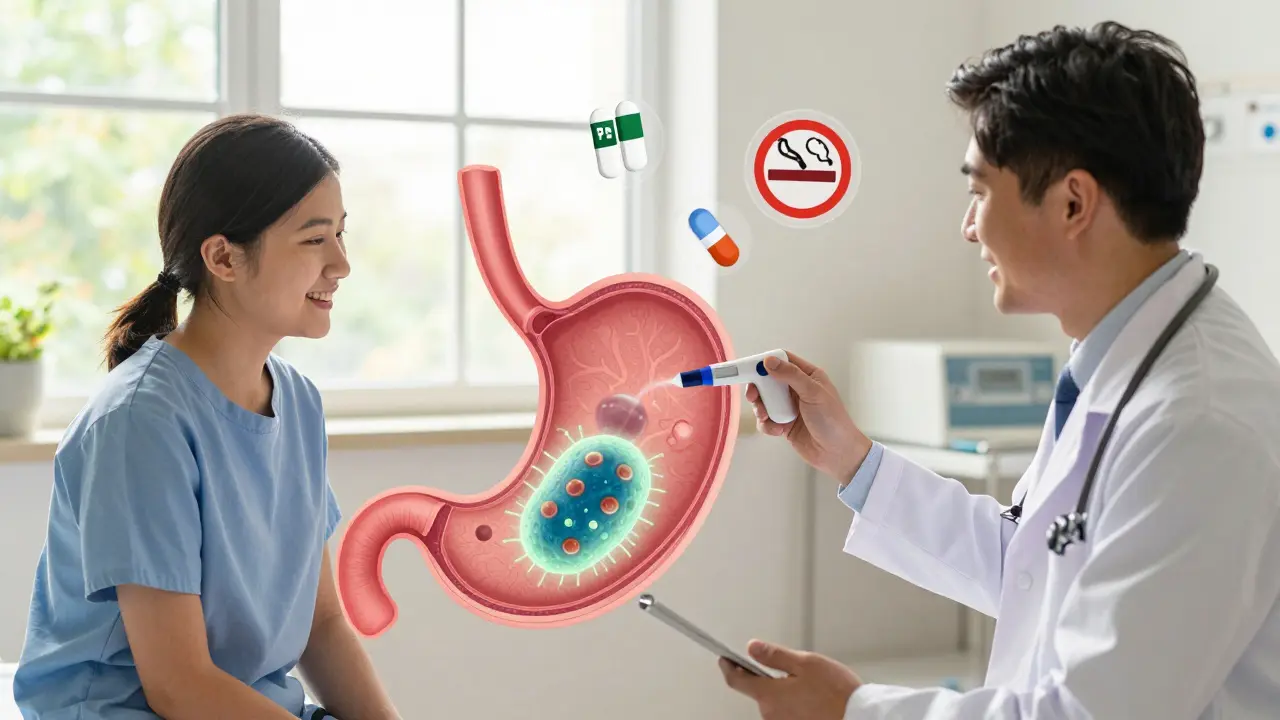
Doctors don’t guess. They test. The gold standard is an endoscopy (a thin camera passed through the mouth to view the stomach and duodenum). They’ll look for the ulcer and take a small tissue sample. They’ll also test for H. pylori using a breath test, stool test, or blood test. If you’ve got an ulcer and no H. pylori, they’ll ask about your NSAID use.
Antibiotics: The Real Cure for H. pylori
If you have H. pylori, you don’t just need acid reducers-you need antibiotics. That’s the key. Treating the infection cuts your chance of the ulcer coming back from 70% down to just 10%.The standard treatment is called triple therapy (a 7- to 14-day course of two antibiotics plus a proton pump inhibitor). Common combinations include:
- Amoxicillin + clarithromycin + omeprazole
- Metronidazole + clarithromycin + pantoprazole
- Amoxicillin + metronidazole + esomeprazole
Some patients get quadruple therapy (adding bismuth to the mix), especially in places where clarithromycin resistance is high-like the U.S., where over a third of strains no longer respond to it.
Antibiotics are tough. People report bad side effects: metallic taste (especially with metronidazole), diarrhea, nausea, and bloating. But you can’t skip doses. If you don’t finish the full course, the bacteria survive-and come back stronger. That’s why treatment fails more often than not: people stop when they feel better.
Doctors now recommend testing for antibiotic resistance before treatment, especially if you’ve had prior antibiotic use. By 2025, 60% of H. pylori treatments in the U.S. will be guided by these tests-up from just 15% in 2022.
Acid-Reducing Medications: Letting the Ulcer Heal
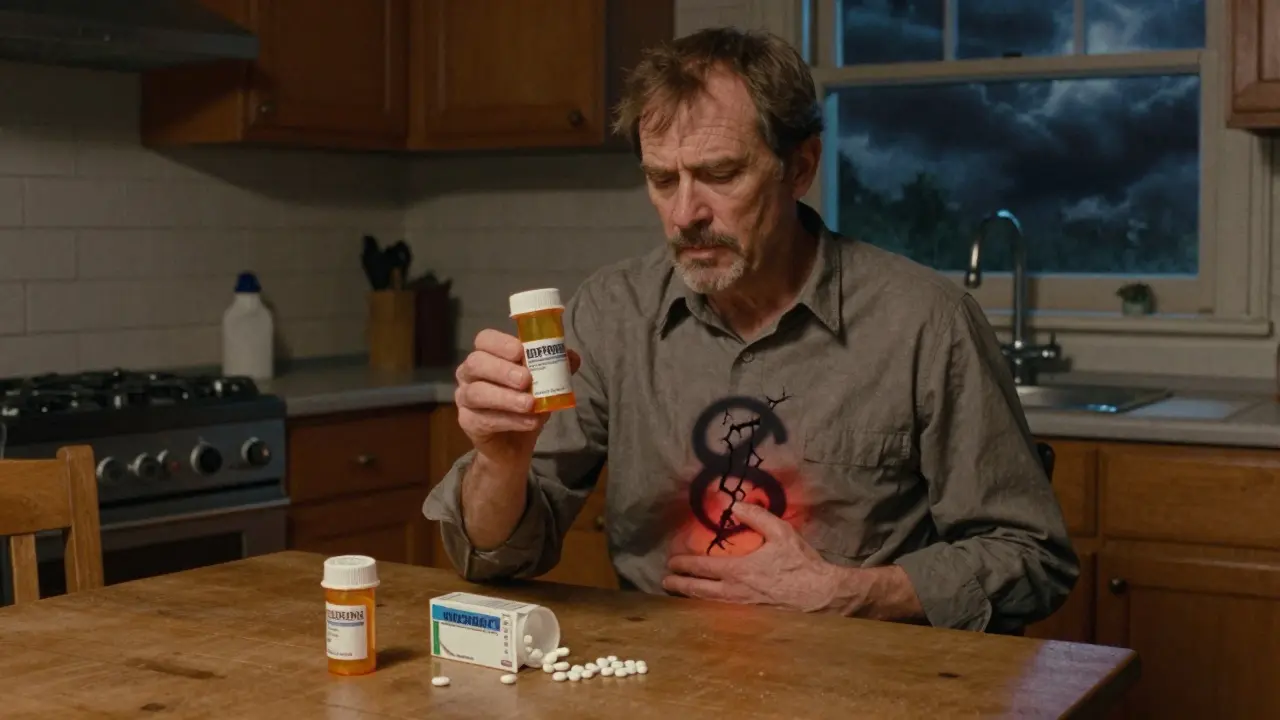
While antibiotics kill the bacteria, you need acid blockers to give your stomach lining time to heal. There are two types:Proton Pump Inhibitors (PPIs)
These are the first-line choice. They shut down acid production for up to 72 hours per dose. Common ones include:- Omeprazole (Prilosec)
- Esomeprazole (Nexium)
- Lansoprazole (Prevacid)
- Pantoprazole (Protonix)
- Rabeprazole (AcipHex)
PPIs work best when taken 30-60 minutes before breakfast (and sometimes dinner). They’re not just for symptom relief-they actively help the ulcer close. Studies show they heal 90% of ulcers in 8 weeks.
But they’re not perfect. Long-term use (over a year) has been linked to lower vitamin B12 levels, higher risk of bone fractures, and a rare kidney condition called acute interstitial nephritis. The FDA added warnings for these in 2010-2011. Some people also get rebound acid reflux after stopping PPIs-so doctors often taper the dose instead of quitting cold turkey.
H2 Blockers
These are older drugs that reduce acid for 10-12 hours. They’re less powerful than PPIs. Examples:- Famotidine (Pepcid AC)
- Cimetidine (Tagamet)
- Nizatidine (Axid)
They’re still used sometimes-especially at night to control nighttime acid. But they’re no longer the go-to for healing ulcers. PPIs are simply more effective.
Newer options are coming. In January 2023, the FDA approved vonoprazan (a potassium-competitive acid blocker that works faster and stronger than PPIs). In Japan, it’s already shown 90% success in killing H. pylori-better than traditional PPIs.
What If Your Ulcer Was Caused by NSAIDs?
If you’re on daily ibuprofen or naproxen for arthritis or back pain, stopping isn’t always possible. So doctors have two options:- Switch to a safer painkiller like acetaminophen (Tylenol)-it doesn’t hurt the stomach lining.
- Keep taking NSAIDs but add a PPI daily for protection.
Some patients get misoprostol (a synthetic prostaglandin that rebuilds the stomach’s protective mucus layer) as a preventive, especially if they’re high-risk. But it causes diarrhea and cramping, so it’s not first-choice for most.
COX-2 inhibitors like celecoxib (Celebrex) are gentler on the stomach than older NSAIDs-but they’re not risk-free and can raise heart risks. Always talk to your doctor before switching.
Lifestyle Changes That Actually Help
Medication works best when paired with smart habits:- Quit smoking. Smoking cuts blood flow to the stomach lining, slowing healing by up to 50%.
- Limit alcohol. More than 3 drinks a day triples your risk of ulcers.
- Avoid NSAIDs. Use acetaminophen instead for pain.
- Eat normally. There’s no “ulcer diet.” Skip the myths. Don’t starve yourself. Just avoid foods that make you feel worse.
- Take meds on time. PPIs before meals. Antibiotics exactly as prescribed.
Most people feel better within a week. But healing takes time. Don’t stop your meds just because the pain’s gone.
What If the Ulcer Doesn’t Heal?
If your ulcer hasn’t improved after 8-12 weeks of treatment, it’s called a “refractory ulcer.” That usually means one of three things:- You didn’t take your antibiotics correctly.
- Your H. pylori strain is resistant to the drugs used.
- You’re still taking NSAIDs or smoking.
Doctors will repeat the endoscopy, test for resistance, and check your medication adherence. Sometimes, they’ll switch to quadruple therapy or try vonoprazan. Rarely, surgery is needed-but that’s now very uncommon.
What’s Next for Peptic Ulcer Treatment?
The future is personalized. We’re moving away from one-size-fits-all treatment. By 2026, doctors will likely:- Test your H. pylori strain for antibiotic resistance before prescribing
- Use vonoprazan as first-line in high-resistance areas
- Offer long-term PPIs only to those who truly need them (like NSAID users)
- Reduce H. pylori screening in young, low-risk people as infection rates drop
While H. pylori ulcers are fading in places like Australia and the U.S., NSAID-induced ulcers are rising-especially in older adults. That means PUD isn’t going away. But it’s no longer a mystery. It’s a solvable problem.
Can stress cause a peptic ulcer?
No, stress doesn’t directly cause peptic ulcers. While it can make symptoms feel worse or slow healing, the two main causes are H. pylori infection and NSAID use. The myth that stress causes ulcers comes from older beliefs before H. pylori was discovered in 1982.
Can I take ibuprofen if I’ve had a peptic ulcer?
It’s risky. If you’ve had a peptic ulcer, taking ibuprofen or other NSAIDs again can trigger a new ulcer or cause bleeding. Talk to your doctor first. They may suggest switching to acetaminophen (Tylenol) or adding a daily PPI if you must keep using NSAIDs. Never take NSAIDs without medical advice after an ulcer.
How long do I need to take antibiotics for H. pylori?
Most people take antibiotics for 10 to 14 days, along with a proton pump inhibitor. It’s critical to finish the full course-even if you feel better after a few days. Stopping early increases the chance the bacteria survive and become resistant. After treatment, you’ll usually get a follow-up test (like a stool or breath test) to confirm the infection is gone.
Do PPIs cause long-term damage?
Long-term PPI use (over a year) has been linked to small risks: lower vitamin B12 levels, slightly higher fracture risk, and rare kidney issues. But for most people taking them for 4-8 weeks to heal an ulcer, the benefits far outweigh the risks. If you need long-term acid suppression, your doctor will monitor you and use the lowest effective dose.
Can I test for H. pylori at home?
Yes. Stool antigen tests and breath tests are reliable and can be done in a clinic or with a home kit approved by your doctor. Blood tests are less useful because they show past exposure, not current infection. The breath test is the most accurate for detecting active H. pylori and is often used after treatment to confirm it’s gone.
Is surgery still used for peptic ulcers?
Rarely. Surgery was common before antibiotics and PPIs. Today, it’s only needed in emergencies-like if the ulcer bleeds uncontrollably, perforates the stomach wall, or blocks the digestive tract. Over 95% of peptic ulcers are now cured with medication alone.
What Should You Do Now?
If you’ve been told you have a peptic ulcer, don’t panic. This isn’t a life sentence. It’s a diagnosis with a clear, effective path forward. Get tested for H. pylori. Stop NSAIDs if you can. Take your antibiotics exactly as prescribed. Don’t skip your PPI doses. Quit smoking. Cut back on alcohol. Follow up with your doctor.Most people heal completely. And once the infection is gone and the lining repairs itself, you can get back to living without the pain-or the fear it’ll come back.
Lance Nickie
January 14, 2026 AT 23:47helicobacter pylori? more like heli-crap-ori. i took ibuprofen for years and never had an ulcer. guess i’m just immune to science.
Gregory Parschauer
January 16, 2026 AT 12:49Let me be perfectly clear: the fact that you’re still entertaining the myth that stress causes ulcers is why medicine is in crisis. You’re not just misinformed-you’re perpetuating dangerous ignorance. H. pylori isn’t some niche curiosity-it’s the dominant pathogen behind peptic ulcer disease, and the WHO has classified it as a Class I carcinogen since 1994. The Nobel Prize wasn’t a gift-it was a reckoning. And yet here we are, in 2025, with people still blaming their ‘anxiety’ for a bacterial infection they could’ve eradicated with a 14-day course of amoxicillin. If you’re taking NSAIDs daily and not on a PPI, you’re not ‘managing pain’-you’re playing Russian roulette with your gastric mucosa. And don’t even get me started on the fact that 60% of H. pylori strains in the U.S. are now clarithromycin-resistant. This isn’t a medical issue-it’s a public health failure. Stop Googling ‘natural remedies’ and start listening to the data.
James Castner
January 18, 2026 AT 12:42There is a profound metaphysical truth embedded within the clinical management of peptic ulcer disease: the body is not a machine to be fixed, but a symphony to be harmonized. The antibiotics do not ‘kill’ H. pylori-they restore balance. The proton pump inhibitors do not merely suppress acid-they create the sacred space for the mucosal lining to remember its innate capacity for regeneration. We have, as a civilization, reduced healing to a pharmacological transaction: pill in, pain out. But what of the soul of the stomach? What of the microbiome’s ancient covenant with the human host? The rise of NSAID-induced ulcers is not merely a pharmacological side effect-it is the embodiment of our collective disconnection from embodied wisdom. To treat an ulcer with a PPI alone is to silence the symptom without listening to the message. To eradicate H. pylori without addressing the underlying terrain of inflammation, chronic stress, and dietary alienation is to prune the branch while the root festers. The future of gastroenterology lies not in more potent drugs, but in the reawakening of the patient as co-architect of their own healing. Vonoprazan may be faster-but is it wiser? We must ask not only ‘how’ we heal, but ‘why’ we were broken in the first place.
Adam Rivera
January 18, 2026 AT 23:40Hey, just wanted to say this is one of the clearest explanations I’ve ever read on ulcers. I’ve had two of them and thought it was from too much coffee and work stress-turns out I was just dumb. Got tested for H. pylori last year, positive as hell. Did the triple therapy, felt like garbage for two weeks (that metallic taste?? yuck), but now I’m good. Still take omeprazole before breakfast like clockwork. And yeah, I quit smoking. Best decision ever. Thanks for writing this!
Rosalee Vanness
January 19, 2026 AT 15:32Okay, I’ve been reading this whole thing with my coffee and honestly? I’m tearing up a little. Not because it’s sad-but because it’s so beautifully practical. I used to be the person who thought ‘just eat bland food and chill out’ would fix it. Then my dad got diagnosed with a refractory ulcer after ignoring his NSAIDs for three years. He’s 72, diabetic, on daily ibuprofen for his knees. We had to switch him to acetaminophen and start him on a daily PPI-and now he’s actually sleeping through the night. This article didn’t just inform me-it gave me a roadmap to save someone I love. I’m printing this out and handing it to my mom. Also, the part about not stopping antibiotics because you ‘feel better’? That’s the one thing every single person I know gets wrong. Please, please, please-don’t be that person. Finish your meds. Your stomach will thank you.
lucy cooke
January 20, 2026 AT 03:15How quaint. We’ve reduced the sacred mystery of gastric erosion to a checklist of pharmaceutical interventions. H. pylori? A mere bacterium. PPIs? A chemical crutch. The real ulcer, my dear technocrats, is not in the mucosa-it is in the soul of modern medicine’s reductionist dogma. We diagnose, we prescribe, we test, we confirm. But we have forgotten the ancient art of *listening*-to the body’s whispers before they become screams. The stomach does not merely digest food; it digests emotion, trauma, time. The ulcer is a metaphor made flesh. And yet, we hand out antibiotics like coupons at a supermarket. Where is the ritual? The fasting? The ancestral wisdom of fermented foods and herbal bitters? We are not patients-we are data points in a corporate algorithm. And vonoprazan? A gilded cage with a better label. The real cure was never in the pill. It was in the pause. In the silence. In the refusal to numb the wound and instead, to sit with it. But who has time for that in the age of 2-hour delivery?
Trevor Davis
January 20, 2026 AT 07:46Just wanted to add-my doc switched me to vonoprazan last year after my H. pylori came back. Honestly? Way better than omeprazole. No rebound heartburn, and I didn’t feel like I had a battery acid bath in my gut. The only downside? It’s still not covered by my insurance. $300/month. But I’d pay twice that to not feel like I’m swallowing broken glass every morning. Also, side note: the stool test for H. pylori? Way easier than the breath test. Just poop in a cup, mail it in. No weird breath-holding nonsense. Highly recommend.
John Tran
January 20, 2026 AT 19:18so like… if you get an ulcer from NSAIDs, you’re basically just addicted to painkillers and your stomach paid the price? i mean, i get it, but isn’t that just the cost of living in a world where we treat pain like a bug to be eradicated? i used to take naproxen for my back like it was candy-until i started vomiting black stuff. now i’m on celecoxib and a PPI and i still feel like my body is a compromised machine. the real tragedy? we’re all just one ibuprofen away from disaster. and nobody talks about how the whole system is designed to keep us medicated, not healed. they’ll sell you a 14-day cure for H. pylori… then sell you a 14-year subscription to PPIs. capitalism doesn’t cure ulcers. it monetizes them.